Milne Georgina, Allen Adrian, Graham Jordon, Lahuerta-Marin Angela, McCormick Carl, Presho Eleanor, Reid Neil, Skuce Robin, Byrne Andrew W
Veterinary Sciences Division, Agri-food and Biosciences Institute, Belfast, United Kingdom.
Department of Agriculture, Environment, and Rural Affairs, Coleraine, United Kingdom.
PeerJ. 2020 Feb 3;8:e8319. doi: 10.7717/peerj.8319. eCollection 2020.
Despite rigorous controls placed on herds which disclose test positive cattle to bovine tuberculosis, caused by the infection of , many herds in Northern Ireland (NI) experience prolonged breakdowns. These herds represent a considerable administrative and financial burden to the State and farming community.
A retrospective observational study was conducted to better understand the factors associated with breakdown duration, which was modelled using both negative binomial and ordinal regression approaches.
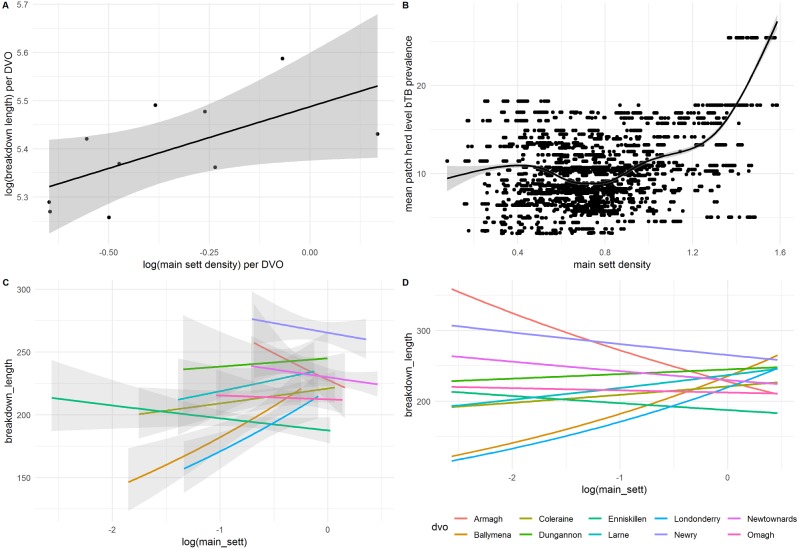
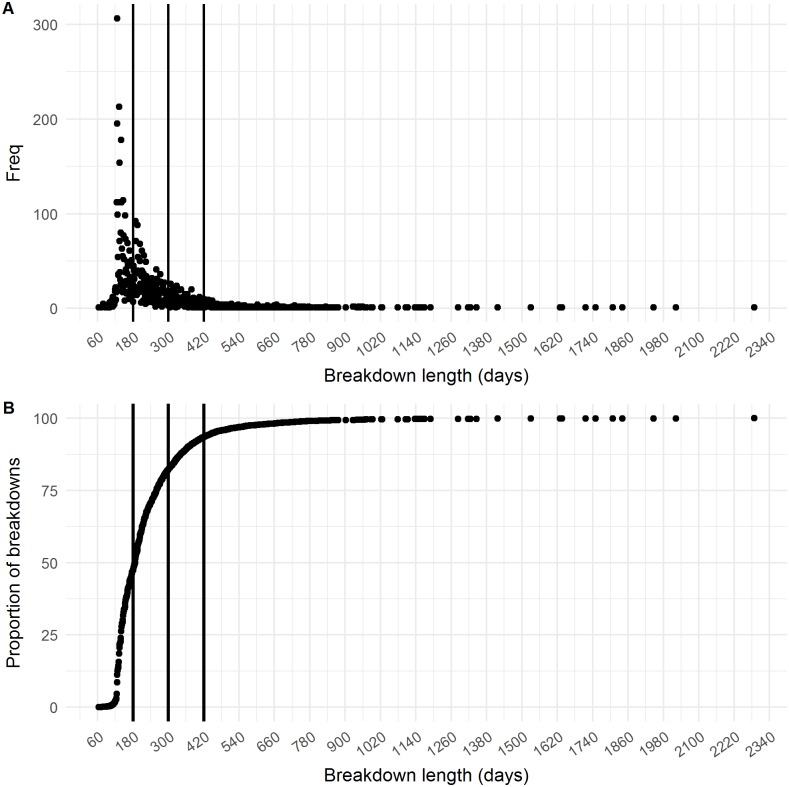
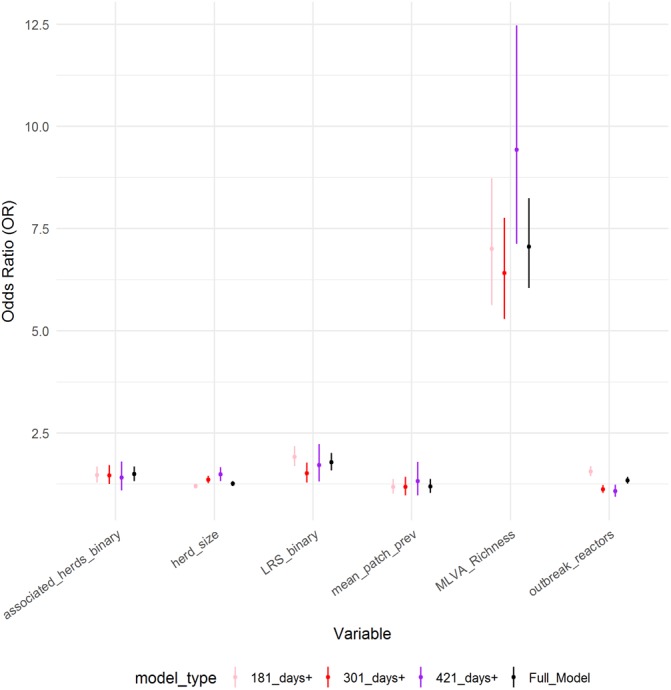
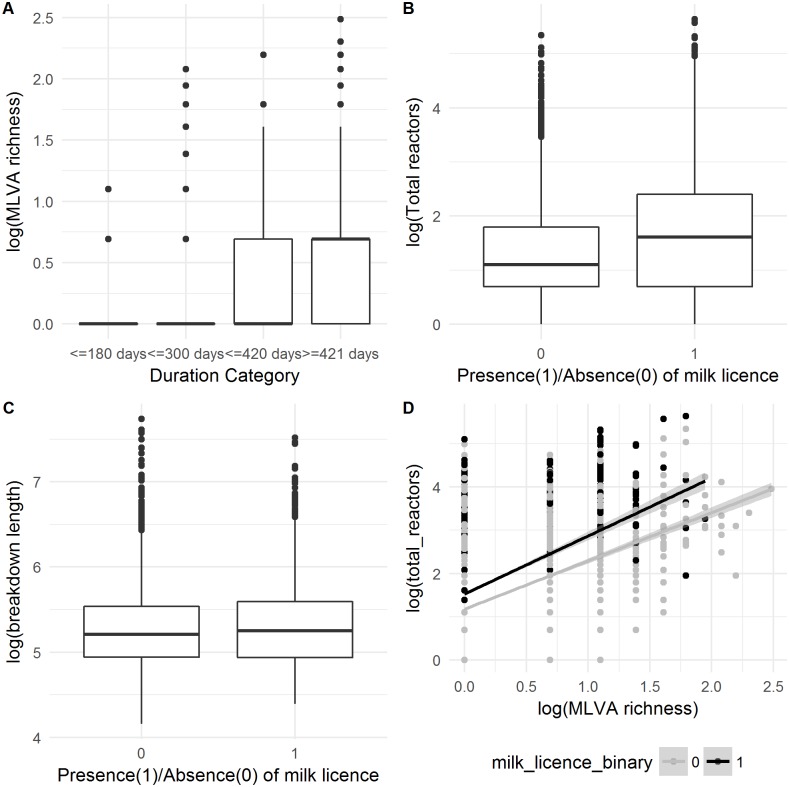
Six explanatory variables were important predictors of breakdown length in both models; herd size, the number of reactors testing positive in the initial SICCT test, the presence of a lesioned animal at routine slaughter (LRS), the count of genotypes during the breakdown (MLVA richness), the local herd-level bTB prevalence, and the presence of herds linked via management factors (associated herds). We report that between 2008 and 2014, mean breakdown duration in NI was 226 days (approx. seven months; median: 188 days). In the same period, however, more than 6% of herds in the region remained under movement restriction for more than 420 days (13 months); almost twice as long as the mean. The MLVA richness variable was a particularly important predictor of breakdown duration. We contend that this variable primarily represents a proxy for beef fattening herds, which can operate by purchasing cattle and selling animals straight to slaughter, despite prolonged trading restrictions. For other herd types, the model supports the hypothesis that prolonged breakdowns are a function of both residual infection within the herd, and infection from the environment (e.g. infected wildlife, contiguous herds and/or a contaminated environment). The impact of badger density on breakdown duration was assessed by including data on main sett (burrow) density. Whilst a positive association was observed in the univariate analysis, confounding with other variables means that the contribution of badgers to prolonged breakdowns was not clear from our study. We do not fully reject the hypothesis that badgers are implicated in prolonging bTB breakdowns via spillback infection, but given our results, we posit that increased disease risk from badgers is unlikely to simply be a function of increasing badger density measured using sett metrics.
尽管对检测出感染牛结核病呈阳性的牛群实施了严格管控,但北爱尔兰(NI)的许多牛群仍经历了长时间的疫情爆发。这些牛群给国家和农业社区带来了相当大的行政和财政负担。
进行了一项回顾性观察研究,以更好地了解与疫情爆发持续时间相关的因素,并使用负二项式和有序回归方法对其进行建模。
在两个模型中,六个解释变量都是疫情爆发时长的重要预测因素;牛群规模、初始单一拭子比较皮内结核菌素试验(SICCT)中检测呈阳性的反应动物数量、常规屠宰时出现病变动物(LRS)、疫情爆发期间的基因型数量(MLVA丰富度)、当地牛群水平的牛结核病患病率,以及通过管理因素关联的牛群(关联牛群)的存在情况。我们报告称,2008年至2014年期间,北爱尔兰疫情爆发的平均持续时间为226天(约七个月;中位数:188天)。然而,在同一时期,该地区超过6%的牛群在行动限制下持续了超过420天(13个月);几乎是平均时长的两倍。MLVA丰富度变量是疫情爆发持续时间的一个特别重要的预测因素。我们认为,这个变量主要代表了肉牛育肥牛群的一个代理指标,尽管交易限制时间延长,这类牛群仍可以通过购买牛并直接将动物出售给屠宰场来运营。对于其他牛群类型,该模型支持这样的假设,即长时间的疫情爆发是牛群内残留感染和环境感染(如感染的野生动物、相邻牛群和/或受污染的环境)共同作用的结果。通过纳入主要洞穴(洞穴)密度的数据,评估了獾密度对疫情爆发持续时间的影响。虽然在单变量分析中观察到了正相关,但与其他变量的混杂意味着从我们的研究中尚不清楚獾对长时间疫情爆发的贡献。我们并未完全排除獾通过回溢感染导致牛结核病疫情爆发时间延长的假设,但鉴于我们的研究结果,我们认为獾导致疾病风险增加不太可能仅仅是洞穴指标所衡量的獾密度增加的函数。