Buschler Arne, Manahan-Vaughan Denise
Department of Neurophysiology, Faculty of Medicine, Ruhr University Bochum Bochum, Germany ; International Graduate School for Neuroscience, Ruhr University Bochum Bochum, Germany.
Front Behav Neurosci. 2012 Dec 14;6:85. doi: 10.3389/fnbeh.2012.00085. eCollection 2012.
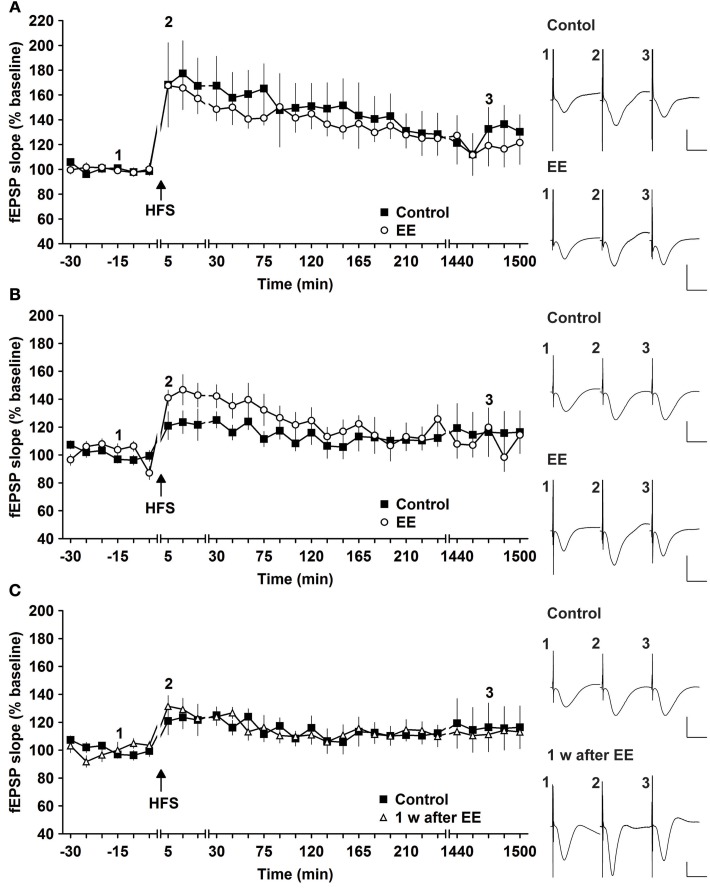
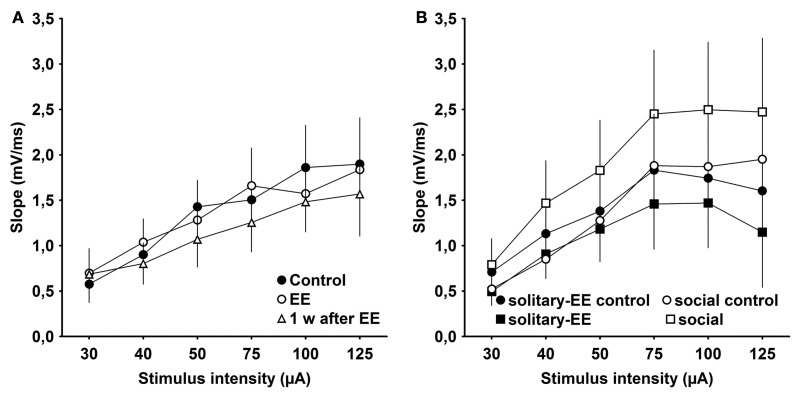
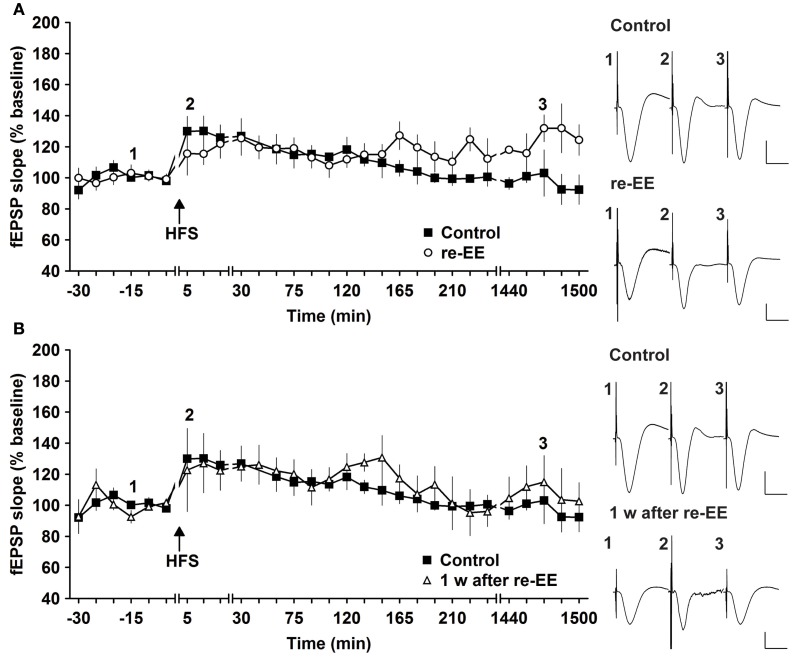
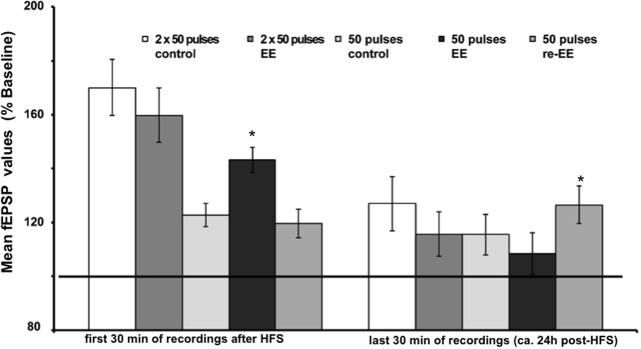
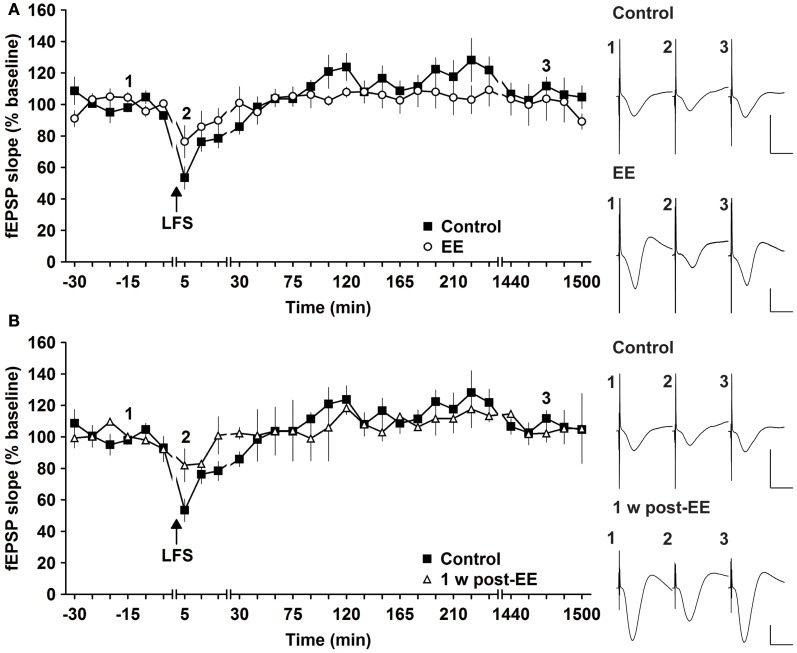
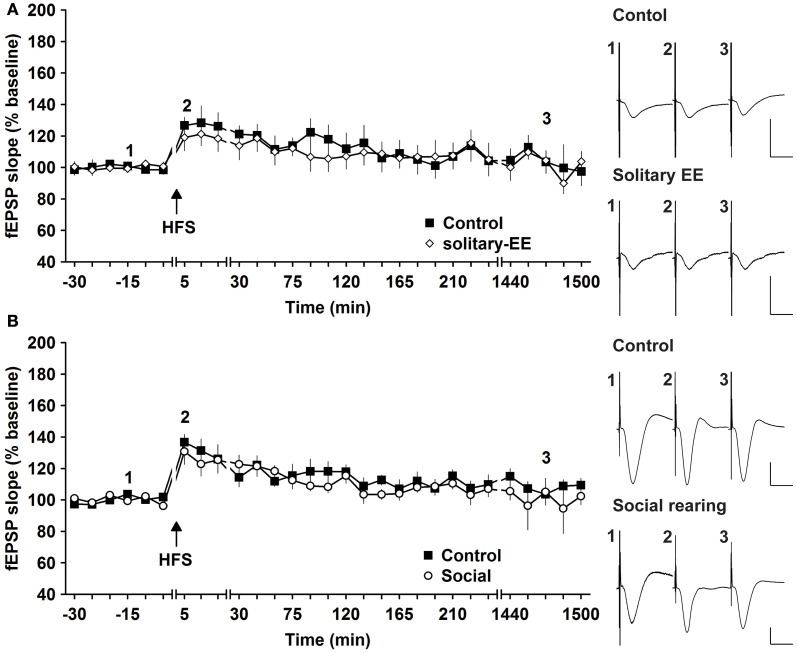
Long-term environmental enrichment (EE) elicits enduring effects on the adult brain, including altered synaptic plasticity. Synaptic plasticity may underlie memory formation and includes robust (>24 h) and weak (<2 h) forms of long-term potentiation (LTP) and long-term depression (LTD). Most studies of the effect of EE on synaptic efficacy have examined the consequences of very prolonged EE-exposure. It is unclear whether brief exposure to EE can alter synaptic plasticity. Clarifying this issue could help develop strategies to address cognitive deficits arising from neglect in children or adults. We assessed whether short-term EE elicits alterations in hippocampal synaptic plasticity and if social context may play a role. Adult mice were exposed to EE for 14 consecutive days. We found that robust late-LTP (>24 h) and short-term depression (<2 h) at Schaffer-collateral-CA1 synapses in freely behaving mice were unaltered, whereas early-LTP (E-LTP, <2 h) was significantly enhanced by EE. Effects were transient: E-LTP returned to control levels 1 week after cessation of EE. Six weeks later, animals were re-exposed to EE for 14 days. Under these conditions, E-LTP was facilitated into L-LTP (>24 h), suggesting that metaplasticity was induced during the first EE experience and that EE-mediated modifications are cumulative. Effects were absent in mice that underwent solitary enrichment or were group-housed without EE. These data suggest that EE in naïve animals strengthens E-LTP, and also promotes L-LTP in animals that underwent EE in the past. This indicates that brief exposure to EE, particularly under social conditions can elicit lasting positive effects on synaptic strength that may have beneficial consequences for cognition that depends on synaptic plasticity.
长期环境富集(EE)对成年大脑会产生持久影响,包括改变突触可塑性。突触可塑性可能是记忆形成的基础,包括强大(>24小时)和微弱(<2小时)形式的长时程增强(LTP)和长时程抑制(LTD)。大多数关于EE对突触效能影响的研究都考察了长时间EE暴露的后果。尚不清楚短暂暴露于EE是否会改变突触可塑性。阐明这个问题有助于制定策略来解决儿童或成人因忽视而产生的认知缺陷。我们评估了短期EE是否会引起海马突触可塑性的改变,以及社会环境是否可能起作用。成年小鼠连续14天暴露于EE环境中。我们发现,自由活动小鼠的Schaffer侧支-CA1突触处的强大晚期LTP(>24小时)和短期抑制(<2小时)未发生改变,而早期LTP(E-LTP,<2小时)则因EE而显著增强。这些影响是短暂的:EE停止1周后,E-LTP恢复到对照水平。六周后,动物再次暴露于EE环境中14天。在这些条件下,E-LTP促进形成了L-LTP(>24小时),这表明在第一次EE经历期间诱导了元可塑性,并且EE介导的修饰是累积性的。在单独进行富集或群居但无EE的小鼠中未观察到这些效应。这些数据表明,未接触过EE的动物中,EE增强了E-LTP,并且在过去经历过EE的动物中还促进了L-LTP。这表明短暂暴露于EE,特别是在社会环境下,可对突触强度产生持久的积极影响,这可能对依赖突触可塑性的认知产生有益影响。