Neuroscience Area, International School for Advanced Studies (SISSA) Trieste, Italy.
Front Hum Neurosci. 2012 Dec 12;6:327. doi: 10.3389/fnhum.2012.00327. eCollection 2012.
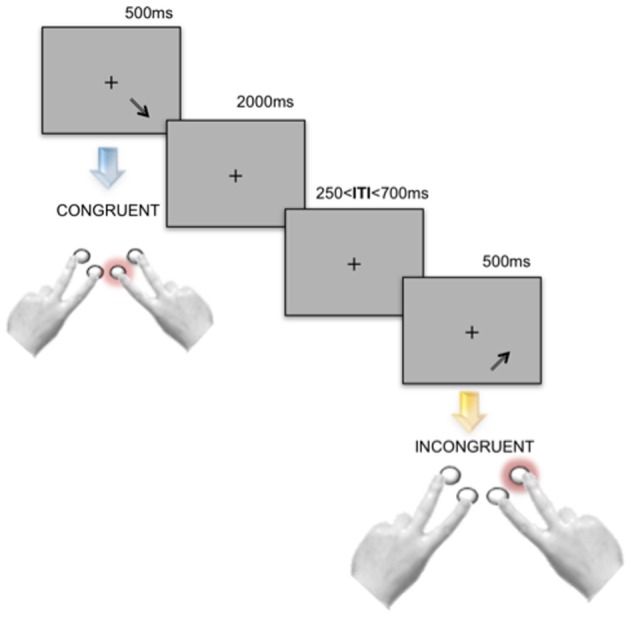
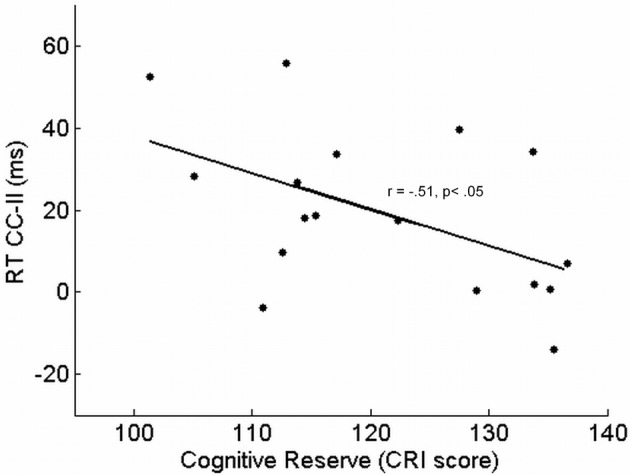
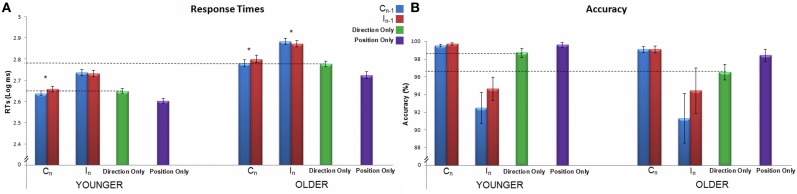
Several studies support the existence of a specific age-related difficulty in suppressing potentially distracting information. The aim of the present study is to investigate whether spatial conflict resolution is selectively affected by aging. The way aging affects individuals could be modulated by many factors determined by the socieconomic status: we investigated whether factors such as cognitive reserve (CR) and years of education may play a compensatory role against age-related deficits in the spatial domain. A spatial Stroop task with no feature repetitions was administered to a sample of 17 non-demented older adults (69-79 years-old) and 18 younger controls (18-34 years-old) matched for gender and years of education. The two age groups were also administered with measures of intelligence and CR. The overall spatial Stroop effect did not differ according to age, neither for speed nor for accuracy. The two age groups equally showed sequential effects for congruent trials: reduced response times (RTs) if another congruent trial preceded them, and accuracy at ceiling. For incongruent trials, older adults, but not younger controls, were influenced by congruency of trial(n-1), since RTs increased with preceding congruent trials. Interestingly, such an age-related modulation negatively correlated with CR. These findings suggest that spatial conflict resolution in aging is predominantly affected by general slowing, rather than by a more specific deficit. However, a high level of CR seems to play a compensatory role for both factors.
多项研究支持特定的年龄相关困难,即抑制潜在干扰信息的能力下降。本研究旨在探究空间冲突解决能力是否会受到衰老的选择性影响。衰老对个体的影响方式可能会受到许多社会经济地位决定的因素的调节:我们调查了认知储备(CR)和受教育年限等因素是否可能在空间领域的年龄相关缺陷中发挥补偿作用。我们对一组 17 名非痴呆老年人(69-79 岁)和 18 名年龄匹配的年轻对照组(18-34 岁)进行了无特征重复的空间 Stroop 任务测试,这些人在性别和受教育年限方面相匹配。两组参与者还接受了智力和 CR 的测试。整体空间 Stroop 效应不因年龄而异,无论是速度还是准确性方面。两个年龄组在一致试验中均表现出顺序效应:如果前一个试验是一致的,则反应时间(RT)会减少,准确性达到上限。对于不一致的试验,只有老年人而不是年轻对照组会受到前一个试验一致性的影响,因为 RT 会随着前一个一致试验的增加而增加。有趣的是,这种与年龄相关的调节与 CR 呈负相关。这些发现表明,衰老过程中的空间冲突解决主要受到一般减速的影响,而不是特定缺陷的影响。然而,高水平的 CR 似乎对这两个因素都起到了补偿作用。