Erasmus MC, University Medical Center Rotterdam, Rotterdam, The Netherlands.
BMC Neurol. 2012 Dec 18;12:159. doi: 10.1186/1471-2377-12-159.
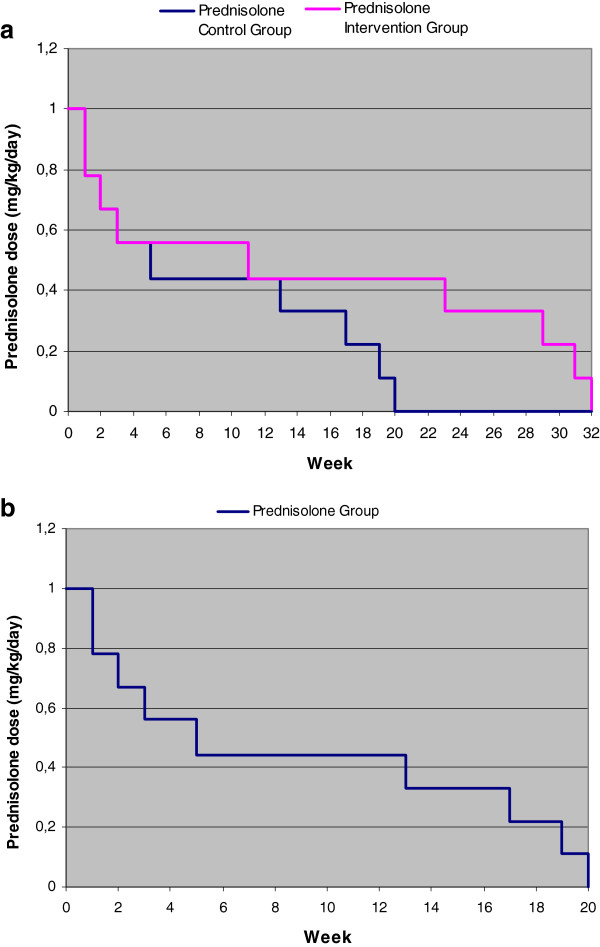
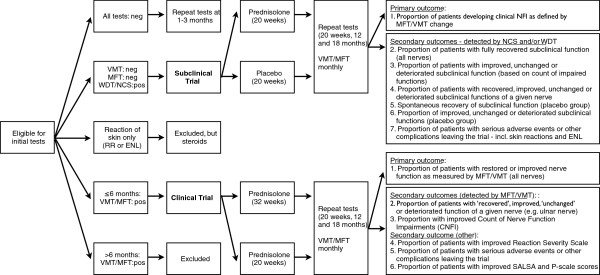
Nerve damage in leprosy often causes disabilities and deformities. Prednisolone is used to treat nerve function impairment (NFI). However, optimal dose and duration of prednisolone treatment has not been established yet. Besides treating existing NFI it would be desirable to prevent NFI. Studies show that before NFI is clinically detectable, nerves often show subclinical damage. Within the 'Treatment of Early Neuropathy in LEProsy' (TENLEP) study two double blind randomized controlled trials (RCT) will be carried out: a trial to establish whether prednisolone treatment of 32 weeks duration is more effective than 20 weeks in restoring nerve function in leprosy patients with clinical NFI (Clinical trial) and a trial to determine whether prednisolone treatment of early sub-clinical NFI can prevent clinical NFI (Subclinical trial).
Two RCTs with a follow up of 18 months will be conducted in six centers in Asia. In the Clinical trial leprosy patients with recent (< 6 months) clinical NFI, as determined by Monofilament Test and Voluntary Muscle Test, are included. The primary outcomes are the proportion of patients with restored or improved nerve function. In the Subclinical trial leprosy patients with subclinical neuropathy, as determined by Nerve Conduction Studies (NCS) and/or Warm Detection Threshold (WDT), and without any clinical signs of NFI are randomly allocated to a placebo group or treatment group receiving 20 weeks prednisolone. The primary outcome is the proportion of patients developing clinical NFI. Reliability and normative studies are carried out before the start of the trial.
This study is the first RCT testing a prednisolone regimen with a duration longer than 24 weeks. Also it is the first RCT assessing the effect of prednisolone in the prevention of clinical NFI in patients with established subclinical neuropathy. The TENLEP study will add to the current understanding of neuropathy due to leprosy and provide insight in the effectiveness of prednisolone on the prevention and recovery of NFI in leprosy patients. In this paper we present the research protocols for both Clinical and Subclinical trials and discuss the possible findings and implications.
Netherlands Trial Register: NTR2300 Clinical Trial Registry India: CTRI/2011/09/002022.
麻风病导致的神经损伤常常导致残疾和畸形。泼尼松龙用于治疗神经功能障碍(NFI)。然而,泼尼松龙治疗的最佳剂量和持续时间尚未确定。除了治疗现有的 NFI 之外,预防 NFI 也是理想的。研究表明,在 NFI 临床可检测之前,神经经常表现出亚临床损伤。在“早期麻风神经病变的治疗(TENLEP)”研究中,将进行两项双盲随机对照试验(RCT):一项试验以确定 32 周疗程的泼尼松龙治疗是否比 20 周疗程更有效地恢复有临床 NFI 的麻风病患者的神经功能(临床试验),以及一项试验以确定早期亚临床 NFI 的泼尼松龙治疗是否可以预防临床 NFI(亚临床试验)。
将在亚洲的六个中心进行两项为期 18 个月的 RCT。在临床试验中,将纳入最近(<6 个月)通过单丝试验和自愿肌肉试验确定有临床 NFI 的麻风病患者。主要结局是恢复或改善神经功能的患者比例。在亚临床试验中,将纳入通过神经传导研究(NCS)和/或温觉检测阈值(WDT)确定有亚临床神经病变且无任何 NFI 临床症状的麻风病患者,随机分配到安慰剂组或接受 20 周泼尼松龙治疗的治疗组。主要结局是发生临床 NFI 的患者比例。在试验开始前进行可靠性和规范性研究。
这项研究是第一个测试持续时间超过 24 周的泼尼松龙方案的 RCT。它也是第一个评估泼尼松龙在预防有既定亚临床神经病变的患者发生临床 NFI 中的作用的 RCT。TENLEP 研究将增加对麻风病引起的神经病变的现有认识,并提供关于泼尼松龙在预防和恢复麻风病患者 NFI 中的有效性的见解。本文介绍了临床试验和亚临床试验的研究方案,并讨论了可能的发现和影响。
荷兰试验注册处:NTR2300 临床试验注册处印度:CTRI/2011/09/002022。