Wagenaar Inge, Post Erik, Brandsma Wim, Ziegler Dan, Rahman Moshiur, Alam Khorshed, Richardus Jan Hendrik
Department of Public Health, Erasmus MC, Rotterdam, The Netherlands.
KIT Health, Royal Tropical Institute, Amsterdam, The Netherlands.
Infect Dis Poverty. 2017 Sep 1;6(1):115. doi: 10.1186/s40249-017-0330-2.
Early detection and treatment of neuropathy in leprosy is important to prevent disabilities. A recent study showed that the Nerve Conduction Studies (NCS) and Warm Detection Thresholds (WDT) tests can detect leprosy neuropathy the earliest. These two tests are not practical under field conditions, however, because they require climate-controlled rooms and highly trained staff and are expensive. We assessed the usefulness of alternative test methods and their sensitivity and specificity to detect neuropathy at an early stage.
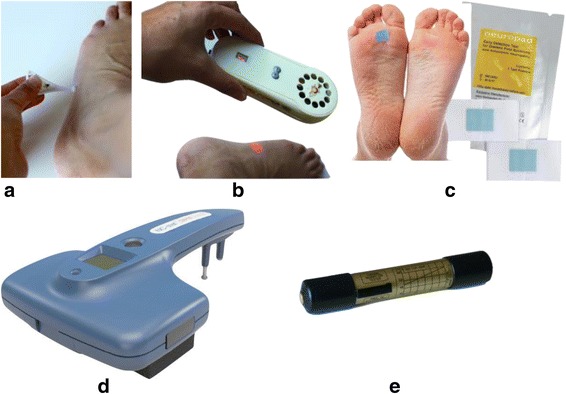
Through a literature search we identified five alternative devices that appeared user-friendly, more affordable, portable and/or battery-operated: the Neuropad®, Vibratip™, NC-Stat®DPNCheck™, NeuroQuick and the Thermal Sensibility Tester (TST), assessing respectively sweat function, vibration sensation, nerve conduction, cold sensation and warm sensation. In leprosy patients in Bangladesh, the posterior tibial and sural nerves that tested normal for the monofilament test and voluntary muscle test were assessed with the NCS and WDT as reference standard tests. The alternative devices were then tested on 94 nerves with abnormal WDT and/or NCS results and on 94 unaffected nerves. Sensitivity and specificity were the main outcomes.
The NeuroQuick and the TST showed very good sensitivity and specificity. On the sural nerve, the NeuroQuick had both a sensitivity and a specificity of 86%. The TST had a sensitivity of 83% and a specificity of 82%. Both the NC-Stat®DPNCheck™ and Vibratip™ had a high specificity (88% and 100%), but a low sensitivity (16% and 0%). On the posterior tibial nerve, the NeuroQuick and the TST also showed good sensitivity, but the sensitivity was lower than for the sural nerve. The Neuropad® had a sensitivity of 56% and a specificity of 61%.
The NeuroQuick and TST are good candidates for further field-testing for reliability and reproducibility. The feasibility of production on a larger scale should be examined.
早期发现和治疗麻风病神经病变对于预防残疾至关重要。最近一项研究表明,神经传导研究(NCS)和温觉阈值(WDT)测试能最早检测出麻风病神经病变。然而,这两项测试在现场条件下并不实用,因为它们需要气候控制的房间、训练有素的工作人员,而且成本高昂。我们评估了替代测试方法的实用性及其在早期检测神经病变的敏感性和特异性。
通过文献检索,我们确定了五种似乎用户友好、更经济实惠、便于携带和/或电池供电的替代设备:Neuropad®、Vibratip™、NC-Stat® DPNCheck™、NeuroQuick和热感觉测试仪(TST),分别评估出汗功能、振动感觉、神经传导、冷感觉和温感觉。在孟加拉国的麻风病患者中,以单丝试验和随意肌试验结果正常的胫后神经和腓肠神经,采用NCS和WDT作为参考标准试验进行评估。然后,对94条WDT和/或NCS结果异常的神经以及94条未受影响的神经进行替代设备测试。主要结果是敏感性和特异性。
NeuroQuick和TST显示出非常好的敏感性和特异性。在腓肠神经上,NeuroQuick的敏感性和特异性均为86%。TST的敏感性为83%,特异性为82%。NC-Stat® DPNCheck™和Vibratip™均具有较高的特异性(分别为88%和100%),但敏感性较低(分别为16%和0%)。在胫后神经上,NeuroQuick和TST也显示出良好的敏感性,但低于腓肠神经。Neuropad®的敏感性为56%,特异性为61%。
NeuroQuick和TST是进一步进行现场测试以评估可靠性和可重复性的良好候选者。应研究大规模生产的可行性。