Dept, of Nutrition, Food Studies & Public Health, New York University, New York, USA.
Int J Equity Health. 2012 Dec 18;11:80. doi: 10.1186/1475-9276-11-80.
Perceived discrimination is related to poor health and has been offered as one explanation for the persistence of health inequalities in some societies. In this study, we explore the prevalence and correlates of perceived discrimination in a large, multiracial Brazilian metropolitan area.
The study uses secondary analysis of a regionally representative household survey conducted in 2010 (n=12,213). Bivariate analyses and multiple logistic regression assess the magnitude and statistical significance of covariates associated with reports of any discrimination and with discrimination in specific settings, including when seeking healthcare services, in the work environment, in the family, in social occasions among friends or in public places, or in other situations.
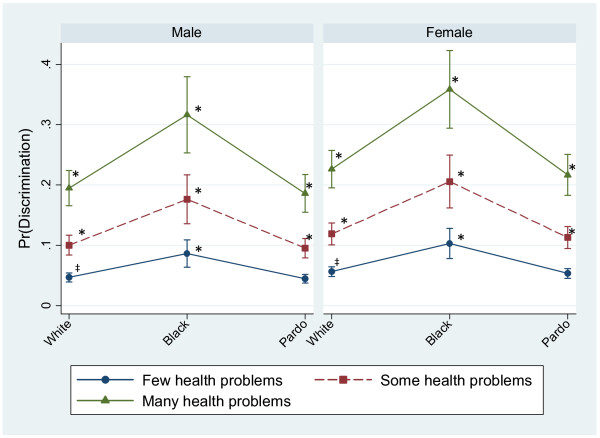
Nearly 9% of the sample reported some type of discrimination. In multivariable models, reports of any discrimination were higher among people who identify as black versus white (OR 1.91), higher (OR 1.21) among women than men, higher (OR 1.33) among people in their 30's and lower (OR 0.63) among older individuals. People with many health problems (OR 4.97) were more likely to report discrimination than those with few health problems. Subjective social status (OR 1.23) and low social trust (OR 1.27) were additional associated factors. Perceived discrimination experienced while seeking healthcare differed from all other types of discrimination, in that it was not associated with skin color, social status or trust, but was associated with sex, poverty, and poor health.
There appear to be multiple factors associated with perceived discrimination in this population that may affect health. Policies and programs aimed at reducing discrimination in Brazil will likely need to address this wider set of interrelated risk factors across different populations.
感知到的歧视与健康状况不佳有关,并且被认为是一些社会中健康不平等持续存在的原因之一。在这项研究中,我们探讨了在一个大型的多种族巴西大都市地区感知到的歧视的流行程度和相关因素。
该研究使用了 2010 年进行的一项具有地区代表性的家庭调查的二次分析(n=12213)。采用双变量分析和多逻辑回归评估与报告任何歧视以及在特定环境中歧视相关的协变量的大小和统计学意义,包括在寻求医疗保健服务时、在工作环境中、在家庭中、在朋友之间的社交场合或在公共场所、或在其他情况下。
样本中近 9%的人报告了某种类型的歧视。在多变量模型中,与自认为是白人的人相比,黑人报告任何歧视的比例更高(OR 1.91),女性比男性(OR 1.21)更高,30 多岁的人(OR 1.33)更高,而年龄较大的人(OR 0.63)则较低。与健康问题较少的人相比,有许多健康问题的人(OR 4.97)更有可能报告歧视。主观社会地位(OR 1.23)和低社会信任(OR 1.27)是其他相关因素。在寻求医疗保健时经历的感知歧视与所有其他类型的歧视不同,因为它与肤色、社会地位或信任无关,而是与性别、贫困和健康状况有关。
在该人群中,与感知歧视相关的因素似乎有多个,这些因素可能会影响健康。旨在减少巴西歧视的政策和计划可能需要针对不同人群解决这一系列相互关联的风险因素。