Salvador C, Vicedo-Cabrera A M, Libonati R, Russo A, Garcia B N, Belem L B C, Gimeno L, Nieto R
Centro de Investigación Mariña Universidade de Vigo Environmental Physics Laboratory (EPhysLab) Ourense Spain.
Institute of Social and Preventive Medicine (ISPM) University of Bern Bern Switzerland.
Geohealth. 2022 Mar 1;6(3):e2021GH000534. doi: 10.1029/2021GH000534. eCollection 2022 Mar.
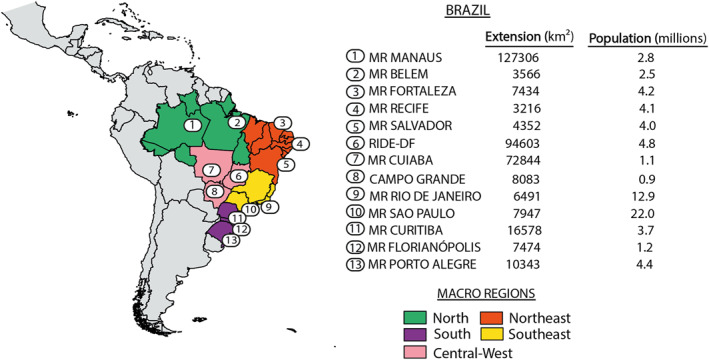
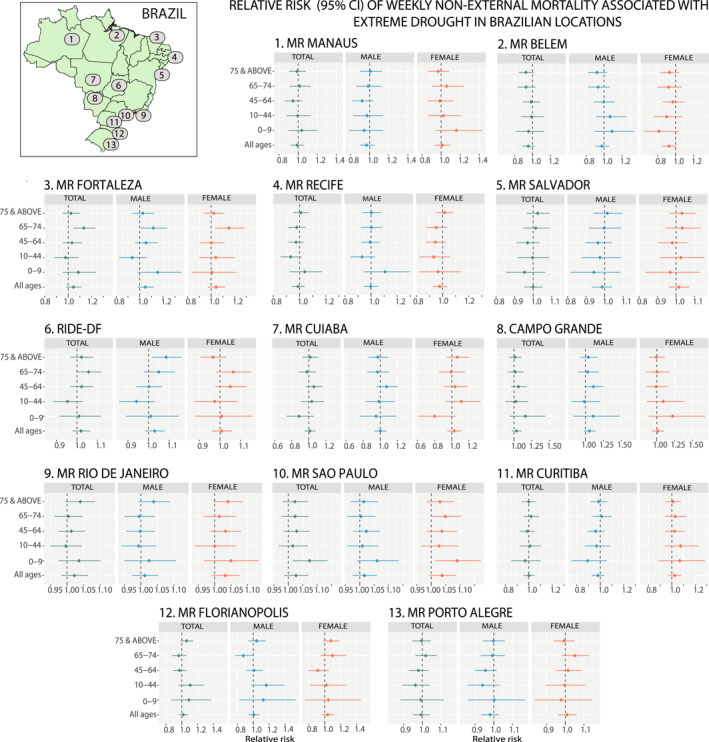
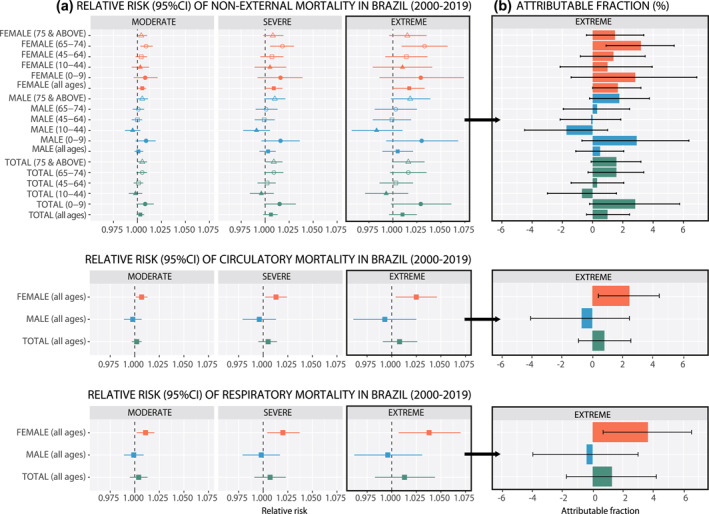
A significant fraction of Brazil's population has been exposed to drought in recent years, a situation that is expected to worsen in frequency and intensity due to climate change. This constitutes a current key environmental health concern, especially in densely urban areas such as several big cities and suburbs. For the first time, a comprehensive assessment of the short-term drought effects on weekly non-external, circulatory, and respiratory mortality was conducted in 13 major Brazilian macro-urban areas across 2000-2019. We applied quasi-Poisson regression models adjusted by temperature to explore the association between drought (defined by the Standardized Precipitation-Evapotranspiration Index) and the different mortality causes by location, sex, and age groups. We next conducted multivariate meta-analytical models separated by cause and population groups to pool individual estimates. Impact measures were expressed as the attributable fractions among the exposed population, from the relative risks (RRs). Overall, a positive association between drought exposure and mortality was evidenced in the total population, with RRs varying from 1.003 [95% CI: 0.999-1.007] to 1.010 [0.996-1.025] for non-external mortality related to moderate and extreme drought conditions, from 1.002 [0.997-1.007] to 1.008 [0.991-1.026] for circulatory mortality, and from 1.004 [0.995-1.013] to 1.013 [0.983-1.044] for respiratory mortality. Females, children, and the elderly population were the most affected groups, for whom a robust positive association was found. The study also revealed high heterogeneity between locations. We suggest that policies and action plans should pay special attention to vulnerable populations to promote efficient measures to reduce vulnerability and risks associated with droughts.
近年来,巴西很大一部分人口遭受了干旱影响,由于气候变化,这种情况在发生频率和强度上预计还会恶化。这构成了当前一个关键的环境卫生问题,尤其是在几个大城市和郊区等人口密集的城市地区。首次在2000年至2019年期间,对巴西13个主要大城市地区的短期干旱对每周非外部、循环系统和呼吸系统死亡率的影响进行了全面评估。我们应用了经温度调整的准泊松回归模型,以探讨干旱(由标准化降水蒸散指数定义)与不同地点、性别和年龄组的不同死亡原因之间的关联。接下来,我们按死因和人群组进行了多变量荟萃分析模型,以汇总个体估计值。影响指标以暴露人群中的归因分数表示,来自相对风险(RRs)。总体而言,在总人口中,干旱暴露与死亡率之间存在正相关,与中度和极端干旱条件相关的非外部死亡率的RRs从1.003[95%置信区间:0.999 - 1.007]到1.010[0.996 - 1.025],循环系统死亡率的RRs从1.002[0.997 - 1.007]到1.008[0.991 - 1.026],呼吸系统死亡率的RRs从1.004[0.995 - 1.013]到1.013[0.983 - 1.044]。女性、儿童和老年人群是受影响最严重的群体,在这些群体中发现了强烈的正相关。该研究还揭示了不同地点之间存在高度异质性。我们建议政策和行动计划应特别关注弱势群体,以促进采取有效措施降低与干旱相关的脆弱性和风险。