Boamah Daniel, Kikuchi Mihoko, Huy Nguyen Tien, Okamoto Kenta, Chen Honggen, Ayi Irene, Boakye Daniel Adjei, Bosompem Kwabena Mante, Hirayama Kenji
Department of Immunogenetics and Global Centre of Excellence, Institute of Tropical Medicine, Nagasaki University, 1-12-4 Sakamoto, Nagasaki City, Nagasaki 852-8523, Japan.
Trop Med Health. 2012 Sep;40(3):89-102. doi: 10.2149/tmh.2012-16. Epub 2012 Oct 24.
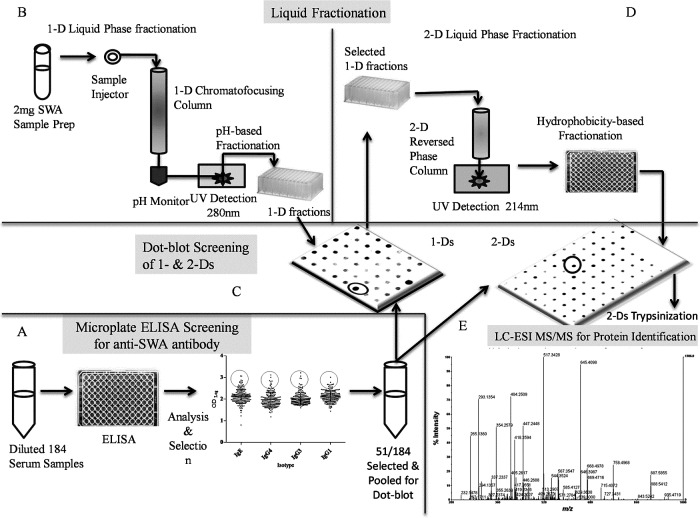
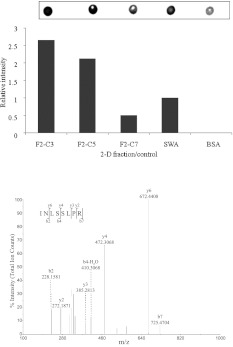
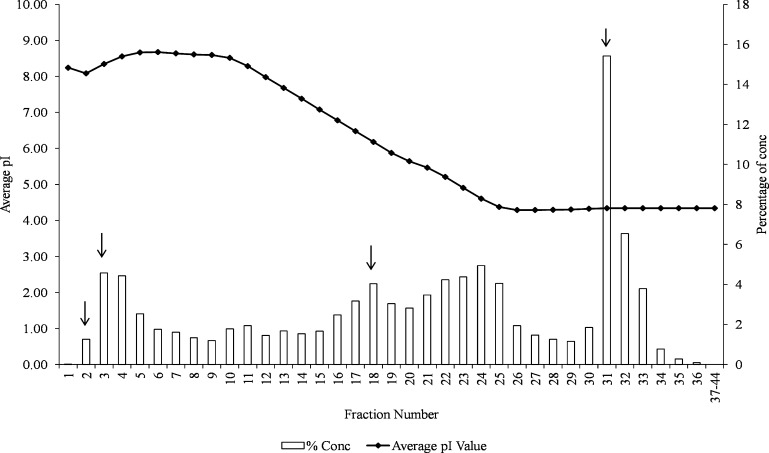
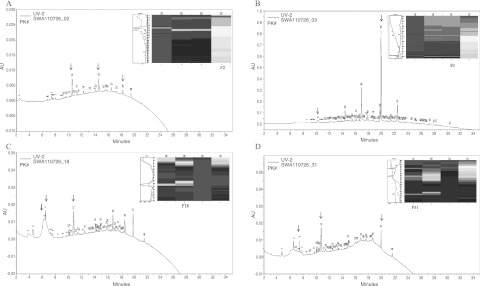
Immunoepidemiological studies from endemic areas have revealed age-dependent resistance correlation with increased level of IgE and decreased level of IgG4 antibodies in responses to schistosomes' soluble worm antigen. However, there have been limited studies on analyses of major antigens that provoke IgE and IgG4 immune response during chronic stage of schistosomiasis. In this study, for the first time, immunoproteomics approach has been applied to identify S. japonicum worm antigens in liquid fractions that are recognized by IgE and IgG4 antibody using plasma from chronically infected population. ProteomeLabPF 2D fractionated 1-D and 2-D fractions of SWA antigens were screened using pooled high IgE/IgG4 reactive plasma samples by dot-blot technique. In 1-D fractions, IgE isotype was detected by fewer antigenic fractions (43.2%). The most recognized isotype was IgG3 (79.5%) followed by IgG1 (75.0%) and IgG4 (61.4%). Liquid chromatography MS/MS protein sequencing of reactive 2-D fractions revealed 18 proteins that were identified, characterized and gene ontology categories determined. 2-D fractions containing proteins such as zinc finger, RanBP2-type, domain-containing protein were strongly recognized by IgE and moderately by IgG4 whereas fractions containing proteins such as ubiquitin-conjugating enzyme and cytosolic II 5'-nucleotidase strongly recognizing by IgG subclasses (IgG1, IgG3 and IgG4) but not IgE. By this study, a simple and reproducible proteomic method has been established to identify major immunoreactive S. japonicum antigens. It is anticipated that this will stimulate further research on the immunogenicity and protective potential of proteins identified as well as discovery of novel compounds that have therapeutic importance.
来自流行地区的免疫流行病学研究表明,在对血吸虫可溶性虫抗原的反应中,年龄依赖性抵抗力与IgE水平升高和IgG4抗体水平降低相关。然而,关于血吸虫病慢性期引发IgE和IgG4免疫反应的主要抗原分析的研究有限。在本研究中,首次应用免疫蛋白质组学方法,使用慢性感染人群的血浆,鉴定在液体组分中被IgE和IgG4抗体识别的日本血吸虫虫抗原。通过斑点印迹技术,使用合并的高IgE/IgG4反应性血浆样本筛选ProteomeLabPF 2D分级分离的SWA抗原的1-D和2-D组分。在1-D组分中,较少的抗原组分(43.2%)检测到IgE同种型。最被识别的同种型是IgG3(79.5%),其次是IgG1(75.0%)和IgG4(61.4%)。对反应性2-D组分进行液相色谱MS/MS蛋白质测序,鉴定出18种蛋白质,对其进行了表征并确定了基因本体类别。含有锌指、RanBP2型含结构域蛋白等蛋白质的2-D组分被IgE强烈识别,被IgG4中度识别,而含有泛素结合酶和胞质II 5'-核苷酸酶等蛋白质的组分被IgG亚类(IgG1、IgG3和IgG4)强烈识别,但不被IgE识别。通过本研究,建立了一种简单且可重复的蛋白质组学方法来鉴定主要的免疫反应性日本血吸虫抗原。预计这将刺激对所鉴定蛋白质的免疫原性和保护潜力的进一步研究,以及发现具有治疗重要性的新化合物。