Laboratory of Functional Genomics and Proteomics, Department of Biology, Katholieke Universiteit Leuven Leuven, Belgium.
Front Endocrinol (Lausanne). 2012 Dec 21;3:167. doi: 10.3389/fendo.2012.00167. eCollection 2012.
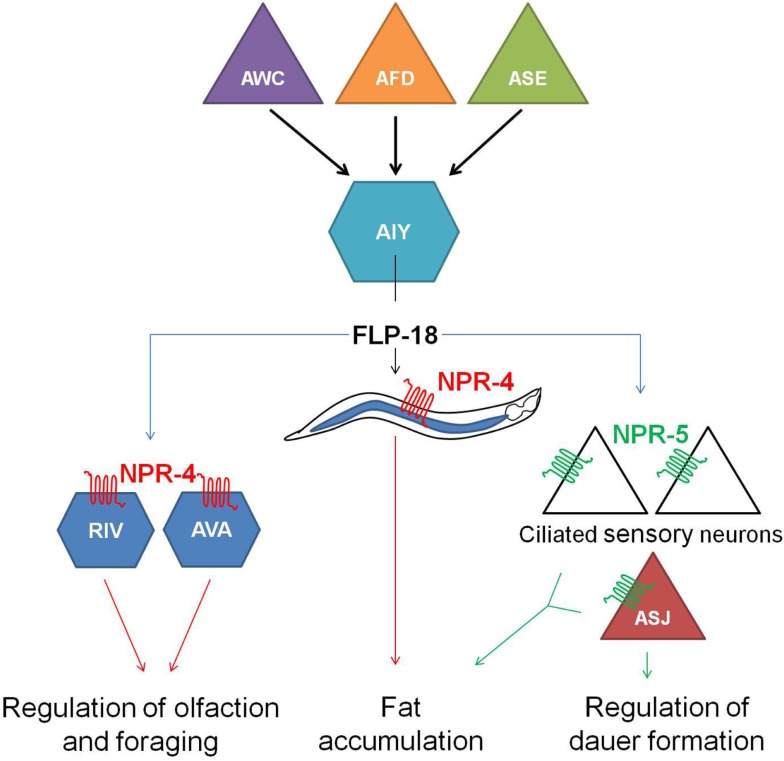
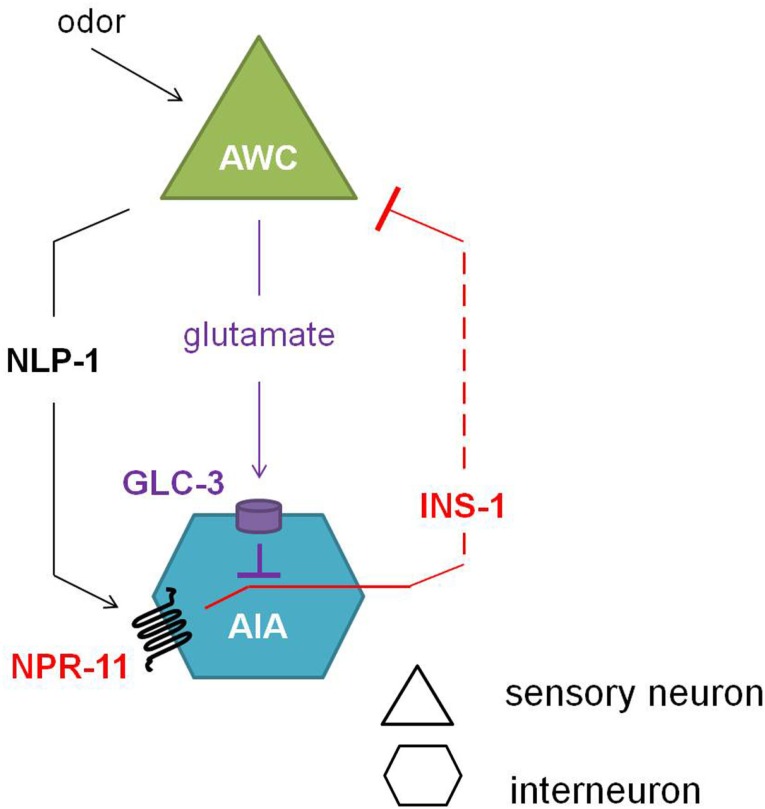
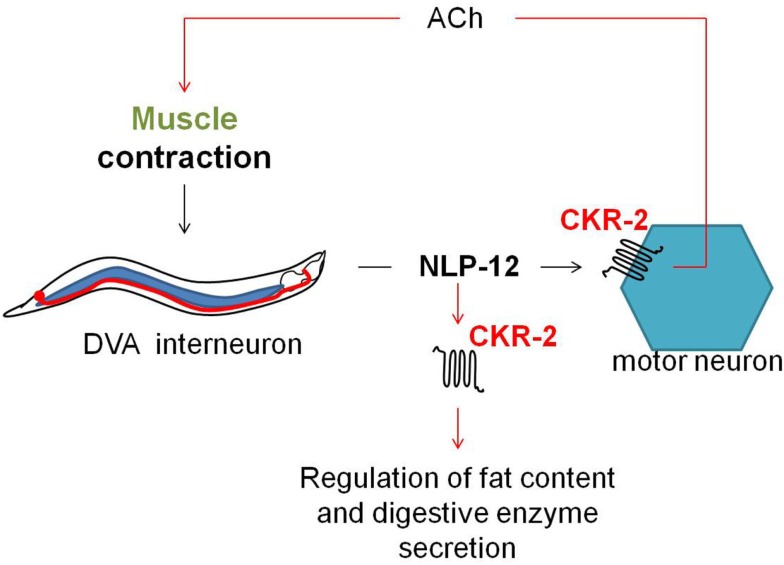
Like most organisms, the nematode Caenorhabditis elegans relies heavily on neuropeptidergic signaling. This tiny animal represents a suitable model system to study neuropeptidergic signaling networks with single cell resolution due to the availability of powerful molecular and genetic tools. The availability of the worm's complete genome sequence allows researchers to browse through it, uncovering putative neuropeptides and their cognate G protein-coupled receptors (GPCRs). Many predictions have been made about the number of C. elegans neuropeptide GPCRs. In this review, we report the state of the art of both verified as well as predicted C. elegans neuropeptide GPCRs. The predicted neuropeptide GPCRs are incorporated into the receptor classification system based on their resemblance to orthologous GPCRs in insects and vertebrates. Appointing the natural ligand(s) to each predicted neuropeptide GPCR (receptor deorphanization) is a crucial step during characterization. The development of deorphanization strategies resulted in a significant increase in the knowledge of neuropeptidergic signaling in C. elegans. Complementary localization and functional studies demonstrate that neuropeptides and their GPCRs represent a rich potential source of behavioral variability in C. elegans. Here, we review all neuropeptidergic signaling pathways that so far have been functionally characterized in C. elegans.
像大多数生物体一样,秀丽隐杆线虫严重依赖神经肽信号。由于拥有强大的分子和遗传工具,这种微小的动物是研究神经肽信号网络的合适模型系统,可以实现单细胞分辨率。由于可以获得完整的蠕虫基因组序列,研究人员可以浏览它,发现假定的神经肽及其同源 G 蛋白偶联受体 (GPCR)。人们对秀丽隐杆线虫神经肽 GPCR 的数量进行了许多预测。在这篇综述中,我们报告了已验证和预测的秀丽隐杆线虫神经肽 GPCR 的最新进展。预测的神经肽 GPCR 基于它们与昆虫和脊椎动物同源 GPCR 的相似性被纳入受体分类系统。将天然配体(配体去孤儿化)分配给每个预测的神经肽 GPCR 是特征描述的关键步骤。去孤儿化策略的发展极大地增加了对秀丽隐杆线虫神经肽信号的了解。互补的定位和功能研究表明,神经肽及其 GPCR 代表秀丽隐杆线虫行为变异性的丰富潜在来源。在这里,我们综述了迄今为止在秀丽隐杆线虫中功能表征的所有神经肽信号通路。