Department of Reproductive Endocrinology, Women's Hospital, School of Medicine, Zhejiang University, Hangzhou, China.
Reprod Biol Endocrinol. 2012 Dec 26;10:116. doi: 10.1186/1477-7827-10-116.
The counselling of poor ovarian responders about the probability of pregnancy remains a puzzle for gynaecologists. The aim of this study was to optimise the management of poor responders by investigating the role of the oocyte-derived factor bone morphogenetic protein-15 (BMP-15) combined with chronological age in the prediction of the outcome of in-vitro fertilisation-embryo transfer (IVF-ET) in poor responders.
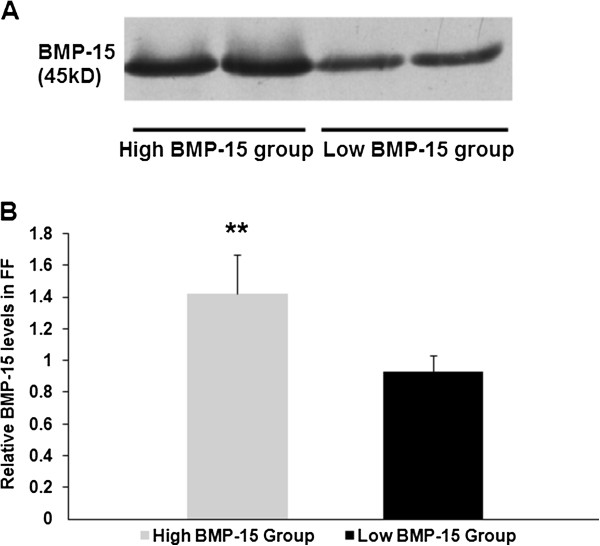
A retrospective study conducted in a university hospital. A total of 207 poor ovarian responders who reached the ovum pick-up stage undergoing IVF/intracytoplasmic sperm injection (ICSI) with three or fewer follicles no less than 14 mm on the day of oocyte retrieval were recruited from July 1, 2008 to December 31, 2009. Another 215 coinstantaneous cycles with normal responses were selected as controls. The BMP-15 levels in the follicular fluid (FF) of the 207 poor responders were analysed by western blot. Based on the FF BMP-15 level and age, poor responders were sub-divided into four groups. The main outcome measures were the FF BMP-15 level, implantation rate, pregnancy rate, and live birth rate.
The implantation rate (24.2% vs. 15.3%), chemical pregnancy rate (40% vs. 23.7%), clinical pregnancy rate (36.5% vs. 20.4%) and live birth rate (29.4% vs. 15.1%) in the high BMP-15 group were significantly higher than those in the low BMP-15 group. Furthermore, poor responders aged less than or equal to 35 years with a higher FF BMP-15 level had the best implantation, pregnancy and live birth rates, which were comparable with those of normal responders.
Our study suggests a potential role of BMP-15 in the prediction of the IVF outcome. A high FF BMP-15 combined with an age less than or equal to 35 years may be used as a potential indicator for repeating IVF cycles in poor ovarian responders.
关于妊娠概率,卵巢反应不良患者的咨询仍然是妇科医生的难题。本研究旨在通过研究卵母细胞来源的因子骨形态发生蛋白 15(BMP-15)与年龄相结合在预测卵巢反应不良患者体外受精-胚胎移植(IVF-ET)结局中的作用来优化卵巢反应不良患者的管理。
这是一项在大学医院进行的回顾性研究。共招募了 207 名卵巢反应不良的患者,这些患者在取卵日至少有 3 个卵泡,每个卵泡直径不小于 14mm,进行 IVF/卵胞浆内单精子注射(ICSI),这些患者于 2008 年 7 月 1 日至 2009 年 12 月 31 日进入研究。另外选择了 215 个同期正常反应的周期作为对照。采用 Western blot 分析 207 例卵巢反应不良患者卵泡液(FF)中的 BMP-15 水平。根据 FF BMP-15 水平和年龄,将卵巢反应不良患者分为四组。主要观察指标是 FF BMP-15 水平、种植率、妊娠率和活产率。
高 BMP-15 组的种植率(24.2% vs. 15.3%)、化学妊娠率(40% vs. 23.7%)、临床妊娠率(36.5% vs. 20.4%)和活产率(29.4% vs. 15.1%)均显著高于低 BMP-15 组。此外,年龄小于或等于 35 岁且 FF BMP-15 水平较高的卵巢反应不良患者的种植、妊娠和活产率最好,与正常反应患者相当。
本研究提示 BMP-15 在预测 IVF 结局中可能具有一定作用。高 FF BMP-15 结合年龄小于或等于 35 岁可作为卵巢反应不良患者重复 IVF 周期的潜在指标。