Department of Microbiology and Immunology, School of Medicine, Southeast University, Nanjing, Jiangsu, China.
PLoS One. 2012;7(12):e51616. doi: 10.1371/journal.pone.0051616. Epub 2012 Dec 13.
The identification of hepatitis E virus (HEV) from rabbits motivated us to assess the possibility of using rabbits as a non-human primate animal model for HEV infection and vaccine evaluation.
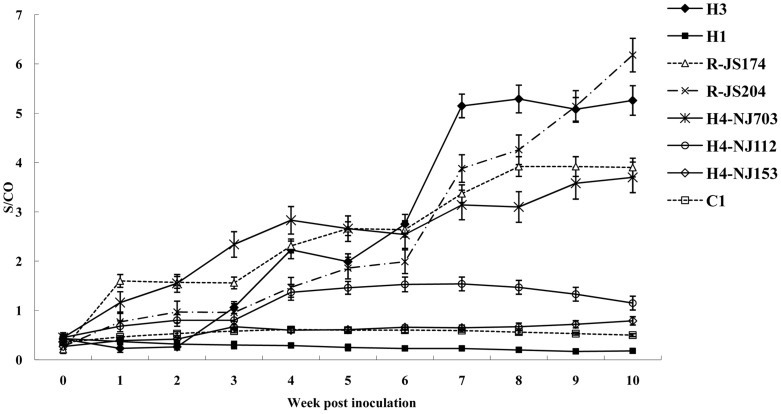
METHODOLOGY/PRINCIPAL FINDINGS: First, 75 rabbits were inoculated with seven strains of genotypes 1, 3, 4, and rabbit HEV, to determine the appropriate strain, administrative route and viral dosage. Second, 15 rabbits were randomly divided into three groups and vaccinated with 0 µg (placebo), 10 µg and 20 µg of HEV candidate vaccine, HEV p179, respectively. After three doses of the vaccination, the rabbits were challenged with 3.3×10(5) genome equivalents of genotype 4 HEV strain H4-NJ703. The strain of genotype 1 HEV was not found to be infectious for rabbits. However, approximately 80% of the animals were infected by two rabbit HEV strains. All rabbits inoculated with a genotype 3 strain were seroconverted but did not show viremia or fecal viral shedding. Although two genotype 4 strains, H4-NJ153 and H4-NJ112, only resulted in part of rabbits infected, another strain of genotype 4, H4-NJ703, had an infection rate of 100% (five out of five) when administrated intravenously. However, only two out of fifteen rabbits showed virus excretion and seroconversion when inoculated orally with H4-NJ703 of three different dosages. In the vaccine evaluation study, rabbits vaccinated with 20 µg of the HEV p179 produced anti-HEV with titers of 1∶10(4)-1∶10(5) and were completely protected from infection. Rabbits vaccinated with 10 µg produced anti-HEV with titers of 1∶10(3)-1∶10(4) and were protected from hepatitis, but two out of the five rabbits showed virus shedding.
CONCLUSIONS/SIGNIFICANCE: Rabbits may be served as an alternative to the non-human primate models for HEV infection and vaccine evaluation when certain virus strains, appropriate viral dosages, and the intravenous route of inoculation are selected.
从兔子中鉴定出戊型肝炎病毒(HEV)促使我们评估将兔子用作 HEV 感染和疫苗评估的非人类灵长类动物模型的可能性。
方法/主要发现:首先,将七种基因型 1、3、4 和兔 HEV 株接种给 75 只兔子,以确定合适的株、给药途径和病毒剂量。其次,将 15 只兔子随机分为三组,分别用 0 µg(安慰剂)、10 µg 和 20 µg 的 HEV 候选疫苗 HEV p179 进行免疫接种。接种三剂后,用 3.3×10(5)基因组等效物的基因型 4 HEV 株 H4-NJ703 对兔子进行攻毒。未发现基因型 1 HEV 株对兔子具有传染性。然而,大约 80%的动物被两种兔 HEV 株感染。接种基因型 3 株的所有兔子均发生血清转换,但未出现病毒血症或粪便病毒排出。虽然两种基因型 4 株 H4-NJ153 和 H4-NJ112 仅导致部分兔子感染,但另一种基因型 4 株 H4-NJ703 静脉内接种时感染率为 100%(5/5)。然而,当用三种不同剂量的 H4-NJ703 口服接种时,只有 15 只兔子中的 2 只出现病毒排出和血清转换。在疫苗评估研究中,用 20 µg 的 HEV p179 免疫接种的兔子产生的抗-HEV 滴度为 1∶10(4)-1∶10(5),并完全免受感染。用 10 µg 的 HEV p179 免疫接种的兔子产生的抗-HEV 滴度为 1∶10(3)-1∶10(4),并免受肝炎的侵害,但 5 只兔子中有 2 只出现病毒排出。
结论/意义:当选择某些病毒株、合适的病毒剂量和静脉接种途径时,兔子可能成为 HEV 感染和疫苗评估的非人类灵长类动物模型的替代模型。