Department of Integrative Biology and Physiology, University of California Los Angeles, 610 Charles E, Young Drive East, Terasaki Life Sciences Building, Los Angeles, CA, 90095, USA.
Skelet Muscle. 2013 Jan 3;3(1):1. doi: 10.1186/2044-5040-3-1.
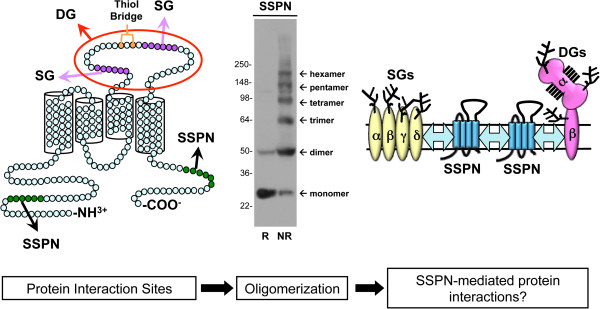
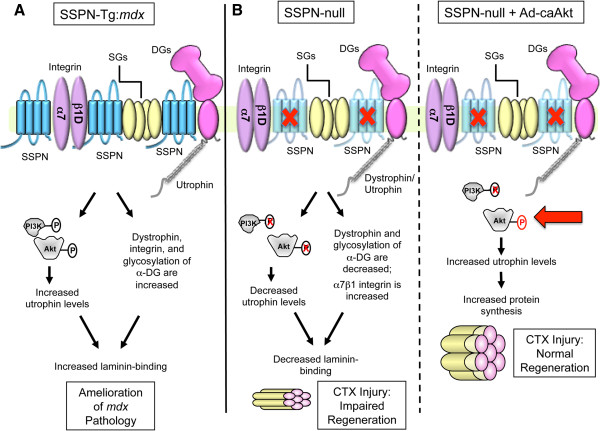
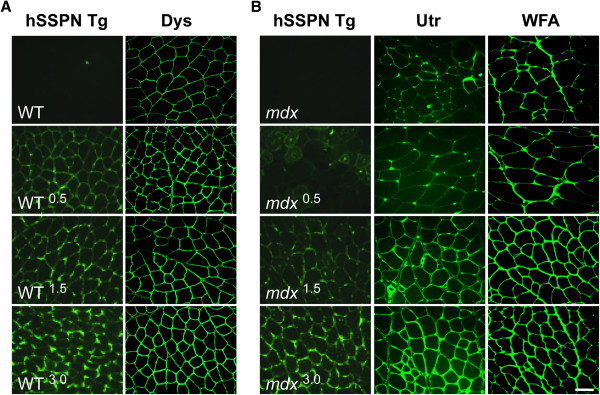
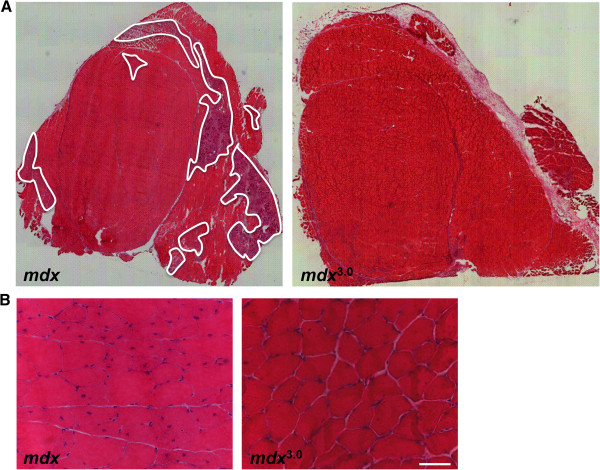
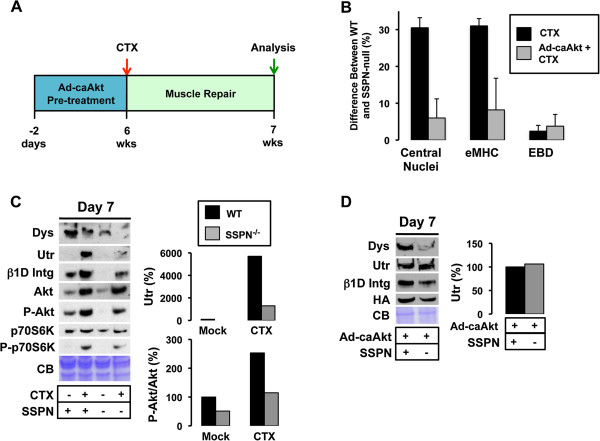
Purification of the proteins associated with dystrophin, the gene product responsible for Duchenne muscular dystrophy, led to the discovery of the dystrophin-glycoprotein complex. Sarcospan, a 25-kDa transmembrane protein, was the last component to be identified and its function in skeletal muscle has been elusive. This review will focus on progress over the last decade revealing that sarcospan is an important regulator of muscle cell adhesion, strength, and regeneration. Investigations using several transgenic mouse models demonstrate that overexpression of sarcospan in the mouse model for Duchenne muscular dystrophy ameliorates pathology and restores muscle cell binding to laminin. Sarcospan improves cell surface expression of the dystrophin- and utrophin-glycoprotein complexes as well as α7β1 integrin, which are the three major laminin-binding complexes in muscle. Utrophin and α7β1 integrin compensate for the loss of dystrophin and the finding that sarcospan increases their abundance at the extra-synaptic sarcolemma supports the use of sarcospan as a therapeutic target. Newly discovered phenotypes in sarcospan-deficient mice, including a reduction in specific force output and increased drop in force in the diaphragm muscle, result from decreased utrophin and dystrophin expression and further reveal sarcospan's role in determining abundance of these complexes. Dystrophin protein levels and the specific force output of the diaphragm muscle are further reduced upon genetic removal of α7 integrin (Itga7) in SSPN-deficient mice, demonstrating that interactions between integrin and sarcospan are critical for maintenance of the dystrophin-glycoprotein complex and force production of the diaphragm muscle. Sarcospan is a major regulator of Akt signaling pathways and sarcospan-deficiency significantly impairs muscle regeneration, a process that is dependent on Akt activation. Intriguingly, sarcospan regulates glycosylation of a specific subpopulation of α-dystroglycan, the laminin-binding receptor associated with dystrophin and utrophin, localized to the neuromuscular junction. Understanding the basic mechanisms responsible for assembly and trafficking of the dystrophin- and utrophin-glycoprotein complexes to the cell surface is lacking and recent studies suggest that sarcospan plays a role in these essential processes.
肌营养不良蛋白相关蛋白的纯化导致了肌营养不良蛋白聚糖复合物的发现。肌联蛋白是一种 25kDa 的跨膜蛋白,是最后一个被鉴定的成分,其在骨骼肌中的功能一直难以捉摸。这篇综述将集中讨论过去十年的进展,揭示肌联蛋白是肌肉细胞黏附、强度和再生的重要调节剂。使用几种转基因小鼠模型的研究表明,在 Duchenne 肌营养不良症的小鼠模型中过度表达肌联蛋白可改善病理学并恢复肌肉细胞与层粘连蛋白的结合。肌联蛋白改善了肌营养不良蛋白和 utrophin 糖蛋白复合物以及α7β1 整联蛋白的细胞表面表达,这三种是肌肉中主要的层粘连蛋白结合复合物。utrophin 和α7β1 整联蛋白补偿了肌营养不良蛋白的缺失,发现肌联蛋白增加了它们在突触外肌细胞膜上的丰度,这支持了将肌联蛋白作为治疗靶点的使用。在肌联蛋白缺陷小鼠中发现的新表型,包括特定力输出减少和膈肌力量下降,是由于 utrophin 和肌营养不良蛋白表达减少引起的,进一步揭示了肌联蛋白在确定这些复合物丰度方面的作用。在 SSPN 缺陷小鼠中遗传去除α7 整合素(Itga7)后,肌营养不良蛋白的水平和膈肌肌肉的特定力输出进一步降低,表明整合素和肌联蛋白之间的相互作用对于维持肌营养不良蛋白聚糖复合物和膈肌肌肉的力产生是至关重要的。肌联蛋白是 Akt 信号通路的主要调节剂,肌联蛋白缺陷显著损害肌肉再生,这一过程依赖于 Akt 的激活。有趣的是,肌联蛋白调节特定亚群α-肌营养不良蛋白的糖基化,α-肌营养不良蛋白是与肌营养不良蛋白和 utrophin 相关的层粘连蛋白结合受体,定位于神经肌肉接头。理解组装和运输到细胞表面的肌营养不良蛋白和 utrophin 糖蛋白复合物的基本机制尚不清楚,最近的研究表明肌联蛋白在这些基本过程中发挥作用。