Department of Medical Biophysics, University of Toronto, Toronto, Canada.
PLoS One. 2012;7(12):e52307. doi: 10.1371/journal.pone.0052307. Epub 2012 Dec 20.
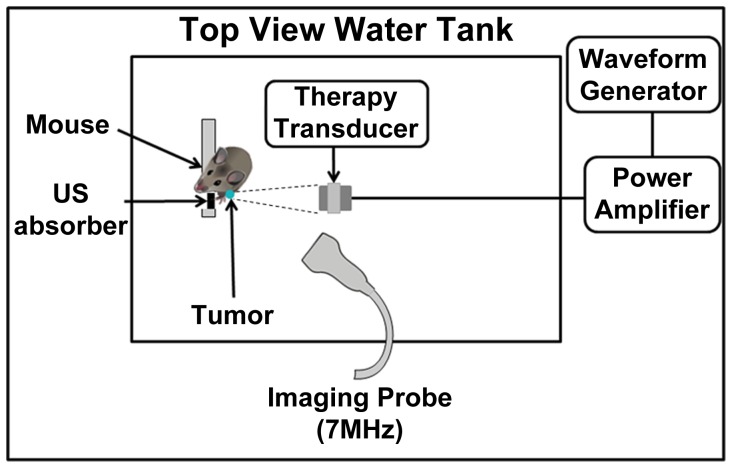
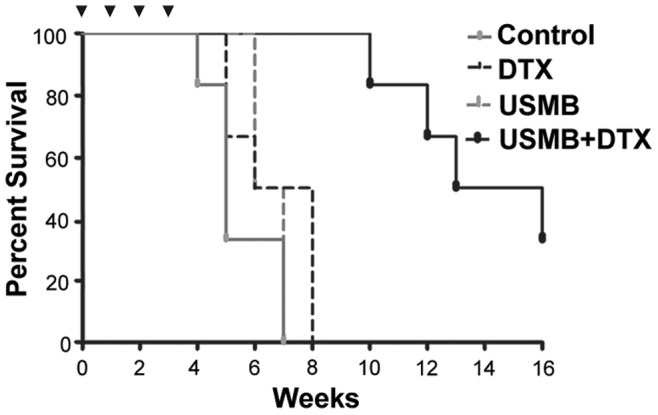
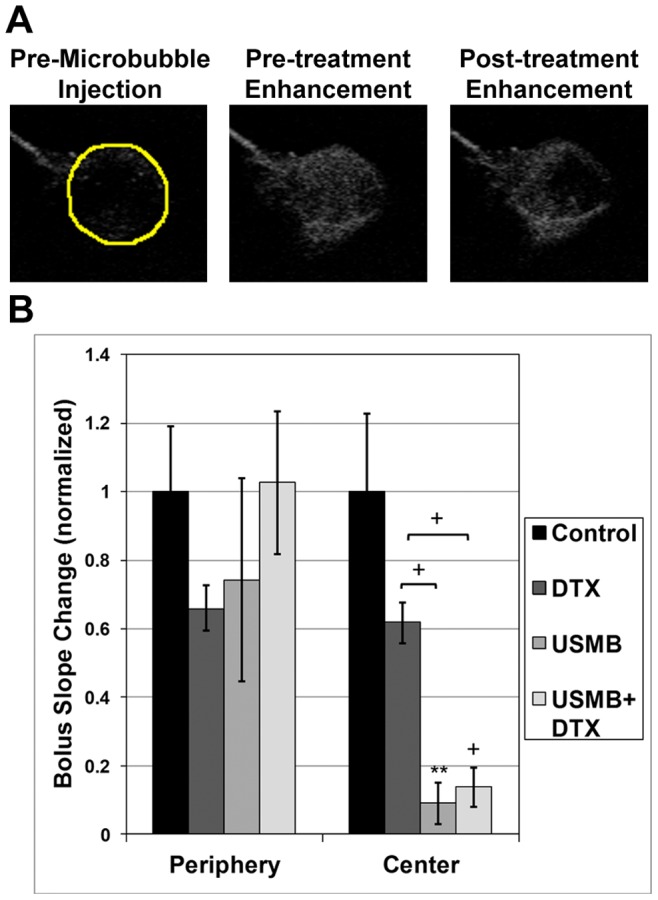
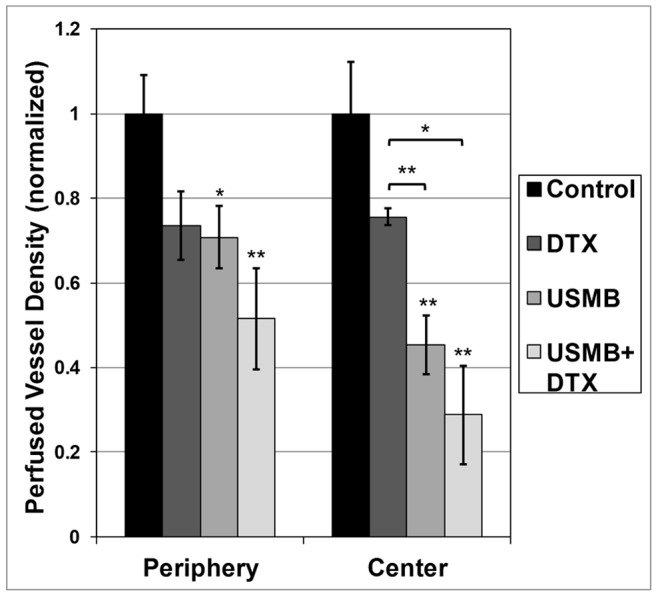
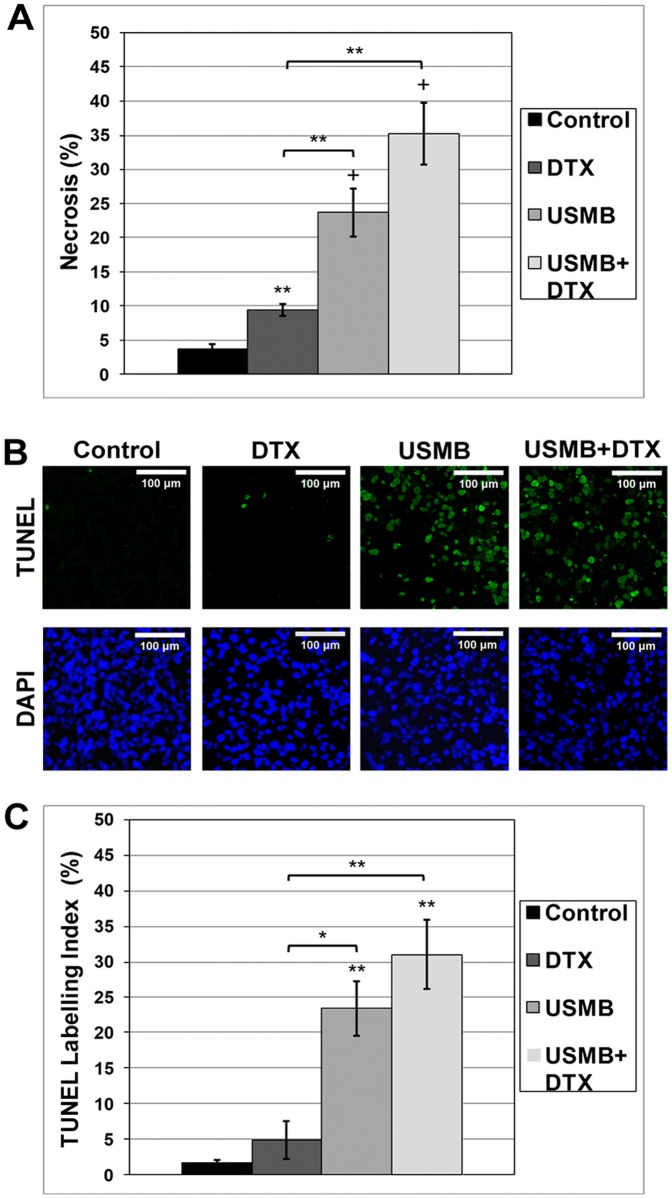
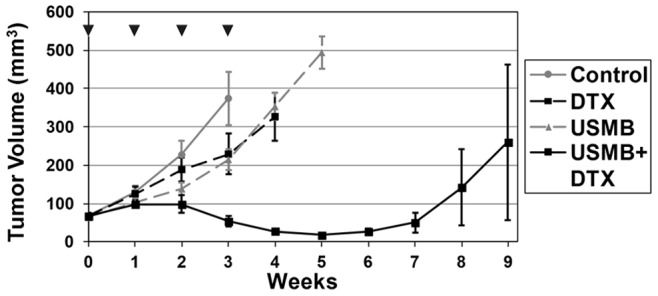
Ultrasound stimulated microbubbles (USMB) are being investigated for their potential to promote the uptake of anticancer agents into tumor tissue by exploiting their ability to enhance microvascular permeability. At sufficiently high ultrasound transmit amplitudes it has also recently been shown that USMB treatments can, on their own, induce vascular damage, shutdown blood flow, and inhibit tumor growth. The objective of this study is to examine the antitumor effects of 'antivascular' USMB treatments in conjunction with chemotherapy, which differs from previous work which has sought to enhance drug uptake with USMBs by increasing vascular permeability. Conceptually this is a strategy similar to combining vascular disrupting agents with a chemotherapy, and we have selected the taxane docetaxel (Taxotere) for evaluating this approach as it has previously been shown to have potent antitumor effects when combined with small molecule vascular disrupting agents. Experiments were conducted on PC3 tumors implanted in athymic mice. USMB treatments were performed at a frequency of 1 MHz employing sequences of 50 ms bursts (0.00024 duty cycle) at 1.65 MPa. USMB treatments were administered on a weekly basis for 4 weeks with docetaxel (DTX) being given intravenously at a dose level of 5 mg/kg. The USMB treatments, either alone or in combination with DTX, induced an acute reduction in tumor perfusion which was accompanied at the 24 hour point by significantly enhanced necrosis and apoptosis. Longitudinal experiments showed a modest prolongation in survival but no significant growth inhibition occurred in DTX-only and USMB-only treatment groups relative to control tumors. The combined USMB-DTX treatment group produced tumor shrinkage in weeks 4-6, and significant growth inhibition and survival prolongation relative to the control (p<0.001), USMB-only (p<0.01) and DTX-only treatment groups (p<0.01). These results suggest the potential of enhancing the antitumor activity of docetaxel by combining it with antivascular USMB effects.
超声刺激微泡(USMB)正在被研究用于通过利用其增强微血管通透性的能力来促进抗癌剂进入肿瘤组织的摄取。最近还表明,在足够高的超声发射幅度下,USMB 治疗本身可以引起血管损伤、关闭血流并抑制肿瘤生长。本研究的目的是检查“抗血管”USMB 治疗与化疗联合的抗肿瘤作用,这与以前试图通过增加血管通透性来增强 USMB 药物摄取的工作不同。从概念上讲,这是一种类似于将血管破坏剂与化疗联合使用的策略,我们选择紫杉醇(Taxotere)作为评估这种方法的药物,因为以前已经表明它与小分子血管破坏剂联合使用时具有很强的抗肿瘤作用。实验在植入无胸腺小鼠的 PC3 肿瘤上进行。USMB 治疗在 1 MHz 频率下进行,采用 50 ms 脉冲序列(0.00024 占空比),声压为 1.65 MPa。USMB 治疗每周进行一次,共进行 4 周,紫杉醇(DTX)以 5mg/kg 的剂量静脉给药。USMB 治疗,无论是单独使用还是与 DTX 联合使用,都会导致肿瘤灌注的急性减少,在 24 小时点时伴随着明显增强的坏死和凋亡。纵向实验显示生存时间略有延长,但与对照肿瘤相比,DTX 单药和 USMB 单药治疗组没有明显的生长抑制。联合 USMB-DTX 治疗组在第 4-6 周导致肿瘤缩小,并与对照(p<0.001)、USMB 单药(p<0.01)和 DTX 单药(p<0.01)治疗组相比,肿瘤生长抑制和生存延长显著。这些结果表明,通过将其与抗血管 USMB 效应结合,有可能增强紫杉醇的抗肿瘤活性。