Department of Diagnostics and Vaccinology, Swedish Institute for Communicable Disease Control, Solna, Sweden.
PLoS One. 2012;7(12):e53511. doi: 10.1371/journal.pone.0053511. Epub 2012 Dec 28.
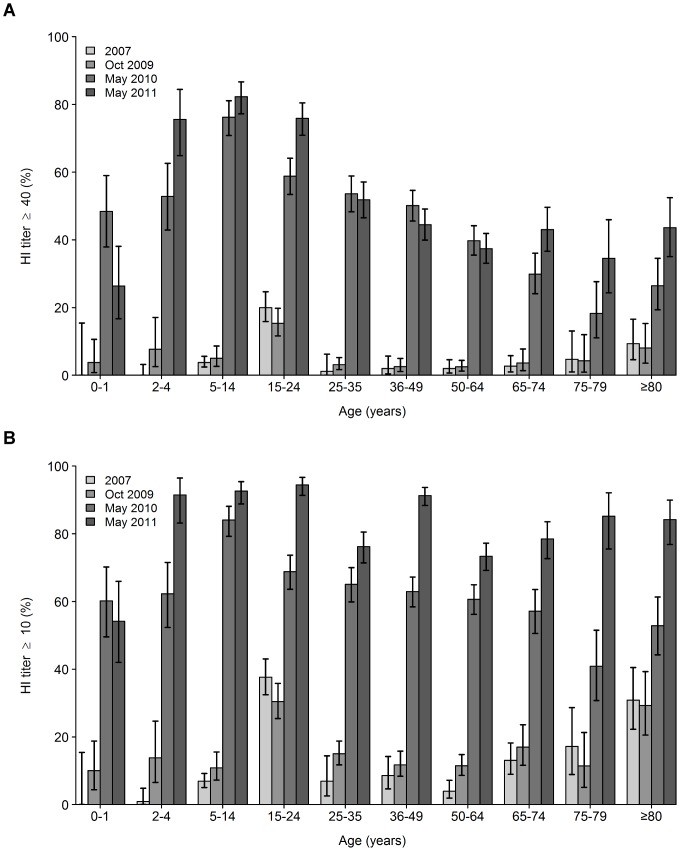
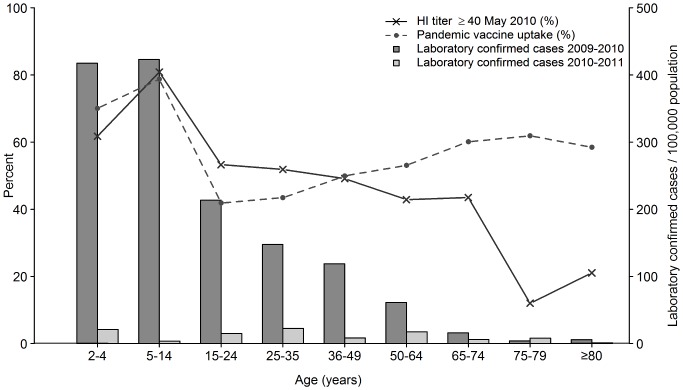
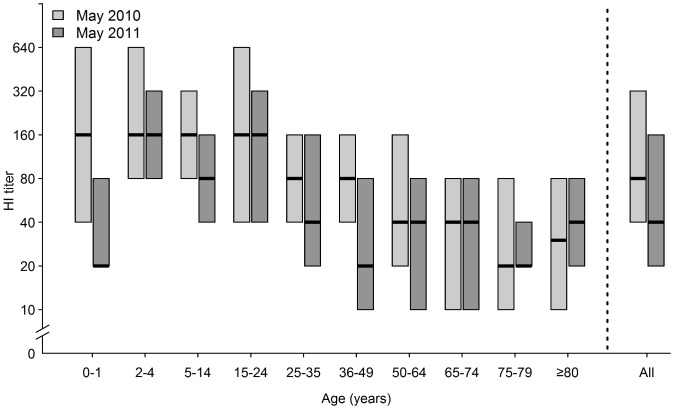
The immunity to pandemic influenza A(H1N1)pdm09 in Sweden before and after the outbreaks in 2009 and 2010 was investigated in a seroepidemiological study. Serum samples were collected at four time points: during 2007 (n = 1968), in October 2009 (n = 2218), in May 2010 (n = 2638) and in May 2011 (n = 2513) and were tested for hemagglutination inhibition (HI) antibodies. In 2007, 4.9% of the population had pre-existing HI titres ≥40, with the highest prevalence (20.0%) in 15-24 year-olds, followed by ≥80 year-olds (9.3%). The overall prevalence of HI titres ≥40 had not changed significantly in October 2009. In May 2010 the prevalence had increased to 48.6% with the highest percentages in 5-14 year-olds (76.2%) andlowest in 75-79 year-olds (18.3%). One year later the prevalence of HI titres ≥40 had increased further to 52.2%. Children 5-14 years had the highest incidence of infection and vaccine uptake as well as the highest post-pandemic protective antibody levels. In contrast, the elderly had high vaccine uptake and low attack rate but low levels of protective antibodies, underlining that factors other than HI antibodies are involved in protection against influenza A(H1N1)pdm09. However, for all age-groups the seroprevalence was stable or increasing between 2010 and 2011, indicating that both vaccine- and infection-induced antibodies were long-lived.
在 2009 年和 2010 年疫情爆发前后,瑞典对大流行性流感 A(H1N1)pdm09 的免疫力进行了血清流行病学研究。在四个时间点采集血清样本:2007 年(n=1968)、2009 年 10 月(n=2218)、2010 年 5 月(n=2638)和 2011 年 5 月(n=2513),并进行血凝抑制(HI)抗体检测。2007 年,有 4.9%的人群存在 HI 滴度≥40 的预先存在抗体,其中 15-24 岁人群的流行率最高(20.0%),其次是≥80 岁人群(9.3%)。2009 年 10 月,HI 滴度≥40 的总体流行率没有显著变化。2010 年 5 月,流行率增加到 48.6%,其中 5-14 岁人群的百分比最高(76.2%),75-79 岁人群的百分比最低(18.3%)。一年后,HI 滴度≥40 的流行率进一步增加到 52.2%。5-14 岁儿童的感染率、疫苗接种率和大流行性后保护性抗体水平最高。相比之下,老年人的疫苗接种率高,发病率低,但保护性抗体水平低,这表明除了 HI 抗体外,还有其他因素参与了对 A(H1N1)pdm09 的保护。然而,对于所有年龄组,2010 年至 2011 年期间血清阳性率保持稳定或上升,表明疫苗和感染诱导的抗体均具有长期持久性。