Chandak Manoj G, Pattanaik Navdheeraj, Das Ayan
Department of Conservative Dentisry and Endodontics, Sharad Pawar Dental College, Sawangi (m) Wardha, Maharastra, India.
Contemp Clin Dent. 2012 Jul;3(3):252-5. doi: 10.4103/0976-237X.103613.
The aim of the study is to compare and evaluate the role of new dental adhesives to bond composite to the resinmodified glass inomer cement (RMGIC).
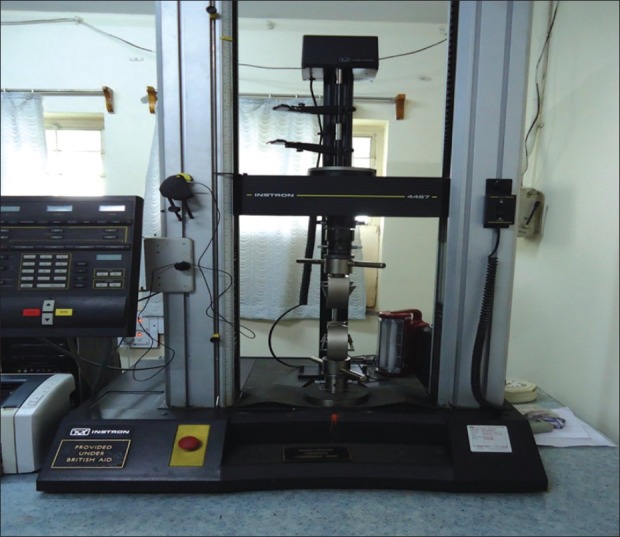
Thirty specimens were prepared on acrylic blocks, with wells prepared in it by drilling holes, to retain the RMGIC. The specimens were randomly divided into three groups of ten specimens each. In Group a thin layer of selfetch adhesive (3M ESPE) was applied between the RMGIC and the composite resin FILTEK P60 (3M SPE). In Group II, total etch adhesive (Adeper Scotch bond 2, 3M ESPE) was applied, and in Group III, there was no application of any adhesive between RMGIC and the composite resin. After curing all the specimens, the shear bond strength was measured using an Instron universal testing machine.
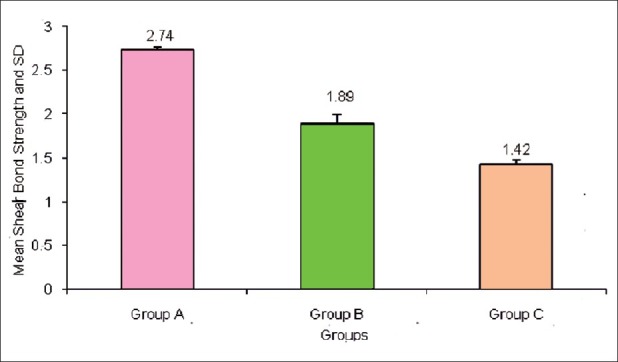
The results were drawn and tabulated using ANOVA-fishers and Dunnet D statistical tests.The maximum shear bond strength values were recorded in Group I specimens with self-etch adhesive showing a mean value of 2.74 when compared to the Group II adhesive (Total etch) showing a mean shear strength of value 1.89, where no adhesive was used, showed a minimum mean shear bond strength of 1.42. There was a great and significant difference between Group I and Group II (P value 0.05) whereas, both Group I and Group II showed a vast and significant difference from Group III (P value = 0-001).
Hence, this present study concludes that application of self-etch adhesive (3M ESPE, U.S.A) in between RMGIC and composite resin increases the shear bond strength between RMGIC and the resin composites, as compared to the total-etch type adhesive (Adeper Scotch bond 2,3M ESPE, U.S.A) as well as without application of the adhesive agent.
本研究旨在比较和评估新型牙科粘合剂在将复合材料粘结到树脂改性玻璃离子水门汀(RMGIC)上的作用。
在丙烯酸树脂块上制备30个标本,通过钻孔在其中制备孔以保留RMGIC。将标本随机分为三组,每组十个标本。在A组中,在RMGIC和复合树脂FILTEK P60(3M SPE)之间涂覆一层薄的自酸蚀粘合剂(3M ESPE)。在第二组中,使用全酸蚀粘合剂(Adeper Scotch bond 2,3M ESPE),在第三组中,RMGIC和复合树脂之间不使用任何粘合剂。固化所有标本后,使用Instron万能试验机测量剪切粘结强度。
使用方差分析-费舍尔检验和邓尼特D统计检验得出结果并制成表格。A组使用自酸蚀粘合剂的标本记录到最大剪切粘结强度值,平均值为2.74,而第二组粘合剂(全酸蚀)的平均剪切强度值为1.89,未使用粘合剂的第三组显示最小平均剪切粘结强度为1.42。A组和第二组之间存在很大且显著的差异(P值0.05),而A组和第二组与第三组之间均显示出巨大且显著的差异(P值=0.001)。
因此,本研究得出结论,与全酸蚀型粘合剂(Adeper Scotch bond 2,3M ESPE,美国)以及不使用粘合剂相比,在RMGIC和复合树脂之间应用自酸蚀粘合剂(3M ESPE,美国)可提高RMGIC与树脂复合材料之间的剪切粘结强度。