Niki Hisateru, Tatsunami Shinobu, Haraguchi Naoki, Aoki Takafumi, Okuda Ryuzo, Suda Yasunori, Takao Masato, Tanaka Yasuhito
Department of Orthopaedic Surgery, St. Marianna University School of Medicine, 2-16-1 Sugao, Miyamae-ku, Kawasaki, Kanagawa 216-8511, Japan.
J Orthop Sci. 2013 Mar;18(2):298-320. doi: 10.1007/s00776-012-0337-2. Epub 2013 Jan 9.
The Japanese Society for Surgery of the Foot (JSSF) is developing a QOL questionnaire instrument for use in pathological conditions related to the foot and ankle. The main body of the outcome instrument (the Self-Administered Foot Evaluation Questionnaire, SAFE-Q version 2) consists of 34 questionnaire items, which provide five subscale scores (1: Pain and Pain-Related; 2: Physical Functioning and Daily Living; 3: Social Functioning; 4: Shoe-Related; and 5: General Health and Well-Being). In addition, the instrument has nine optional questionnaire items that provide a Sports Activity subscale score. The purpose of this study was to evaluate the test-retest reliability of the SAFE-Q.
Version 2 of the SAFE-Q was administered to 876 patients and 491 non-patients, and the test-retest reliability was evaluated for 131 patients. In addition, the SF-36 questionnaire and the JSSF Scale scoring form were administered to all of the participants. Subscale scores were scaled such that the final sum of scores ranged between zero (least healthy) to 100 (healthiest).
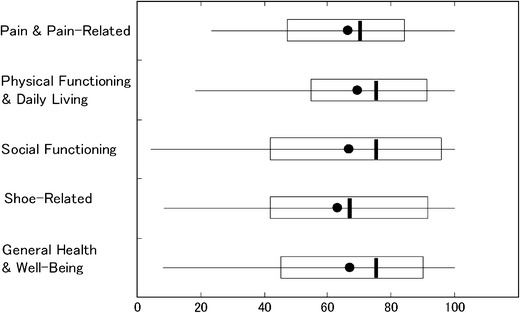
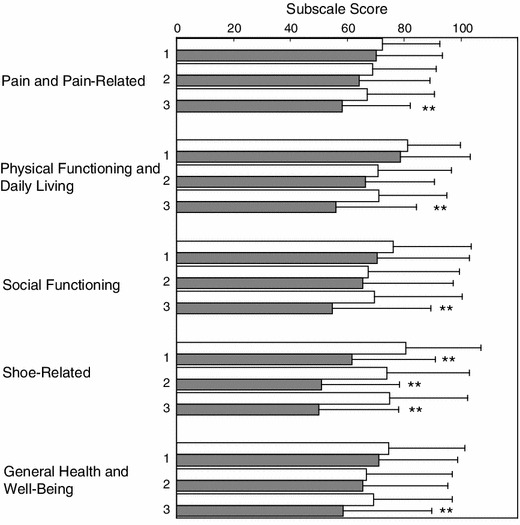
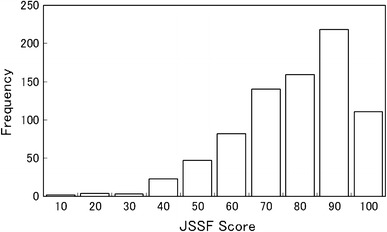
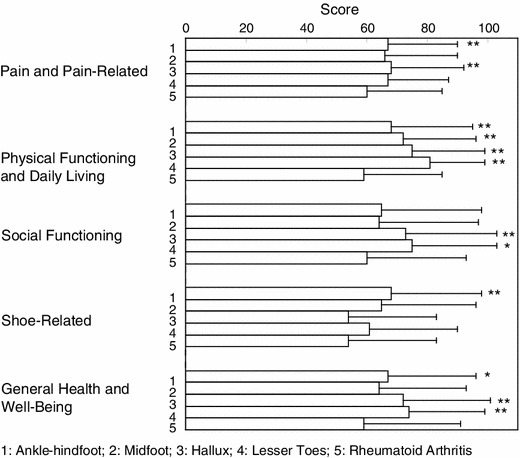
The intraclass correlation coefficients were larger than 0.7 for all of the scores. The means of the five subscale scores were between 60 and 75. The five subscales easily separated patients from non-patients. The coefficients for the correlations of the subscale scores with the scores on the JSSF Scale and the SF-36 subscales were all highly statistically significantly greater than zero (p < 0.001). The means for the five JSSF Scale classification groups fell within a relatively narrow range, indicating that the SAFE-Q labels are sufficiently similar to permit their use for all of the JSSF Scale classifications.
The present study revealed that the test-retest reliability is high for each subscale. Consequently, the SAFE-Q is valid and reliable. In the future, it will be beneficial to test the responsiveness of the SAFE-Q.
日本足外科学会(JSSF)正在开发一种用于足踝相关病理状况的生活质量调查问卷工具。该结果工具的主体(自我管理足部评估问卷,SAFE-Q第2版)由34个问卷项目组成,可提供五个子量表得分(1:疼痛及与疼痛相关;2:身体功能和日常生活;3:社会功能;4:与鞋子相关;5:总体健康和幸福感)。此外,该工具还有九个可选问卷项目,可提供一个体育活动子量表得分。本研究的目的是评估SAFE-Q的重测信度。
将SAFE-Q第2版施用于876例患者和491例非患者,并对131例患者评估重测信度。此外,对所有参与者都施行了SF-36问卷和JSSF量表评分表。子量表得分进行了标准化处理,使得最终得分总和在0(最不健康)至100(最健康)之间。
所有得分的组内相关系数均大于0.7。五个子量表得分的均值在60至75之间。这五个子量表能轻松区分患者和非患者。子量表得分与JSSF量表得分及SF-36子量表得分之间的相关系数均在统计学上极显著大于零(p < 0.001)。五个JSSF量表分类组的均值落在相对较窄的范围内,表明SAFE-Q标签足够相似,可用于所有JSSF量表分类。
本研究表明每个子量表的重测信度都很高。因此,SAFE-Q是有效且可靠的。未来,测试SAFE-Q的反应度将是有益的。