Priority Research Centre for Health Behaviour, School of Medicine and Public Health, Faculty of Health, University of Newcastle, Callaghan, Australia.
BMC Cancer. 2013 Jan 10;13:13. doi: 10.1186/1471-2407-13-13.
The aim of this study was to determine the proportions and predictors of first-degree relatives (FDRs) of colorectal cancer (CRC) patients (i) ever receiving any CRC testing and (ii) receiving CRC screening in accordance with CRC screening guidelines.
Colorectal cancer patients and their FDRs were recruited through the population-based Victorian Cancer Registry, Victoria, Australia. Seven hundred and seven FDRs completed telephone interviews. Of these, 405 FDRs were deemed asymptomatic and eligible for analysis.
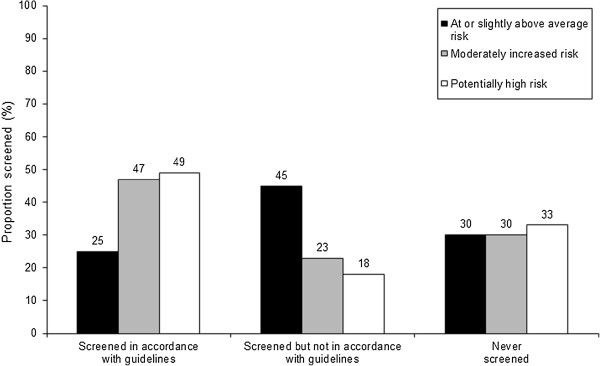
Sixty-nine percent of FDRs had ever received any CRC testing. First-degree relatives of older age, those with private health insurance, siblings and FDRs who had ever been asked about family history of CRC by a doctor were significantly more likely than their counterparts to have ever received CRC testing. Twenty-five percent of FDRs "at or slightly above average risk" were adherent to CRC screening guidelines. For this group, adherence to guideline-recommended screening was significantly more likely to occur for male FDRs and those with a higher level of education. For persons at "moderately increased risk" and "potentially high risk", 47% and 49% respectively adhered to CRC screening guidelines. For this group, guideline-recommended screening was significantly more likely to occur for FDRs who were living in metropolitan areas, siblings, those married or partnered and those ever asked about family history of CRC.
A significant level of non-compliance with screening guidelines was evident among FDRs. Improved CRC screening in accordance with guidelines and effective systematic interventions to increase screening rates among population groups experiencing inequality are needed.
Australian and New Zealand Clinical Trial Registry: ACTRN12609000628246.
本研究旨在确定结直肠癌(CRC)患者一级亲属(FDRs)中符合 CRC 筛查指南的(i)接受任何 CRC 检测的比例和预测因素,以及(ii)接受 CRC 筛查的比例和预测因素。
通过澳大利亚维多利亚州的人群基础维多利亚癌症登记处招募 CRC 患者及其 FDR。707 名 FDR 完成了电话访谈。其中,405 名 FDR 被认为无症状且符合分析条件。
69%的 FDR 曾接受过任何 CRC 检测。年龄较大、有私人医疗保险、兄弟姐妹和曾被医生询问过 CRC 家族史的 FDR,比同龄人更有可能接受过 CRC 检测。25%的“处于或略高于平均风险”的 FDR 符合 CRC 筛查指南。对于这一组,男性 FDR 和受教育程度较高的 FDR 更有可能遵循指南推荐的筛查。对于“中度增加风险”和“潜在高风险”的人群,分别有 47%和 49%符合 CRC 筛查指南。对于这一组,居住在大都市区、兄弟姐妹、已婚或有伴侣以及曾被询问过 CRC 家族史的 FDR,更有可能接受指南推荐的筛查。
FDR 中明显存在不符合筛查指南的情况。需要改善根据指南进行的 CRC 筛查,并采取有效的系统干预措施,以提高处于不平等状态的人群的筛查率。
澳大利亚和新西兰临床试验注册:ACTRN12609000628246。