Tumor Immunity Medical Research Center, Cancer Research Institute, Department of Pathology, Seoul National University College of Medicine, Seoul, Korea.
Exp Mol Med. 2013 Jan 10;45(1):e3. doi: 10.1038/emm.2013.1.
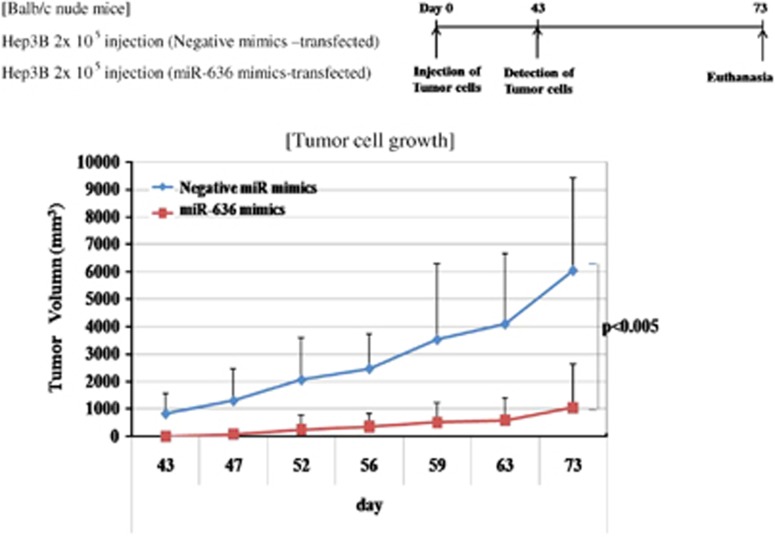
MicroRNAs (miRNAs) participate in diverse biological functions and carcinogenesis by inhibiting specific gene expression. We previously reported that suppression of adenine nucleotide translocase 2 (ANT2) by using the short hairpin RNA (shRNA) approach has an antitumor effect in several cancer cells. We here examined the influence of ANT2 on expression of miRNAs in hepatocellular carcinoma (HCC) to further elucidate the tumor-suppressive mechanism of ANT2 shRNA. We first carried out screening for miRNAs, whose expression is regulated by ANT2 suppression in the Hep3B HCC cell line using miRNA microarrays. Validation of candidate miRNAs was done by incorporating clinical samples, and their effects on the tumorigenesis of HCC were studied in vitro and in vivo. miR-636 was one of the miRNAs whose expression was highly upregulated by ANT2 suppression in miRNA microarray analysis, as confirmed by real-time reverse transcription-polymerase chain reaction. Notably, miR-636 was markedly downregulated in HCC tissues compared with matched non-neoplastic liver in clinical samples. Restoration of miR-636 in Hep3B cells led to significant reduction of cell proliferation and colony formation. miR-636 restoration resulted in a decreased level of Ras, one of the putative targets of miR-636, and inactivation of its signaling pathway. Moreover, tumorigenesis was efficiently suppressed by miR-636 in an in vivo tumor xenograft model of HCC. The data suggest that miR-636 might function as a tumor suppressor miRNA affecting HCC tumorigenesis via downregulation of Ras, and that ANT2 suppression by shRNA could exert an anticancer effect by restoring miR-636 expression in HCC.
微小 RNA(miRNAs)通过抑制特定基因的表达参与多种生物学功能和癌症发生。我们之前的研究报道,使用短发夹 RNA(shRNA)方法抑制腺嘌呤核苷酸转位酶 2(ANT2)在几种癌细胞中具有抗肿瘤作用。我们在此研究了 ANT2 对肝癌(HCC)中 miRNA 表达的影响,以进一步阐明 ANT2 shRNA 的肿瘤抑制机制。我们首先使用 miRNA 微阵列对 Hep3B HCC 细胞系中受 ANT2 抑制调节的 miRNA 进行了筛选。通过纳入临床样本对候选 miRNA 进行了验证,并在体外和体内研究了它们对 HCC 肿瘤发生的影响。miR-636 是 miRNA 微阵列分析中受 ANT2 抑制表达上调的 miRNA 之一,实时逆转录聚合酶链反应(PCR)证实了这一点。值得注意的是,miR-636 在临床样本中 HCC 组织中的表达明显低于匹配的非肿瘤性肝脏。在 Hep3B 细胞中恢复 miR-636 导致细胞增殖和集落形成显著减少。miR-636 恢复导致 Ras 水平降低,Ras 是 miR-636 的假定靶标之一,其信号通路失活。此外,miR-636 在 HCC 的体内肿瘤异种移植模型中有效地抑制了肿瘤发生。这些数据表明,miR-636 可能作为肿瘤抑制 miRNA 通过下调 Ras 影响 HCC 肿瘤发生,并且 shRNA 对 ANT2 的抑制可能通过恢复 miR-636 在 HCC 中的表达发挥抗癌作用。