Division of Mental Health, Norwegian Institute of Public Health, Oslo, Norway.
Int J Eat Disord. 2013 May;46(4):355-68. doi: 10.1002/eat.22088. Epub 2013 Jan 11.
To investigate course and predictors of eating disorders in the postpartum period.
A total of 77,807 women, participating in the Norwegian Mother and Child Cohort Study (MoBa), completed questionnaires during pregnancy including items covering DSM-IV criteria for prepregnancy anorexia nervosa (AN), bulimia nervosa (BN), eating disorder not otherwise specified (EDNOS-P), and binge eating disorder (BED). Additional questionnaires were completed at 18 and 36 months postpartum.
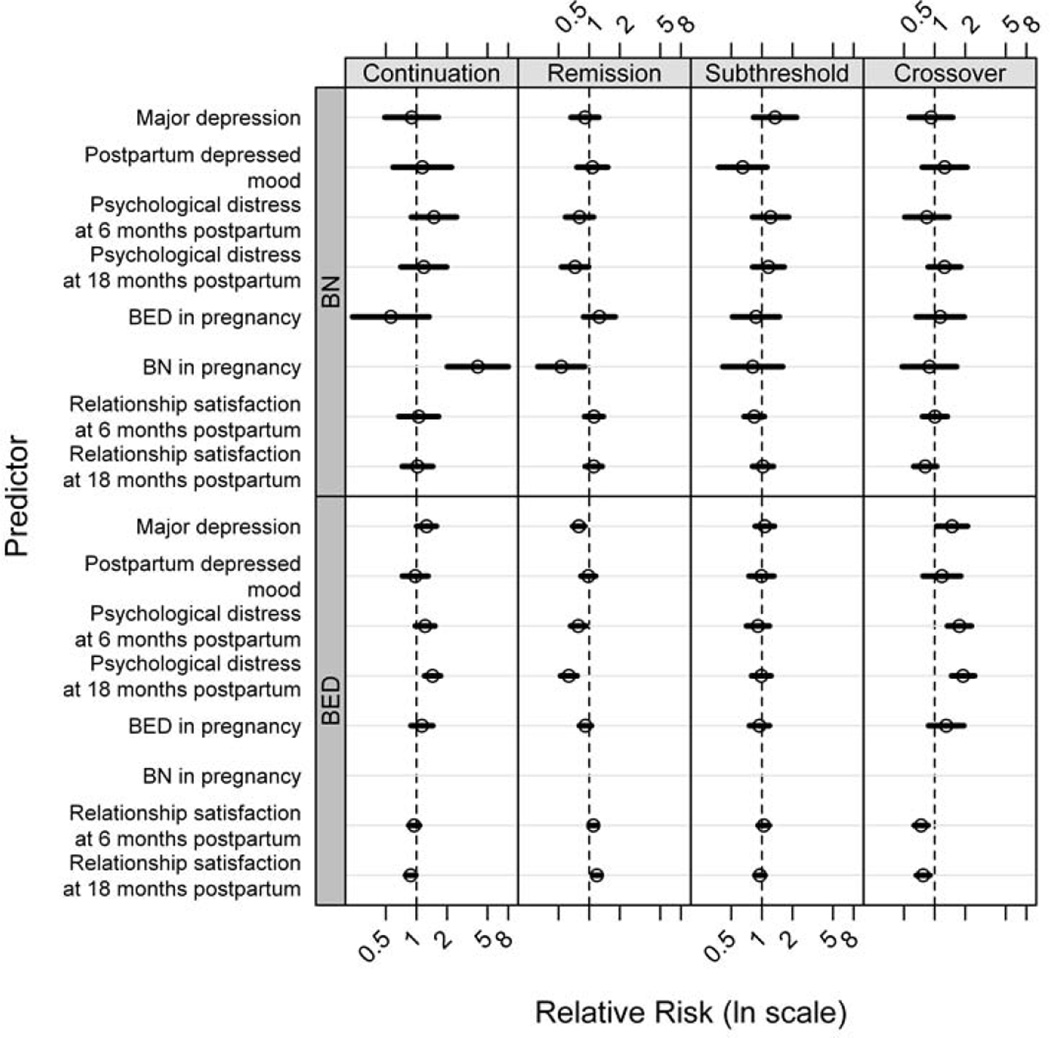
Proportions of women remitting at 18 months and 36 months postpartum were 50% and 59% for AN, 39% and 30% for BN, 46% and 57% for EDNOS-P, and 45% and 42% for BED, respectively. However, disordered eating persisted in a substantial proportion of women meeting criteria for either full or subthreshold eating disorders. BN during pregnancy increased the risk for continuation of BN. BMI and psychological distress were significantly associated with course of BED.
This is the first large-scale population-based study on course of eating disorders in the postpartum period. The results indicated that disordered eating persists in a substantial proportion of women with prepregnancy eating disorders. Health care professionals working with women in this phase of life need to pay specific attention to eating disorder symptoms and behaviors.
研究产后期间进食障碍的病程和预测因素。
共有 77807 名女性参与了挪威母婴队列研究(MoBa),她们在怀孕期间完成了包括 DSM-IV 产前神经性厌食症(AN)、神经性贪食症(BN)、未特定进食障碍(EDNOS-P)和暴食障碍(BED)标准的问卷。在产后 18 个月和 36 个月时还完成了其他问卷。
在产后 18 个月和 36 个月时,AN 的缓解比例分别为 50%和 59%,BN 为 39%和 30%,EDNOS-P 为 46%和 57%,BED 为 45%和 42%。然而,符合完全或亚阈值进食障碍标准的女性中,仍有相当一部分存在饮食紊乱。怀孕期间的 BN 增加了 BN 持续存在的风险。BMI 和心理困扰与 BED 的病程显著相关。
这是第一项关于产后期间进食障碍病程的大规模基于人群的研究。结果表明,患有产前进食障碍的女性中,饮食紊乱在相当一部分女性中持续存在。在这个生命阶段与女性一起工作的医疗保健专业人员需要特别注意饮食障碍症状和行为。