University of Nantes, Laboratory Motricité, Interactions, Performance (EA 4334), Nantes, France.
PLoS One. 2013;8(1):e53159. doi: 10.1371/journal.pone.0053159. Epub 2013 Jan 4.
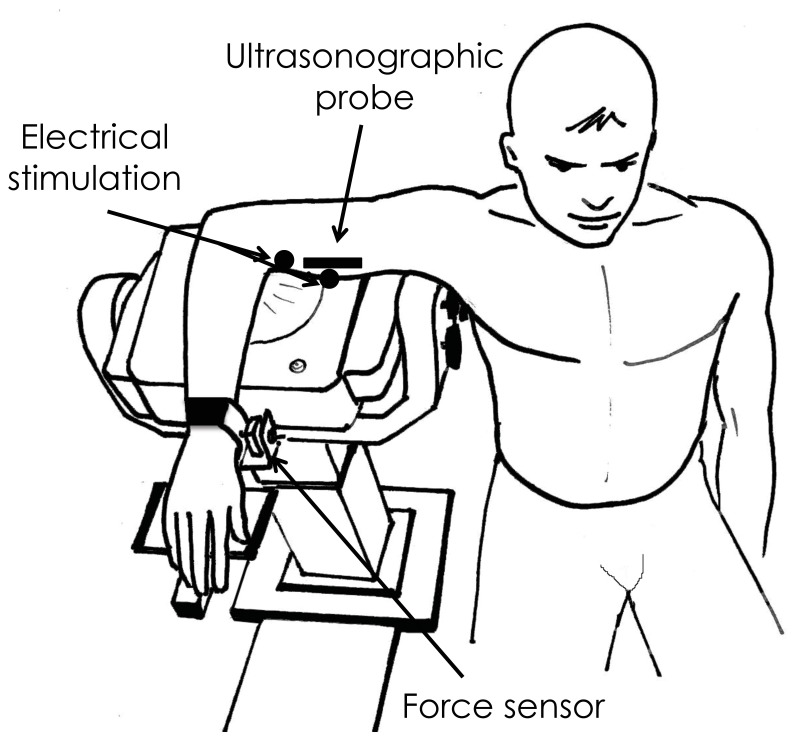
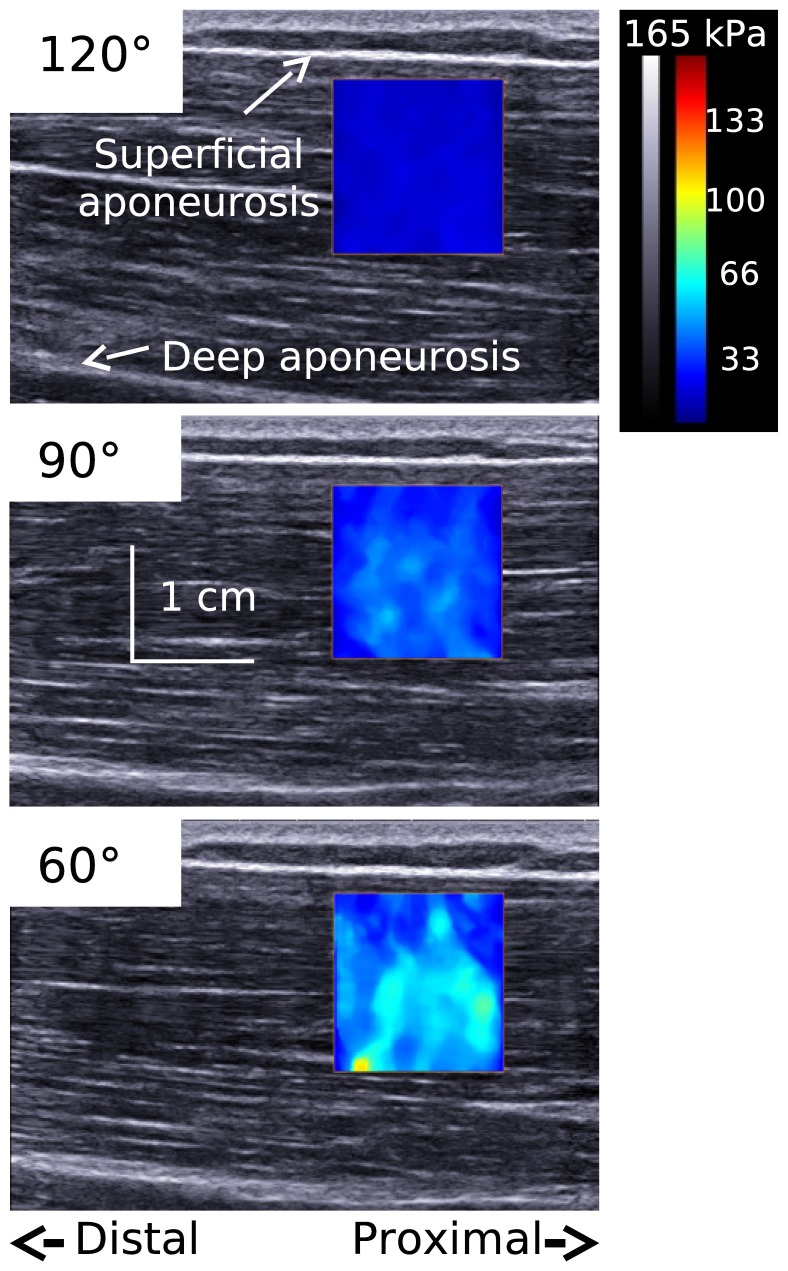
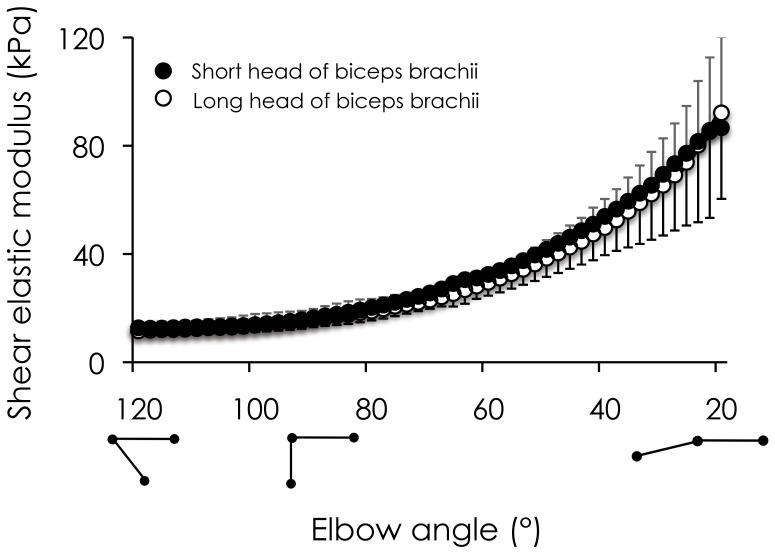
Electromechanical delay is the time lag between onsets of muscle activation and muscle force production and reflects both electro-chemical processes and mechanical processes. The aims of the present study were two-fold: to experimentally determine the slack length of each head of the biceps brachii using elastography and to determine the influence of the length of biceps brachii on electromechanical delay and its electro-chemical/mechanical processes using very high frame rate ultrasound.
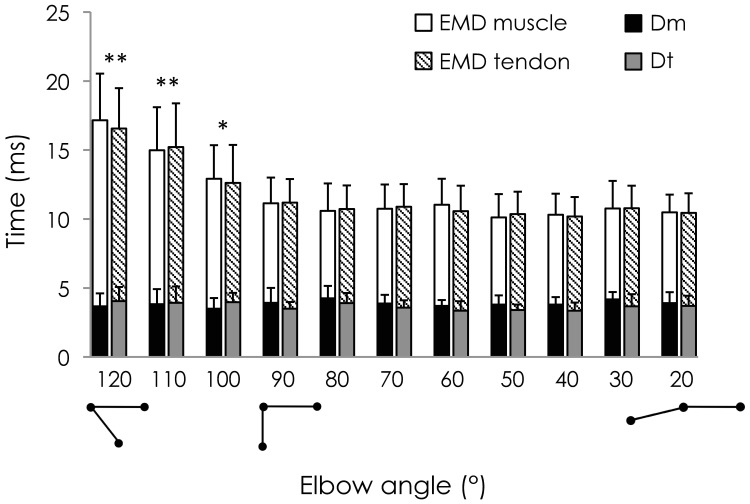
METHODS/RESULTS: First, 12 participants performed two passive stretches to evaluate the change in passive tension for each head of the biceps brachii. Then, they underwent two electrically evoked contractions from 120 to 20° of elbow flexion (0°: full extension), with the echographic probe maintained over the muscle belly and the myotendinous junction of biceps brachii. The slack length was found to occur at 95.5 ± 6.3° and 95.3 ± 8.2° of the elbow joint angle for the long and short heads of the biceps brachii, respectively. The electromechanical delay was significantly longer at 120° (16.9 ± 3.1 ms; p<0.001), 110° (15.0 ± 3.1 ms; p<0.001) and 100° (12.7 ± 2.5 ms; p = 0.01) of elbow joint angle compared to 90° (11.1 ± 1.7 ms). However, the delay between the onset of electrical stimulation and the onset of both muscle fascicles (3.9 ± 0.2 ms) and myotendinous junction (3.7 ± 0.3 ms) motion was not significantly affected by the joint angle (p>0.95).
In contrast to previous observations on gastrocnemius medialis, the onset of muscle motion and the onset of myotendinous junction motion occurred simultaneously regardless of the length of the biceps brachii. That suggests that the between-muscles differences reported in the literature cannot be explained by different muscle passive tension but instead may be attributable to muscle architectural differences.
机电延迟是肌肉激活和肌肉力量产生之间的时间延迟,反映了电化学过程和机械过程。本研究的目的有两个:一是使用弹性成像实验确定肱二头肌每个头的松弛长度,二是使用超高帧率超声确定肱二头肌长度对机电延迟及其电化学/机械过程的影响。
方法/结果:首先,12 名参与者进行了两次被动伸展,以评估肱二头肌每个头的被动张力变化。然后,他们在 120 到 20°的肘关节角度范围内进行了两次电诱发收缩(0°:完全伸展),超声探头保持在肌肉腹部和肱二头肌的肌肌腱交界处。发现长头和短头肱二头肌的松弛长度分别为 95.5±6.3°和 95.3±8.2°的肘关节角度。机电延迟在 120°(16.9±3.1 ms;p<0.001)、110°(15.0±3.1 ms;p<0.001)和 100°(12.7±2.5 ms;p=0.01)的肘关节角度显著更长,而在 90°(11.1±1.7 ms)的肘关节角度显著更短。然而,电刺激起始和两个肌纤维束(3.9±0.2 ms)和肌肌腱交界处(3.7±0.3 ms)运动起始之间的延迟不受关节角度的显著影响(p>0.95)。
与之前对腓肠肌内侧的观察结果相反,无论肱二头肌的长度如何,肌肉运动的起始和肌肌腱交界处运动的起始同时发生。这表明,文献中报道的肌肉之间的差异不能用不同的肌肉被动张力来解释,而可能归因于肌肉结构的差异。