Department of Orthopaedics and Trauma Surgery, University of Bonn, Bonn, Germany.
BMC Musculoskelet Disord. 2013 Jan 11;14:19. doi: 10.1186/1471-2474-14-19.
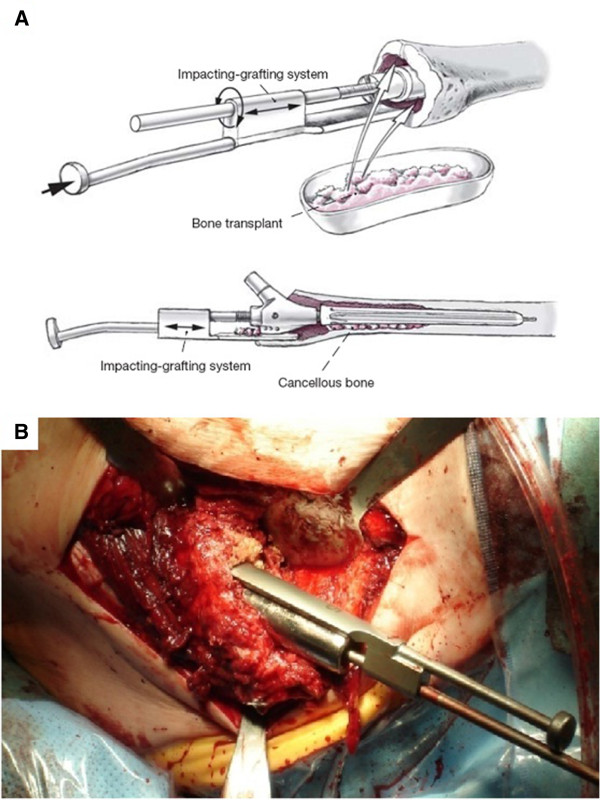
We present a descriptive and retrospective analysis of revision total hip arthroplasties (THA) using the MRP-TITAN stem (Peter Brehm, Weisendorf, GER) with distal diaphyseal fixation and metaphyseal defect augmentation. Our hypothesis was that the metaphyseal defect augmentation (Impaction Bone Grafting) improves the stem survival.
We retrospectively analyzed the aggregated and anonymized data of 243 femoral stem revisions. 68 patients with 70 implants (28.8%) received an allograft augmentation for metaphyseal defects; 165 patients with 173 implants (71.2%) did not, and served as controls. The mean follow-up was 4.4 ± 1.8 years (range, 2.1-9.6 years). There were no significant differences (p > 0.05) between the study and control group regarding age, body mass index (BMI), femoral defects (types I-III as described by Paprosky), and preoperative Harris Hip Score (HHS). Postoperative clinical function was evaluated using the HHS. Postoperative radiologic examination evaluated implant stability, axial implant migration, signs of implant loosening, periprosthetic radiolucencies, as well as bone regeneration and resorption.
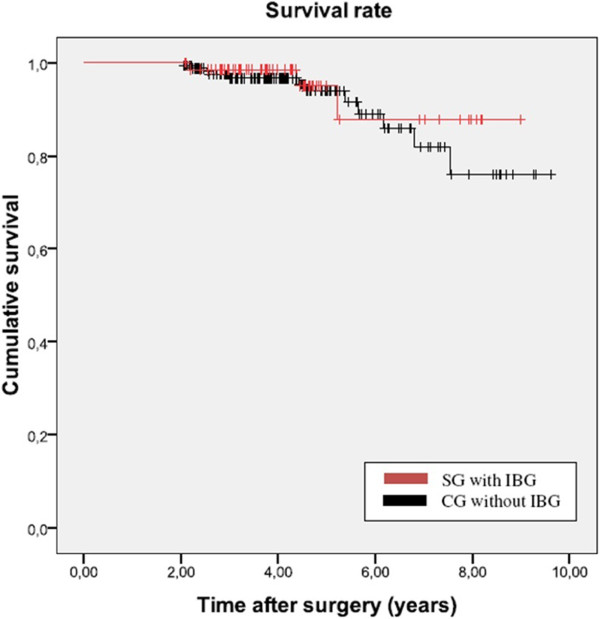
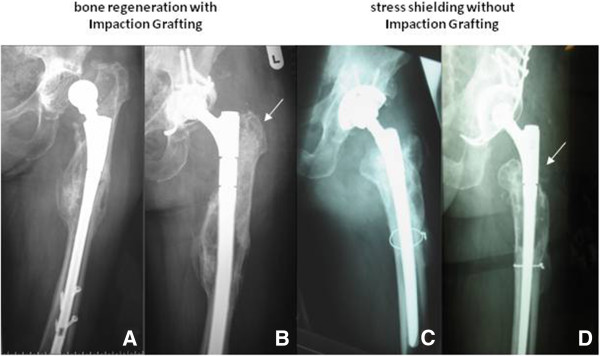
There were comparable rates of intraoperative and postoperative complications in the study and control groups (p > 0.05). Clinical function, expressed as the increase in the postoperative HHS over the preoperative score, showed significantly greater improvement in the group with Impaction Bone Grafting (35.6 ± 14.3 vs. 30.8 ± 15.8; p ≤ 0.05). The study group showed better outcome especially for larger defects (types II C and III as described by Paprosky) and stem diameters ≥ 17 mm. The two groups did not show significant differences in the rate of aseptic loosening (1.4% vs. 2.9%) and the rate of revisions (8.6% vs. 11%). The Kaplan-Meier survival for the MRP-TITAN stem in both groups together was 93.8% after 8.8 years. [Study group 95.7% after 8.54 years ; control group 93.1% after 8.7 years]. Radiologic evaluation showed no significant change in axial implant migration (4.3% vs. 9.3%; p = 0.19) but a significant reduction in proximal stress shielding (5.7% vs. 17.9%; p < 0.05) in the study group. Periprosthetic radiolucencies were detected in 5.7% of the study group and in 9.8% of the control group (p = 0.30). Radiolucencies in the proximal zones 1 and 7 according to Gruen occurred significantly more often in the control group without allograft augmentation (p ≤ 0.05).
We present the largest analysis of the impaction grafting technique in combination with cementless distal diaphyseal stem fixation published so far. Our data provides initial evidence of improved bone regeneration after graft augmentation of metaphyseal bone defects. The data suggests that proximal metaphyseal graft augmentation is beneficial for large metaphyseal bone defects (Paprosky types IIC and III) and stem diameters of 17 mm and above. Due to the limitations of a retrospective and descriptive study the level of evidence remains low and prospective trials should be conducted.
我们展示了使用带有远端骨干固定和骨干缺损增强的 MRP-TITAN 柄(Peter Brehm,Weisendorf,德国)进行翻修全髋关节置换术(THA)的描述性和回顾性分析。我们的假设是骨干缺损增强(压配骨移植)可提高柄的存活率。
我们回顾性分析了 243 例股骨柄翻修的汇总和匿名数据。68 例患者(70 个假体)接受同种异体骨移植治疗骨干缺损;165 例患者(173 个假体)未接受同种异体骨移植,作为对照组。平均随访时间为 4.4±1.8 年(范围 2.1-9.6 年)。研究组和对照组在年龄、体重指数(BMI)、股骨缺损(Paprosky 描述的 I-III 型)和术前 Harris 髋关节评分(HHS)方面无显著差异(p>0.05)。术后临床功能采用 HHS 进行评估。术后影像学检查评估了植入物的稳定性、轴向植入物迁移、植入物松动的迹象、假体周围透亮线以及骨再生和吸收。
研究组和对照组术中及术后并发症发生率相当(p>0.05)。临床功能,即术后 HHS 评分较术前评分的增加,在接受压配骨移植的组中明显改善(35.6±14.3 比 30.8±15.8;p≤0.05)。研究组在较大的缺损(Paprosky 描述的 II C 和 III 型)和直径≥17mm 的柄中表现出更好的结果。两组在无菌性松动率(1.4%比 2.9%)和翻修率(8.6%比 11%)方面无显著差异。两组的 MRP-TITAN 柄的 Kaplan-Meier 生存率在 8.8 年后均为 93.8%。[研究组 8.54 年后为 95.7%;对照组 8.7 年后为 93.1%]。影像学评估显示轴向植入物迁移无显著变化(4.3%比 9.3%;p=0.19),但研究组近端应力遮挡显著减少(5.7%比 17.9%;p<0.05)。研究组 5.7%和对照组 9.8%的患者出现假体周围透亮线(p=0.30)。在未接受同种异体骨移植的对照组中,根据 Gruen 分区的近端区 1 和 7 出现透亮线的频率显著更高(p≤0.05)。
我们目前报道了最大规模的关于压配骨移植技术联合非骨水泥远端骨干固定的分析。我们的数据提供了骨再生在骨干缺损增强后改善的初步证据。数据表明,近端骨干骨移植增强对较大的骨干骨缺损(Paprosky 类型 IIC 和 III)和直径为 17mm 及以上的柄有益。由于回顾性和描述性研究的局限性,证据水平仍然较低,应进行前瞻性试验。