Department of Internal Medicine, Erasmus Medical Center, Rotterdam, the Netherlands.
Diabetes Care. 2013 Jun;36(6):1619-28. doi: 10.2337/dc12-1188. Epub 2013 Jan 11.
Individuals with type 2 diabetes have increased fracture risk despite higher bone mineral density (BMD). Our aim was to examine the influence of glucose control on skeletal complications.
Data of 4,135 participants of the Rotterdam Study, a prospective population-based cohort, were available (mean follow-up 12.2 years). At baseline, 420 participants with type 2 diabetes were classified by glucose control (according to HbA1c calculated from fructosamine), resulting in three comparison groups: adequately controlled diabetes (ACD; n = 203; HbA1c <7.5%), inadequately controlled diabetes (ICD; n = 217; HbA1c ≥ 7.5%), and no diabetes (n = 3,715). Models adjusted for sex, age, height, and weight (and femoral neck BMD) were used to test for differences in bone parameters and fracture risk (hazard ratio [HR] [95% CI]).
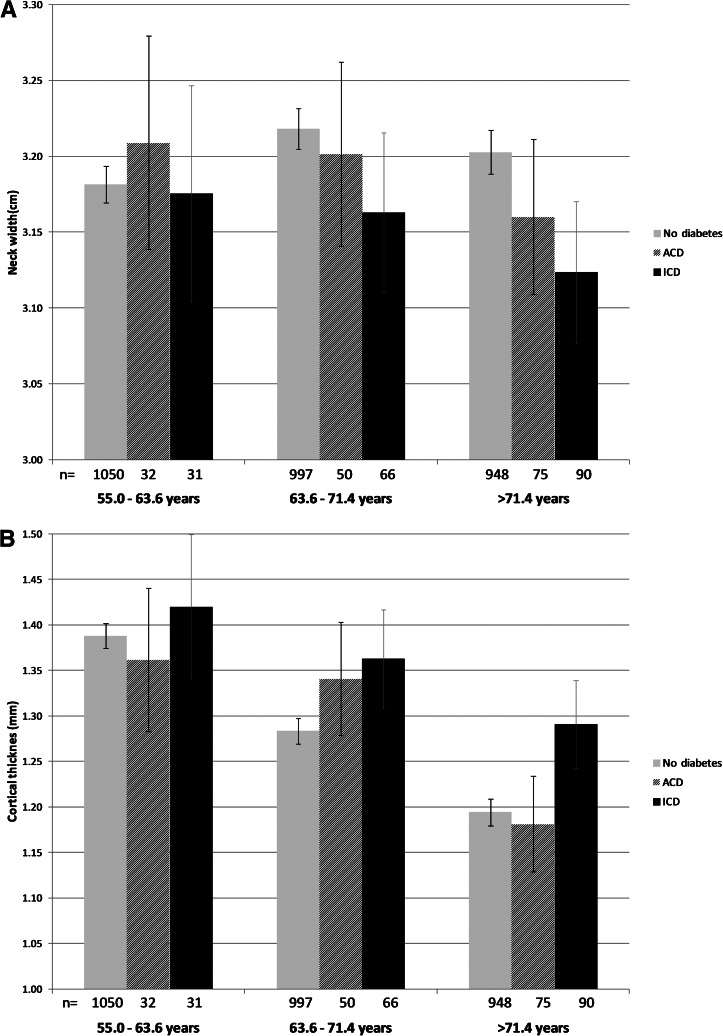
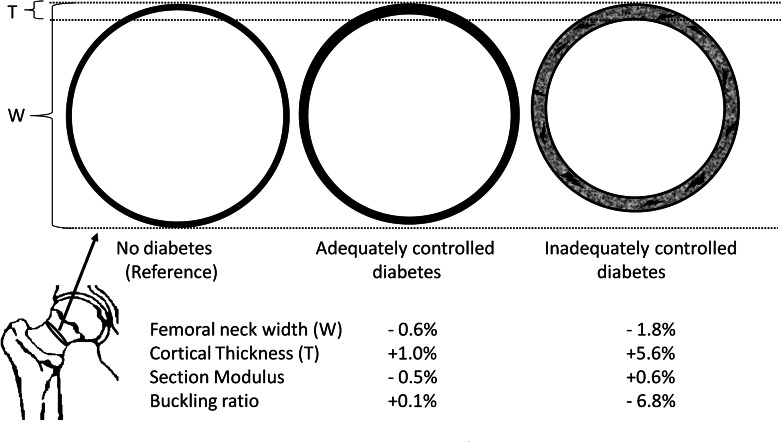
The ICD group had 1.1-5.6% higher BMD, 4.6-5.6% thicker cortices, and -1.2 to -1.8% narrower femoral necks than ACD and ND, respectively. Participants with ICD had 47-62% higher fracture risk than individuals without diabetes (HR 1.47 [1.12-1.92]) and ACD (1.62 [1.09-2.40]), whereas those with ACD had a risk similar to those without diabetes (0.91 [0.67-1.23]).
Poor glycemic control in type 2 diabetes is associated with fracture risk, high BMD, and thicker femoral cortices in narrower bones. We postulate that fragility in apparently "strong" bones in ICD can result from microcrack accumulation and/or cortical porosity, reflecting impaired bone repair.
尽管骨密度(BMD)较高,但 2 型糖尿病患者的骨折风险增加。我们的目的是研究血糖控制对骨骼并发症的影响。
Rotterdam 研究是一项前瞻性人群队列研究,共有 4135 名参与者的数据可用(平均随访 12.2 年)。在基线时,根据果糖胺计算的糖化血红蛋白(HbA1c),将 420 名 2 型糖尿病患者分为血糖控制组(ACD;n = 203;HbA1c <7.5%)、血糖控制不佳组(ICD;n = 217;HbA1c ≥ 7.5%)和无糖尿病组(n = 3715)。使用调整性别、年龄、身高和体重(和股骨颈 BMD)的模型来测试骨参数和骨折风险(风险比[HR] [95%CI])的差异。
ICD 组的 BMD 比 ACD 和 ND 分别高 1.1-5.6%,皮质厚度分别厚 4.6-5.6%,股骨颈分别窄-1.2 至-1.8%。与无糖尿病患者(HR 1.47 [1.12-1.92])和 ACD 患者(1.62 [1.09-2.40])相比,ICD 患者的骨折风险高 47-62%,而 ACD 患者的骨折风险与无糖尿病患者相似(0.91 [0.67-1.23])。
2 型糖尿病患者血糖控制不佳与骨折风险、BMD 升高和股骨皮质增厚以及骨狭窄有关。我们推测,ICD 中看似“强壮”的骨骼的脆弱性可能是由于微裂纹积累和/或皮质多孔性,反映了骨修复受损。