Department of Endocrinology and Gastroenterology, Bispebjerg University Hospital, Copenhagen, Denmark.
Health Qual Life Outcomes. 2011 Dec 7;9:110. doi: 10.1186/1477-7525-9-110.
Type 2 diabetes can seriously affect patients' health-related quality of life and their self-rated health. Most often, evaluation of diabetes interventions assess effects on glycemic control with little consideration of quality of life. The aim of the current study was to study the effectiveness of group-based rehabilitation versus individual counselling on health-related quality of life (HRQOL) and self-rated health in type 2 diabetes patients.
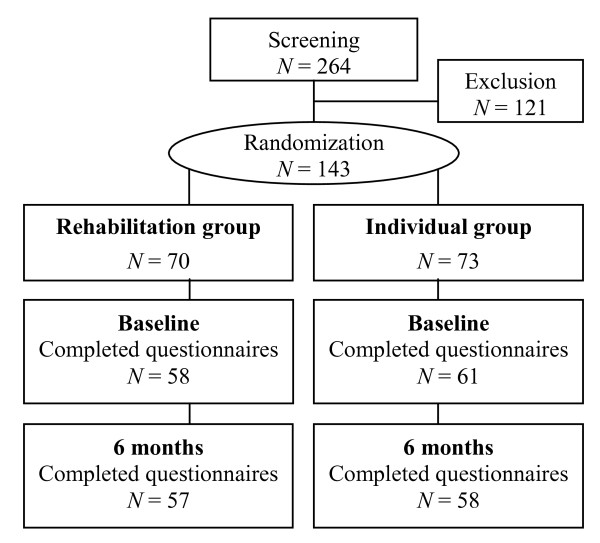
We randomised 143 type 2 diabetes patients to either a six-month multidisciplinary group-based rehabilitation programme including patient education, supervised exercise and a cooking-course or a six-month individual counselling programme. HRQOL was measured by Medical Outcomes Study Short Form 36-item Health Survey (SF-36) and self-rated health was measured by Diabetes Symptom Checklist - Revised (DCS-R).
In both groups, the lowest estimated mean scores of the SF36 questionnaire at baseline were "vitality" and "general health". There were no significant differences in the change of any item between the two groups after the six-month intervention period. However, vitality-score increased 5.2 points (p = 0.12) within the rehabilitation group and 5.6 points (p = 0.03) points among individual counselling participants.In both groups, the highest estimated mean scores of the DSC-R questionnaire at baseline were "Fatigue" and "Hyperglycaemia". Hyperglycaemic and hypoglycaemic distress decreased significantly after individual counselling than after group-based rehabilitation (difference -0.3 points, p = 0.04). No between-group differences occurred for any other items. However, fatigue distress decreased 0.40 points within the rehabilitation group (p = 0.01) and 0.34 points within the individual counselling group (p < 0.01). In the rehabilitation group cardiovascular distress decreased 0.25 points (p = 0.01).
A group-based rehabilitation programme did not improve health-related quality of life and self-rated health more than an individual counselling programme. In fact, the individual group experienced a significant relief in hyper- and hypoglycaemic distress compared with the rehabilitation group.However, the positive findings of several items in both groups indicate that lifestyle intervention is an important part of the management of type 2 diabetes patients.
2 型糖尿病会严重影响患者的健康相关生活质量和自我健康评估。大多数情况下,评估糖尿病干预措施的效果主要关注血糖控制,很少考虑生活质量。本研究的目的是研究基于小组的康复治疗与个体咨询对 2 型糖尿病患者健康相关生活质量(HRQOL)和自我健康评估的影响。
我们将 143 名 2 型糖尿病患者随机分为 6 个月的多学科小组康复计划组,该计划包括患者教育、监督锻炼和烹饪课程,或 6 个月的个体咨询计划组。采用医疗结局研究简表 36 项健康调查(SF-36)评估 HRQOL,采用糖尿病症状清单修订版(DCS-R)评估自我健康评估。
在两组中,SF36 问卷的最低估计平均基线得分均为“活力”和“总体健康”。在 6 个月的干预期后,两组之间任何项目的变化均无显着差异。然而,康复组的活力评分增加了 5.2 分(p = 0.12),个体咨询组增加了 5.6 分(p = 0.03)。在两组中,DCS-R 问卷的最高估计平均基线得分均为“疲劳”和“高血糖”。个体咨询后,高血糖和低血糖困扰明显低于小组康复(差值 -0.3 分,p = 0.04)。其他任何项目均无组间差异。然而,康复组的疲劳困扰降低了 0.40 分(p = 0.01),个体咨询组降低了 0.34 分(p < 0.01)。在康复组中,心血管困扰降低了 0.25 分(p = 0.01)。
小组康复计划并未比个体咨询计划更能改善健康相关生活质量和自我健康评估。实际上,个体组与康复组相比,高血糖和低血糖困扰明显减轻。然而,两组中多个项目的积极发现表明,生活方式干预是 2 型糖尿病患者管理的重要组成部分。