Centre for Research on Professional Learning & Development, Corporate Training and Lifelong Learning, University of Leuven, Dekenstraat 2, Box 3773, 3000 Leuven, Belgium.
Perspect Med Educ. 2012 Aug;1(3):104-18. doi: 10.1007/s40037-012-0018-z. Epub 2012 Jun 15.
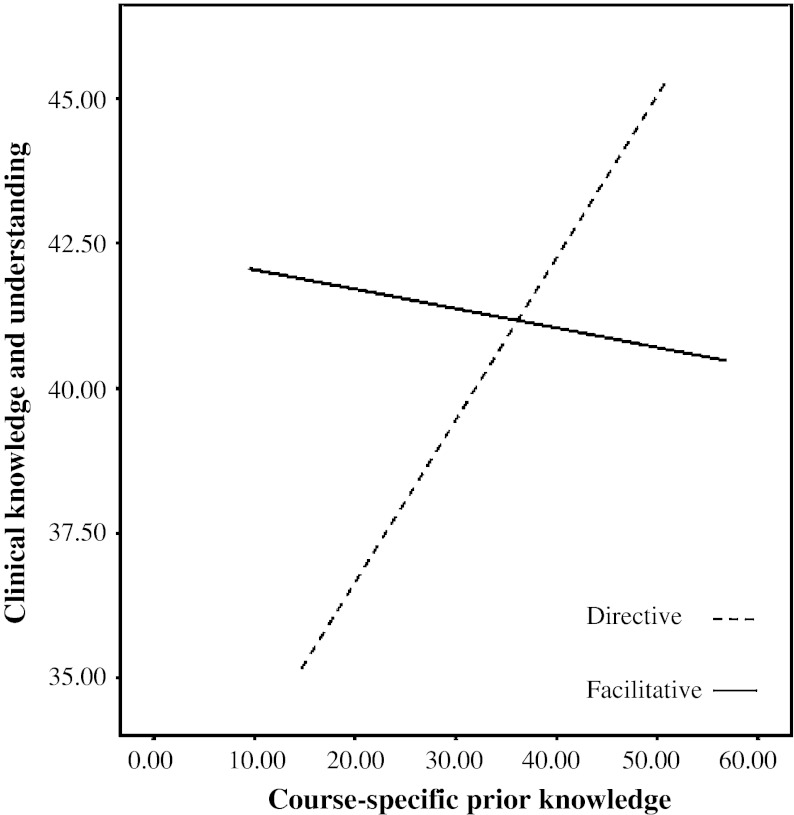
Over the years, many medical school curricula have started implementing diverse student-centred teaching and learning methodologies. Previous studies, however, have indicated that students prefer more traditional and directive methodologies instead, raising questions on which training approach should be advocated. This study contrasts the effects of a student-centred (i.e. facilitative) training approach on students' clinical skills learning with students' perceptions. More specifically, a quasi-experimental study was set up in which students experienced either a directive or facilitative training approach. Data were collected by means of an OSCE on the one hand, and a questionnaire on students' perceptions of the training sessions, and two open-ended questions about students' likes and dislikes on the other hand. While no general differences were found in terms of clinical knowledge and understanding, and actual clinical performance, an interaction between students' course-specific prior knowledge and the training approach was found. Especially students with low levels of knowledge benefited more from the facilitative training approach in terms of clinical knowledge, while highly knowledgeable students experienced a negative effect of this training approach. Moreover, students' perceptions revealed that facilitative-trained students reported more deep-level learning, while the directive training approach turned out to score higher in terms of quality and perceived effects.
多年来,许多医学院校的课程已经开始实施多样化的以学生为中心的教学方法。然而,之前的研究表明,学生更喜欢更传统和直接的教学方法,这引发了关于应该提倡哪种培训方法的问题。本研究对比了以学生为中心(即促进式)的培训方法对学生临床技能学习的影响及其学生的感知。更具体地说,进行了一项准实验研究,其中学生体验了直接或促进式培训方法。一方面,通过 OSCE 收集数据,另一方面,通过问卷调查学生对培训课程的看法,以及关于学生喜欢和不喜欢的两个开放式问题。虽然在临床知识和理解以及实际临床表现方面没有发现一般差异,但在学生的课程特定先验知识和培训方法之间发现了一种相互作用。特别是知识水平较低的学生从促进式培训方法中获益更多,因为他们在临床知识方面表现更好,而知识渊博的学生则受到这种培训方法的负面影响。此外,学生的感知表明,接受促进式培训的学生报告了更多的深度学习,而直接式培训方法在质量和感知效果方面得分更高。