School of Medicine and Public Health, University of Wisconsin, Madison, WI, USA.
J Appl Clin Med Phys. 2013 Jan 7;14(1):3991. doi: 10.1120/jacmp.v14i1.3991.
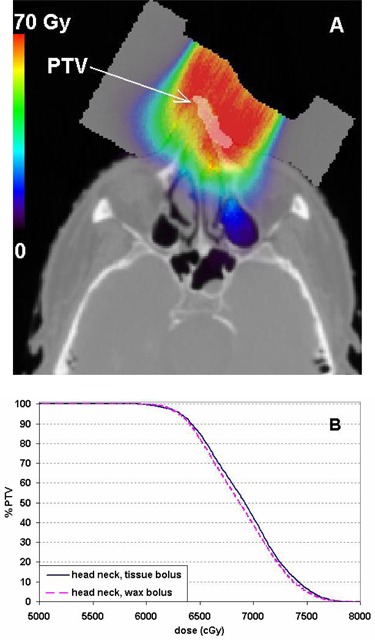
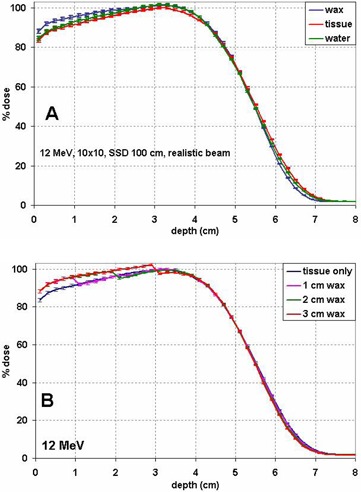
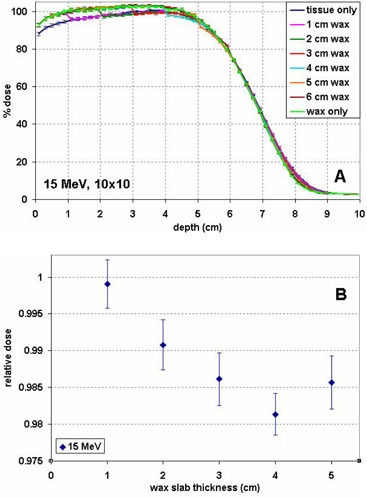
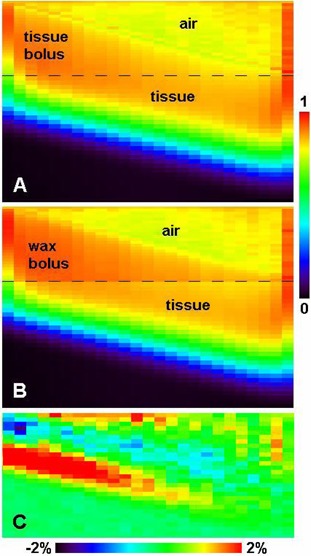
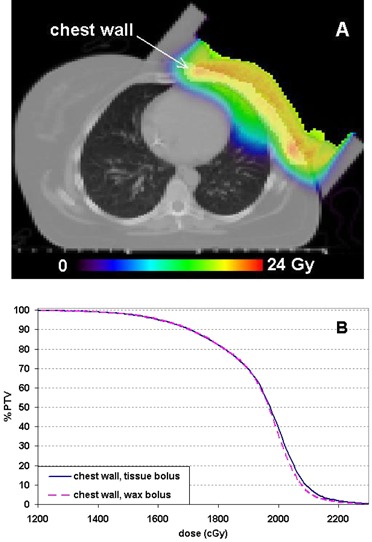
With CT-based Monte Carlo (MC) dose calculations, material composition is often assigned based on the standard Hounsfield unit ranges. This is known as the density threshold method. In bolus electron conformal therapy (BolusECT), the bolus material, machineable wax, would be assigned as soft tissue and the electron density is assumed equivalent to soft tissue based on its Hounsfield unit. This study investigates the dose errors introduced by this material assignment. BEAMnrc was used to simulate electron beams from a Trilogy accelerator. SPRRZnrc was used to calculate stopping power ratios (SPR) of tissue to wax, SPR (tissue) (wax), and tissue to water, SPR(tissue) (water), for 6, 9, 12, 15, and 18 MeV electron beams, of which 12 and 15MeV beams are the most commonly used energies in BolusECT. DOSXYZnrc was applied in dose distribution calculations in a tissue phantom with either flat wax slabs of various thicknesses or a wedge-shaped bolus on top. Dose distribution for two clinical cases, a chest wall and a head and neck, were compared with the bolus material treated as wax or tissue. The SPR(tissue) (wax) values for 12 and 15MeV beams are between 0.935 and 0.945, while the SPR(tissue) (water) values are between 0.990 and 0.991. For a 12 MeV beam, the dose in tissue immediately under the bolus is overestimated by 2.5% for a 3 cm bolus thickness if the wax bolus is treated as tissue. For 15 MeV beams, the error is 1.4%. However, in both clinical cases the differences in the PTV DVH is negligible. Due to stopping power differences, dose differences of up to 2.5% are observed in MC simulations if the bolus material is misassigned as tissue in BolusECT dose calculations. However, for boluses thinner than 2 cm that are more likely encountered in practice, the error is within clinical tolerance.
基于 CT 的蒙特卡罗(MC)剂量计算,材料组成通常根据标准的亨氏单位范围进行分配。这被称为密度阈值法。在电子适形束热塑成形治疗(BolusECT)中,热塑成形材料,可机加工蜡,被分配为软组织,并且根据其亨氏单位假设电子密度与软组织等效。本研究调查了这种材料分配引起的剂量误差。BEAMnrc 用于模拟来自 Trilogy 加速器的电子束。SPRZnrc 用于计算组织与蜡的阻止本领比(SPR)、组织与水的阻止本领比(SPR(tissue)(water)),用于 6、9、12、15 和 18 MeV 电子束,其中 12 和 15 MeV 束是 BolusECT 中最常用的能量。DOSXYZnrc 应用于具有不同厚度的平板蜡片或楔形热塑成形物的组织体模中的剂量分布计算。将两个临床病例,一个是胸壁,另一个是头颈部,的剂量分布与将热塑成形物作为蜡或组织处理的情况进行了比较。12 和 15 MeV 束的 SPR(tissue)(wax)值在 0.935 到 0.945 之间,而 SPR(tissue)(water)值在 0.990 到 0.991 之间。对于 12 MeV 束,如果将 3 cm 厚的蜡块作为组织处理,热塑成形物下方组织中的剂量将高估 2.5%。对于 15 MeV 束,误差为 1.4%。然而,在这两个临床病例中,PTV DVH 的差异可以忽略不计。由于阻止本领的差异,如果在 BolusECT 剂量计算中错误地将热塑成形物材料分配为组织,MC 模拟中会观察到高达 2.5%的剂量差异。然而,对于在实践中更可能遇到的厚度小于 2 cm 的热塑成形物,误差在临床可接受范围内。