Department of Health Sciences, Purdue University, West Lafayette, IN 47907-2051, USA.
J Appl Clin Med Phys. 2013 Jan 7;14(1):3993. doi: 10.1120/jacmp.v14i1.3993.
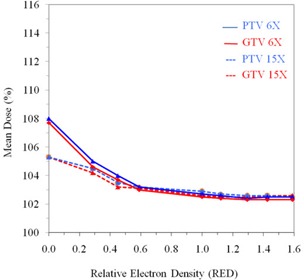
The use of rectal balloon in radiotherapy of prostate cancer is shown to be effective in reducing prostate motion and minimizing rectal volume, thus reducing rectal toxicity. Air-filled rectal balloon has been used most commonly, but creates dose perturbation at the air-tissue interface. In this study, we evaluate the effects of rectal balloon-filling materials on the dose distribution to the target and organs at risk. The dosimetric impact of rectal balloon filling was studied in detail for a typical prostate patient, and the general effect of the balloon filling was investigated from a study of ten prostate patients covering a wide range of anterior-posterior and left-right separations, as well as rectal and bladder volumes. Hounsfield units (HU) of the rectal balloon filling was changed from -1000 HU to 1000 HU at an interval of 250 HU, and the corresponding changes in the relative electron density (RED) was calculated. For each of the HU of the rectal balloon filling, a seven-field IMRT plan was generated with 6 MV and 15 MV photon beams, respectively. Dosimetric evaluation was performed with the AAA algorithm for inhomogeneity corrections. A detailed study of the rectal balloon filling shows that the GTV, PTV, rectal, and bladder mean dose decreased with increasing values of RED in the rectal balloon. There is significant underdosage in the target volume at the rectum-prostate interface with an air-filled balloon as compared to that with a water-filled balloon for both 6 MV and 15 MV beams. While the dosimetric effect of the rectal balloon filling is reduced when averaged over ten patients, generally an air-filled balloon results in lower minimum dose and lower mean dose in the overlap region (and possibly the PTV) compared to those produced by water-filled or contrast-filled balloons. Dose inhomogeneity in the target volume is increased with an air-filled rectal balloon. Thus a water-filled or contrast-filled rectal balloon is preferred to an air-filled rectal balloon in EBRT of prostate treatment.
直肠气囊在前列腺癌放射治疗中的应用被证明能有效减少前列腺运动和最小化直肠体积,从而降低直肠毒性。最常使用充气式直肠气囊,但在气-组织界面会产生剂量干扰。在这项研究中,我们评估了直肠气囊填充材料对靶区和危及器官剂量分布的影响。我们详细研究了直肠气囊填充对典型前列腺患者的剂量影响,并通过对十名前列腺患者的研究,研究了气囊填充的一般影响,这些患者涵盖了广泛的前后和左右分离以及直肠和膀胱体积。直肠气囊填充的亨氏单位(HU)从-1000 HU 以 250 HU 的间隔增加到 1000 HU,相应的相对电子密度(RED)变化也被计算出来。对于直肠气囊填充的每个 HU,分别使用 6 MV 和 15 MV 光子束生成了七个场的调强放射治疗计划。剂量评估使用 AAA 算法进行不均匀性校正。对直肠气囊填充的详细研究表明,随着直肠气囊中 RED 值的增加,GTV、PTV、直肠和膀胱平均剂量都降低了。与水填充气囊相比,空气填充气囊在直肠-前列腺界面的靶区体积存在显著的剂量不足。虽然对十名患者进行平均处理会降低直肠气囊填充的剂量效应,但一般来说,与水填充或对比剂填充气囊相比,空气填充气囊会导致更低的最小剂量和重叠区域(可能还有 PTV)的平均剂量。目标体积的剂量不均匀性随着充气式直肠气囊的使用而增加。因此,在前列腺治疗的 EBRT 中,水填充或对比填充的直肠气囊优于空气填充的直肠气囊。