Minneapolis Radiation Oncology, Minneapolis, MN, USA.
J Appl Clin Med Phys. 2013 Jan 2;14(1):4066. doi: 10.1120/jacmp.v14i1.4066.
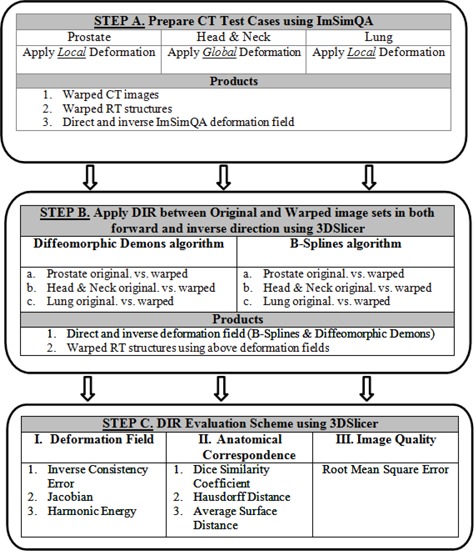
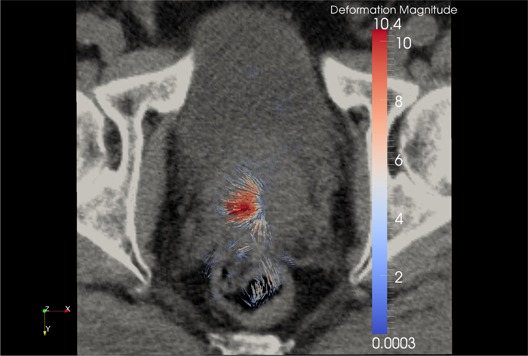
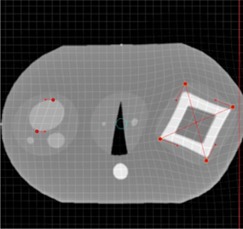
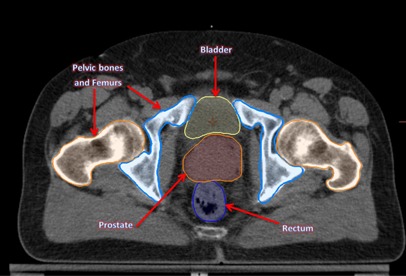
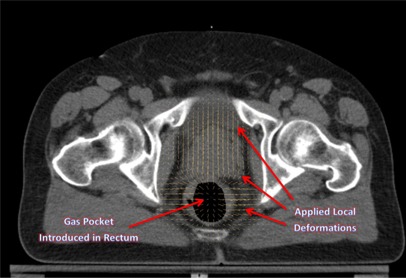
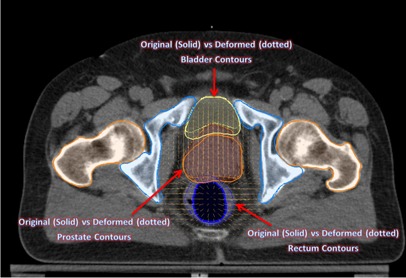
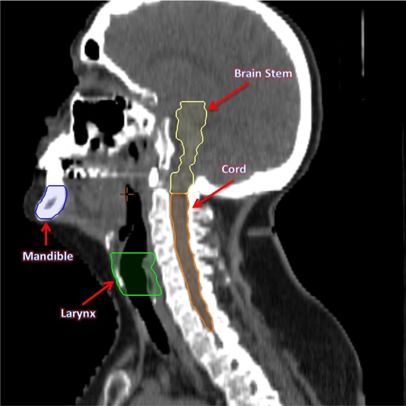
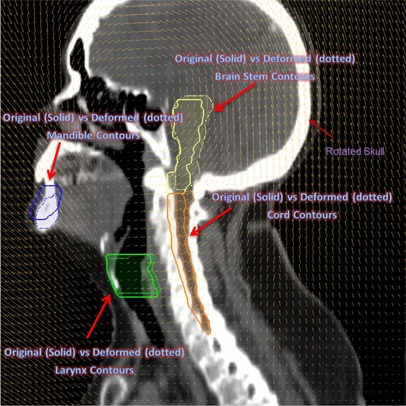
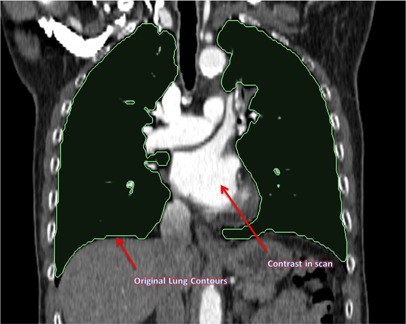
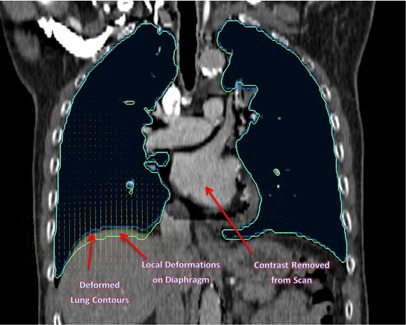
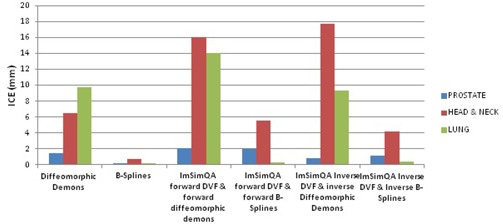
Quantitative validation of deformable image registration (DIR) algorithms is extremely difficult because of the complexity involved in constructing a deformable phantom that can duplicate various clinical scenarios. The purpose of this study is to describe a framework to test the accuracy of DIR based on computational modeling and evaluating using inverse consistency and other methods. Three clinically relevant organ deformations were created in prostate (distended rectum and rectal gas), head and neck (large neck flexion), and lung (inhale and exhale lung volumes with variable contrast enhancement) study sets. DIR was performed using both B-spline and diffeomorphic demons algorithms in the forward and inverse direction. A compositive accumulation of forward and inverse deformation vector fields was done to quantify the inverse consistency error (ICE). The anatomical correspondence of tumor and organs at risk was quantified by comparing the original RT structures with those obtained after DIR. Further, the physical characteristics of the deformation field, namely the Jacobian and harmonic energy, were computed to quantify the preservation of image topology and regularity of spatial transformation obtained in DIR. The ICE was comparable in prostate case but the B-spline algorithm had significantly better anatomical correspondence for rectum and prostate than diffeomorphic demons algorithm. The ICE was 6.5 mm for demons algorithm for head and neck case when compared to 0.7 mm for B-spline. Since the induced neck flexion was large, the average Dice similarity coefficient between both algorithms was only 0.87, 0.52, 0.81, and 0.67 for tumor, cord, parotids, and mandible, respectively. The B-spline algorithm accurately estimated deformations between images with variable contrast in our lung study, while diffeomorphic demons algorithm led to gross errors on structures affected by contrast variation. The proposed framework offers the application of known deformations on any image datasets, to evaluate the overall accuracy and limitations of a DIR algorithm used in radiation oncology. The evaluation based on anatomical correspondence, physical characteristics of deformation field, and image characteristics can facilitate DIR verification with the ultimate goal of implementing adaptive radiotherapy. The suitability of application of a particular evaluation metric in validating DIR is dependent on the clinical deformation observed.
定量验证形变图像配准(DIR)算法极其困难,因为构建能够复制各种临床场景的可变形体模非常复杂。本研究旨在描述一种基于计算建模测试 DIR 准确性的框架,并使用反向一致性和其他方法进行评估。在前列腺(扩张的直肠和直肠气体)、头颈部(大颈部弯曲)和肺部(吸气和呼气时具有不同对比增强的肺容积)研究集中创建了三个具有临床相关性的器官变形。在正向和反向方向上使用 B 样条和非刚性 demons 算法进行 DIR。对正向和反向变形矢量场进行综合积累,以量化反向一致性误差(ICE)。通过将原始 RT 结构与 DIR 后获得的结构进行比较,量化肿瘤和危险器官的解剖对应关系。此外,还计算了变形场的物理特性,即雅可比行列式和调和能量,以量化 DIR 中获得的图像拓扑和空间变换规则性的保持。在前列腺病例中,ICE 是可比的,但 B 样条算法在直肠和前列腺方面的解剖对应关系明显优于非刚性 demons 算法。在头颈部病例中,demons 算法的 ICE 为 6.5mm,而 B 样条算法的 ICE 为 0.7mm。由于诱导的颈部弯曲较大,两种算法之间的平均 Dice 相似系数分别为肿瘤、脊髓、腮腺和下颌骨的 0.87、0.52、0.81 和 0.67。B 样条算法准确估计了我们肺部研究中具有不同对比度的图像之间的变形,而非刚性 demons 算法导致受对比度变化影响的结构出现严重误差。所提出的框架提供了在任何图像数据集上应用已知变形的应用,以评估在放射肿瘤学中使用的 DIR 算法的整体准确性和局限性。基于解剖对应关系、变形场物理特性和图像特性的评估可以促进 DIR 验证,最终目标是实现自适应放疗。特定评估指标在验证 DIR 中的适用性取决于观察到的临床变形。