Pediatric Oncology Branch, Center for Cancer Research, National Cancer Institute, Bethesda, MD, USA.
Oncogene. 2013 Nov 21;32(47):5429-38. doi: 10.1038/onc.2012.590. Epub 2013 Jan 14.
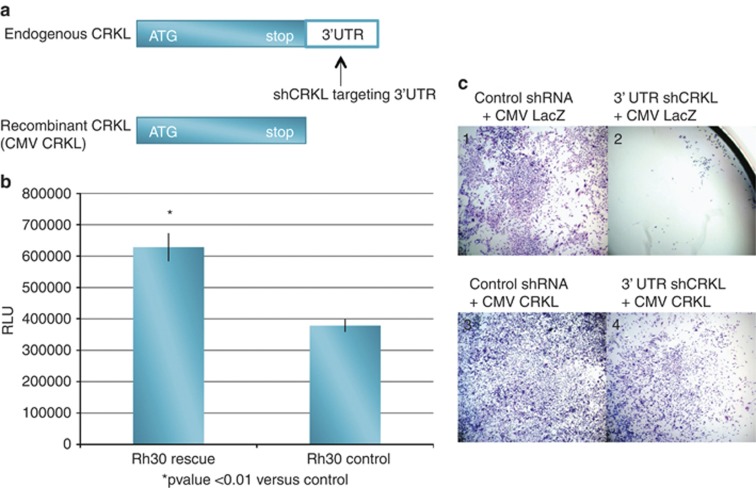
To identify novel signaling pathways necessary for rhabdomyosarcoma (RMS) survival, we performed a loss-of-function screen using an inducible small hairpin RNA (shRNA) library in an alveolar and an embryonal RMS cell line. This screen identified CRKL expression as necessary for growth of alveolar RMS and embryonal RMS both in vitro and in vivo. We also found that CRKL was uniformly highly expressed in both RMS cell lines and tumor tissue. As CRKL is a member of the CRK adapter protein family that contains an SH2 and two SH3 domains and is involved in signal transduction from multiple tyrosine kinase receptors, we evaluated CRKL interaction with multiple tyrosine kinase receptor signaling pathways in RMS cells. While we saw no interaction of CRKL with IGFIR, MET or PI3KAKT/mTOR pathways, we determined that CRKL signaling was associated with SRC family kinase (SFK) signaling, specifically with YES kinase. Inhibition of SFK signaling with dasatinib or another SFK inhibitor, sarcatinib, suppressed RMS cell growth in vitro and in vivo. These data identify CRKL as a novel critical component of RMS growth. This study also demonstrates the use of functional screening to identify a potentially novel therapeutic target and treatment approach for these highly aggressive pediatric cancers.
为了鉴定横纹肌肉瘤(RMS)生存所必需的新信号通路,我们使用诱导型短发夹 RNA(shRNA)文库在肺泡和胚胎 RMS 细胞系中进行了功能丧失筛选。该筛选发现 CRKL 表达对于肺泡 RMS 和胚胎 RMS 的体外和体内生长都是必需的。我们还发现 CRKL 在两种 RMS 细胞系和肿瘤组织中均高度表达。由于 CRKL 是包含 SH2 和两个 SH3 结构域的 CRK 衔接蛋白家族的成员,并且参与来自多个酪氨酸激酶受体的信号转导,因此我们评估了 CRKL 在 RMS 细胞中与多个酪氨酸激酶受体信号通路的相互作用。虽然我们没有看到 CRKL 与 IGFIR、MET 或 PI3KAKT/mTOR 通路相互作用,但我们确定 CRKL 信号与 SRC 家族激酶(SFK)信号有关,特别是与 YES 激酶有关。用达沙替尼或另一种 SFK 抑制剂 sarcatinib 抑制 SFK 信号会抑制 RMS 细胞的体外和体内生长。这些数据将 CRKL 鉴定为 RMS 生长的新的关键组成部分。本研究还证明了使用功能筛选来鉴定这些高度侵袭性儿科癌症的潜在新治疗靶点和治疗方法。