Slaughter Laurel A, Patel Anup D, Slaughter Jonathan L
Division of Child Neurology, Nationwide Children's Hospital, Columbus, OH 43205, USA.
J Child Neurol. 2013 Mar;28(3):351-64. doi: 10.1177/0883073812470734. Epub 2013 Jan 14.
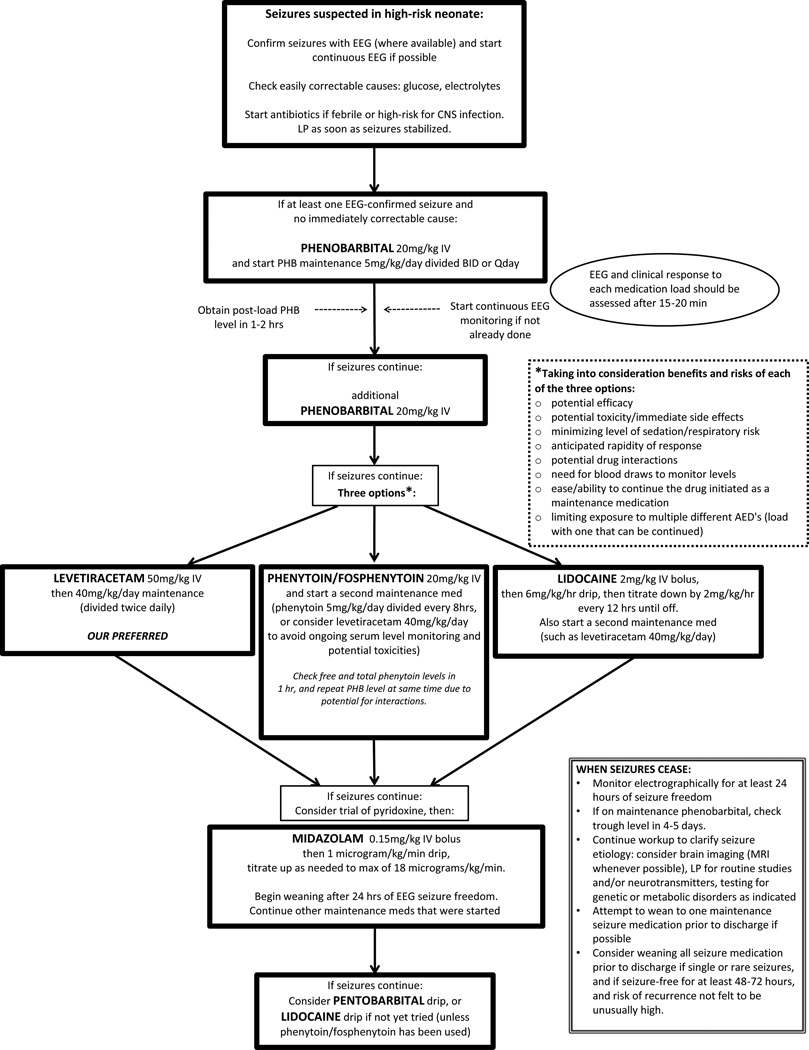
Pharmacologic treatment options for neonatal seizures have expanded over the past 2 decades, and there is no consensus on optimal treatment strategy. We systematically reviewed the published literature to determine which medication(s) are most effective for treating neonatal seizures, by retrieving trials and observational investigations via PubMed (through August 2011) that focused on pharmacological seizure treatment of neonates (≤ 28 days old) and utilized continuous or amplitude-integrated EEG to confirm seizure diagnosis and cessation. Our search identified 557 initial articles and 14 additional studies after reference reviews, with 16 meeting inclusion criteria. Of these, 2 were randomized trials and only 3 additional investigations included comparison groups. We found limited evidence regarding the best pharmacologic treatment for neonatal seizures, but were able to devise a treatment algorithm from available data. These findings have the potential to serve as a clinical reference and to inform the design of comparative effectiveness investigations for neonatal antiepileptics.
在过去20年里,新生儿惊厥的药物治疗选择有所增加,但对于最佳治疗策略尚无共识。我们系统回顾了已发表的文献,通过检索PubMed(截至2011年8月)上的试验和观察性研究,以确定哪种药物对治疗新生儿惊厥最有效,这些研究聚焦于新生儿(≤28日龄)的药物性惊厥治疗,并利用连续或振幅整合脑电图来确认惊厥的诊断和停止。我们的检索在参考文献回顾后确定了557篇初始文章和14项其他研究,其中16项符合纳入标准。其中,2项为随机试验,另外只有3项研究包括比较组。我们发现关于新生儿惊厥最佳药物治疗的证据有限,但能够根据现有数据制定一种治疗方案。这些发现有可能作为临床参考,并为新生儿抗癫痫药物的比较疗效研究设计提供信息。