Department of Pediatrics, University of Washington School of Medicine, Seattle.
Department of Pediatrics, University of Louisville School of Medicine, Norton Children's Medical Group-Neonatology, Louisville, Kentucky.
JAMA Netw Open. 2024 Oct 1;7(10):e2441372. doi: 10.1001/jamanetworkopen.2024.41372.
Results of clinical trials can only represent included participants, and many neonatal trials fail due to insufficient participation. Infants not included in research may differ from those included in meaningful ways, biasing the sample and limiting the generalizability of findings.
To describe the proportion of eligible infants included in neonatal clinical trials and the reasons for noninclusion.
A systematic search of Cochrane CENTRAL was performed by retrieving articles meeting the following inclusion criteria: full-length, peer-reviewed articles describing clinical trial results in at least 20 human infants from US neonatal intensive care units, published in English, and added to Cochrane CENTRAL between 2017 and 2022. Retrieved articles were screened for inclusion by 2 independent researchers.
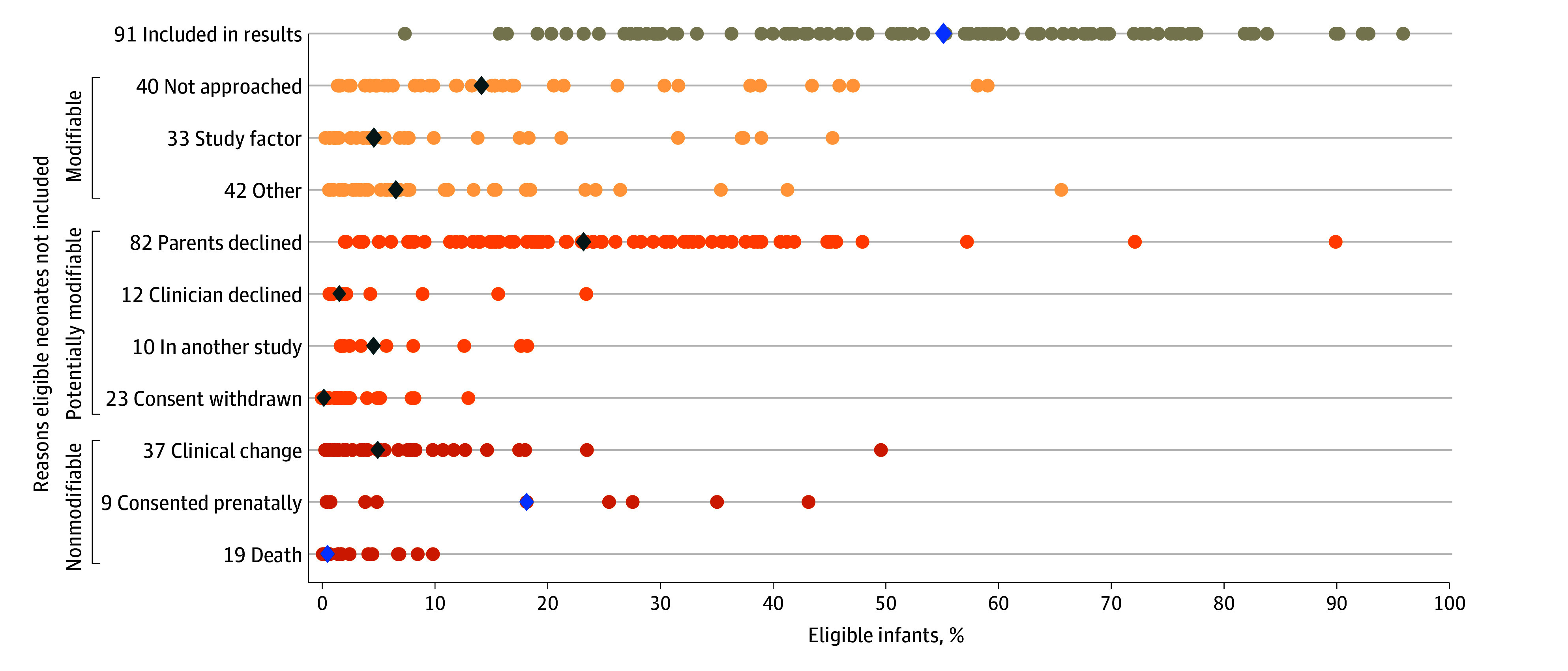
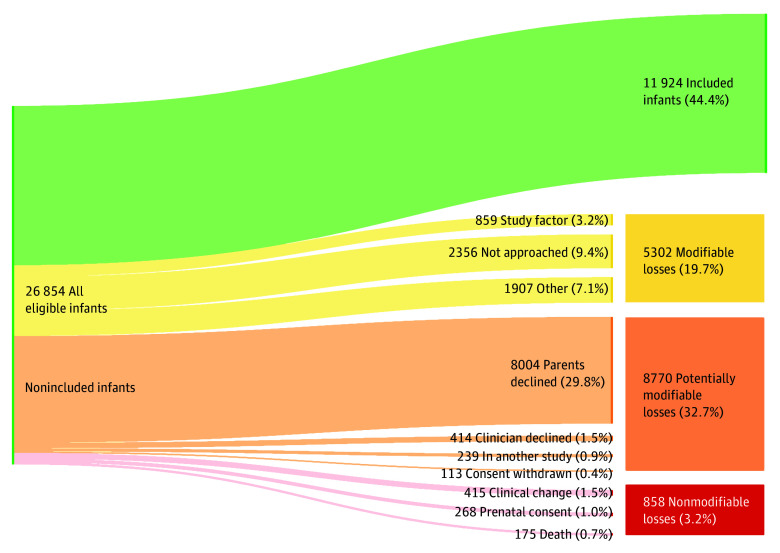
In total 120 articles met inclusion criteria and 91 of these (75.8%) reported the number of infants eligible for participation, which totaled 26 854 in aggregate. Drawing from these, an aggregate of 11 924 eligible infants (44.4%) were included in reported results. Among all eligible infants, most reasons for noninclusion in results were classified as modifiable or potentially modifiable by the research team. Parents declining to participate (8004 infants [29.8%]) or never being approached (2507 infants [9.3%]) were the 2 predominant reasons for noninclusion. Other modifiable reasons included factors related to study logistics, such as failure to appropriately collect data on enrolled infants (859 of 26 854 infants [3.2%]) and other reasons (1907 of 26 854 infants [7.1%]), such as loss to follow-up or eligible participants that were unaccounted for. Nonmodifiable reasons, including clinical change or death, accounted for a small proportion of eligible infants who were not included (858 of 26 854 infants [3.2%]).
This systematic review of reporting on eligible infants included and not included in neonatal clinical trials highlights the need for improved documentation on the flow of eligible infants through neonatal clinical trials and may also inform recruitment expectations for trialists designing future protocols. Improved adherence to standardized reporting may clarify which potential participants are being missed, improving understanding of the generalizability of research findings. Furthermore, these findings suggest that future work to understand why parents decline to participate in neonatal research trials and why some are never approached about research may help increase overall participation.
临床试验的结果只能代表纳入的参与者,许多新生儿试验因参与不足而失败。未纳入研究的婴儿可能与纳入研究的婴儿在重要方面存在差异,从而使样本产生偏差,并限制研究结果的普遍性。
描述纳入新生儿临床试验的合格婴儿的比例以及未纳入的原因。
通过检索符合以下纳入标准的全文同行评审文章,在 Cochrane CENTRAL 中进行了系统搜索:至少有 20 名来自美国新生儿重症监护病房的人类婴儿的临床试验结果的全长、同行评审文章,以英文发表,并在 2017 年至 2022 年期间添加到 Cochrane CENTRAL 中。由 2 名独立研究人员筛选纳入的文章。
共有 120 篇文章符合纳入标准,其中 91 篇(75.8%)报告了参与人数,总计 26854 人。从中得出,共有 11924 名合格婴儿(44.4%)被纳入报告结果。在所有合格婴儿中,研究团队认为大多数未纳入结果的原因是可修改或可能修改的。父母拒绝参与(8004 名婴儿[29.8%])或从未被接触(2507 名婴儿[9.3%])是未纳入的两个主要原因。其他可修改的原因包括与研究物流相关的因素,例如未能适当收集入组婴儿的数据(26854 名婴儿中的 859 名[3.2%])和其他原因(26854 名婴儿中的 1907 名[7.1%]),例如失访或未被纳入的合格参与者。不可修改的原因,包括临床变化或死亡,在未纳入的合格婴儿中占很小的比例(26854 名婴儿中的 858 名[3.2%])。
对纳入和未纳入新生儿临床试验的合格婴儿的报告进行的系统审查强调了需要改进对合格婴儿在新生儿临床试验中的流动情况的记录,并可能为设计未来方案的试验人员提供有关招募的预期。更好地遵守标准化报告可能会更清楚地了解哪些潜在参与者被遗漏,从而更好地了解研究结果的普遍性。此外,这些发现表明,未来的工作需要了解为什么父母拒绝参与新生儿研究试验,以及为什么有些父母从未被提及研究,这可能有助于提高整体参与率。