Vossel Simone, Mathys Christoph, Daunizeau Jean, Bauer Markus, Driver Jon, Friston Karl J, Stephan Klaas E
Wellcome Trust Centre for Neuroimaging, University College London, WC1N 3BG London, UK.
Cereb Cortex. 2014 Jun;24(6):1436-50. doi: 10.1093/cercor/bhs418. Epub 2013 Jan 14.
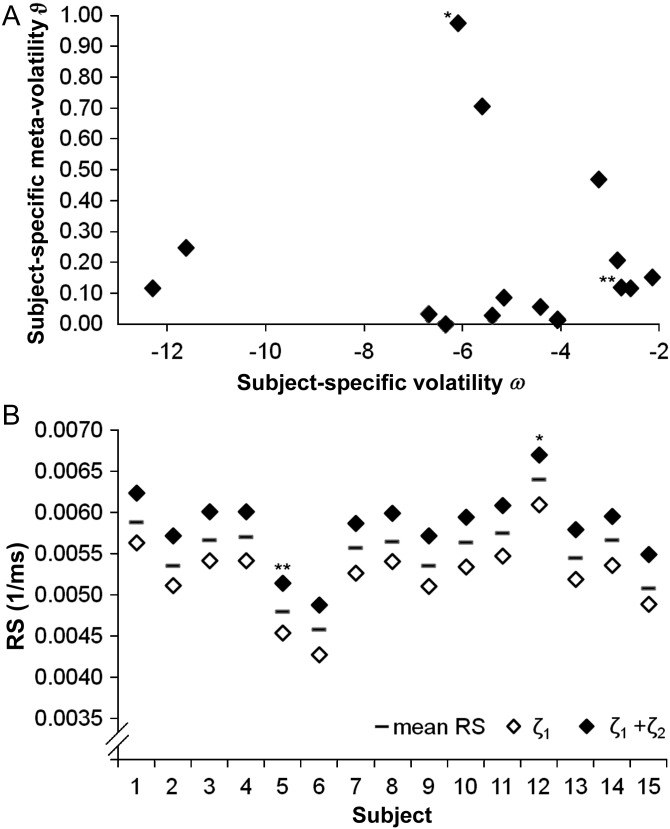
Inferring the environment's statistical structure and adapting behavior accordingly is a fundamental modus operandi of the brain. A simple form of this faculty based on spatial attentional orienting can be studied with Posner's location-cueing paradigm in which a cue indicates the target location with a known probability. The present study focuses on a more complex version of this task, where probabilistic context (percentage of cue validity) changes unpredictably over time, thereby creating a volatile environment. Saccadic response speed (RS) was recorded in 15 subjects and used to estimate subject-specific parameters of a Bayesian learning scheme modeling the subjects' trial-by-trial updates of beliefs. Different response models-specifying how computational states translate into observable behavior-were compared using Bayesian model selection. Saccadic RS was most plausibly explained as a function of the precision of the belief about the causes of sensory input. This finding is in accordance with current Bayesian theories of brain function, and specifically with the proposal that spatial attention is mediated by a precision-dependent gain modulation of sensory input. Our results provide empirical support for precision-dependent changes in beliefs about saccade target locations and motivate future neuroimaging and neuropharmacological studies of how Bayesian inference may determine spatial attention.
推断环境的统计结构并据此调整行为是大脑的一种基本运作方式。基于空间注意定向的这种能力的一种简单形式可以通过波斯纳的位置提示范式进行研究,在该范式中,一个提示以已知概率指示目标位置。本研究聚焦于该任务的一个更复杂版本,其中概率背景(提示有效性百分比)随时间不可预测地变化,从而创造出一个不稳定的环境。记录了15名受试者的扫视反应速度(RS),并用于估计贝叶斯学习方案中特定于受试者的参数,该方案模拟了受试者逐次试验的信念更新。使用贝叶斯模型选择比较了不同的反应模型——指定计算状态如何转化为可观察行为。扫视RS最合理的解释是作为对感觉输入原因的信念精度的函数。这一发现与当前关于脑功能的贝叶斯理论一致,特别是与空间注意由感觉输入的精度依赖增益调制介导的提议一致。我们的结果为关于扫视目标位置的信念中依赖精度的变化提供了实证支持,并推动了未来关于贝叶斯推理如何确定空间注意的神经成像和神经药理学研究。