Department of Medicine, State University of New York Health Science Center at Brooklyn, Brooklyn, NY, USA.
Diabet Med. 2013 Jun;30(6):687-93. doi: 10.1111/dme.12132. Epub 2013 Mar 7.
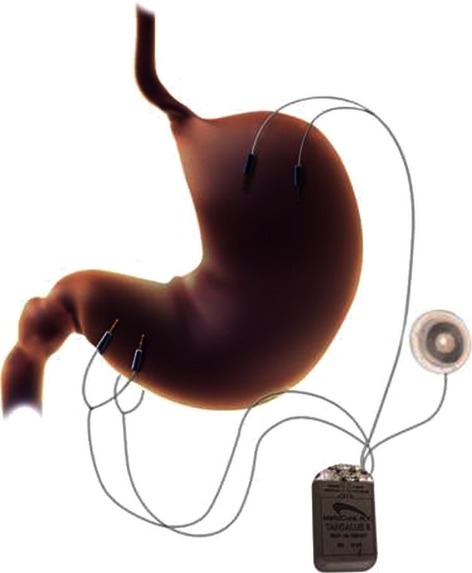
Non-stimulatory, meal-mediated electrical stimulation of the stomach (TANTALUS-DIAMOND) improves glycaemic control and causes modest weight loss in patients with Type 2 diabetes who are inadequately controlled on oral anti-diabetic medications. The magnitude of the glycaemic response in clinical studies has been variable. A preliminary analysis of data from patients who had completed 6 months of treatment indicated that the glycaemic response to the electrical stimulation was inversely related to the baseline fasting plasma triglyceride level.
An analysis of 40 patients who had had detailed longitudinal studies for 12 months.
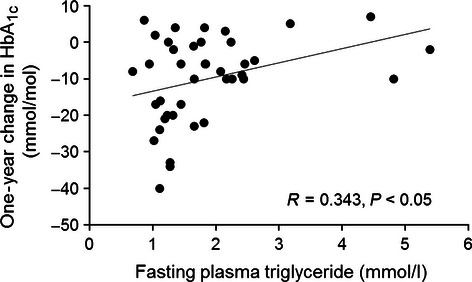
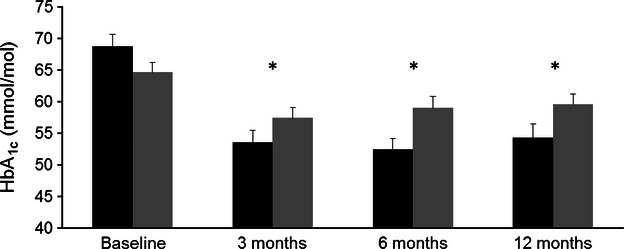
Twenty-two patients with fasting plasma triglycerides ≤ 1.7 mmol/l had mean decreases in HbA1c after 3, 6 and 12 months of gastric contraction modulation treatment of -15 ± 2.1 mmol/mol (-1.39 ± 0.20%), -16 ± 2.2 mmol/mol (-1.48 ± 0.20%) and -14 ± 3.0 mmol/mol (-1.31 ± 0.26%), respectively. In contrast, 18 patients with fasting plasma triglyceride > 1.7 mmol/l had mean decreases in HbA1c of -7 ± 1.7 mmol/mol (-0.66 ± 0.16%), -5 ± 1.6 mmol/mol (-0.44 ± 0.18%) and -5 ± 1.7 mmol/mol (-0.42 ± 0.16%), respectively. Pearson's correlation coefficient between fasting plasma triglyceride and decreases in HbA1c at 12 months of treatment was 0.34 (P < 0.05). Homeostasis model assessment of insulin resistance was unchanged during 12 months of treatment in patients with high baseline fasting triglycerides, while it progressively improved in patients with low fasting plasma triglycerides. Patients with low fasting plasma triglycerides had a tendency to lose more weight than those with high fasting plasma triglycerides, but this did not achieve statistical significance.
The data presented suggest the existence of a triglyceride lipotoxic mechanism that interferes with gastric/neural mediated pathways that can regulate glycaemic control in patients with type 2 diabetes. The data suggest the existence of a triglyceride lipotoxic pathway that interferes with gastric/neural mediated pathways that can regulate glycaemic control.
非刺激性、进餐介导的胃电刺激(TANTALUS-DIAMOND)可改善血糖控制,并使口服降糖药物控制不佳的 2 型糖尿病患者体重适度减轻。临床研究中的血糖反应幅度各不相同。对已完成 6 个月治疗的患者数据的初步分析表明,电刺激的血糖反应与基线空腹血浆甘油三酯水平呈负相关。
对 40 例接受了 12 个月详细纵向研究的患者进行分析。
22 例空腹血浆甘油三酯≤1.7mmol/l 的患者,在接受胃收缩调节治疗 3、6 和 12 个月后,HbA1c 平均降低 -15±2.1mmol/mol(-1.39±0.20%)、-16±2.2mmol/mol(-1.48±0.20%)和-14±3.0mmol/mol(-1.31±0.26%)。相比之下,18 例空腹血浆甘油三酯>1.7mmol/l 的患者,HbA1c 平均降低 -7±1.7mmol/mol(-0.66±0.16%)、-5±1.6mmol/mol(-0.44±0.18%)和-5±1.7mmol/mol(-0.42±0.16%)。治疗 12 个月时,空腹血浆甘油三酯与 HbA1c 降低之间的 Pearson 相关系数为 0.34(P<0.05)。基线空腹甘油三酯较高的患者在 12 个月的治疗期间,胰岛素抵抗的稳态模型评估没有变化,而空腹血浆甘油三酯较低的患者则逐渐改善。空腹血浆甘油三酯较低的患者体重减轻的趋势大于空腹血浆甘油三酯较高的患者,但无统计学意义。
目前的数据表明,存在一种甘油三酯脂毒性机制,干扰可调节 2 型糖尿病患者血糖控制的胃/神经介导途径。数据表明存在一种甘油三酯脂毒性途径,干扰可调节血糖控制的胃/神经介导途径。