Department of Computing, Imperial College London, London, United Kingdom.
BMC Genomics. 2013 Jan 16;14:35. doi: 10.1186/1471-2164-14-35.
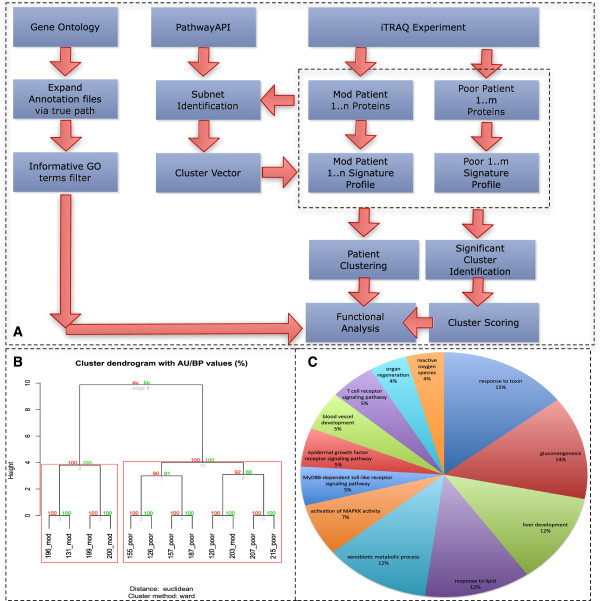
Proteomics Signature Profiling (PSP) is a novel hit-rate based method that proved useful in resolving consistency and coverage issues in proteomics. As a follow-up study, several points need to be addressed: 1/ PSP's generalisability to pathways, 2/ understanding the biological interplay between significant complexes and pathway subnets co-located on the same pathways on our liver cancer dataset, 3/ understanding PSP's false positive rate and 4/ demonstrating that PSP works on other suitable proteomics datasets as well as expanding PSP's analytical resolution via the use of specialised ontologies.
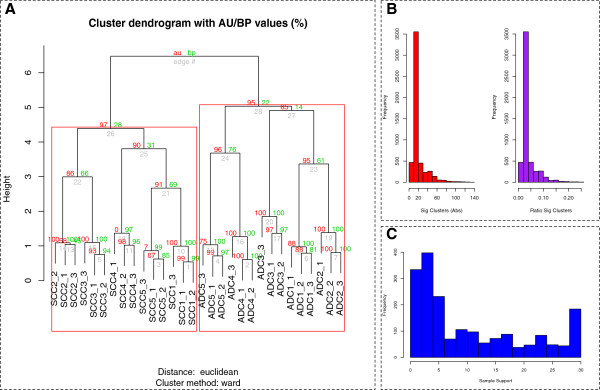
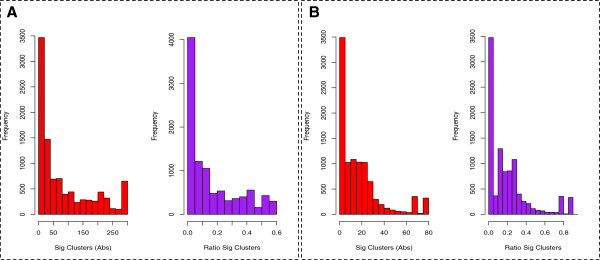
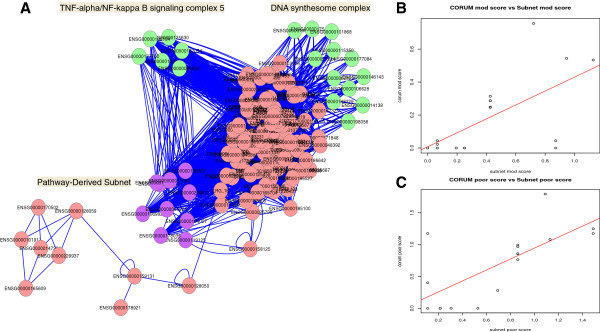
1/ PSP performs well with Pathway-Derived Subnets (PDSs). Comparing the performance of PDSs derived from various pathway databases, we find that an integrative approach is best for optimising analytical resolution. Feature selection also confirms that significant PDSs are closely connected to the cancer phenotype.2/ In liver cancer, correlation studies of significant PSP complexes and PDSs co-localised on the same pathways revealed an interesting relationship between the purine metabolism pathway and two other complexes involved in DNA repair. Our work suggests progression to poor stage requires additional mutations that disrupt DNA repair enzymes.3/ False positive analysis reveals that PSP, applied on both complexes and PDSs, is powerful and precise.4/ Via an expert-curated lipid ontology, we uncovered several interesting lipid-associated complexes that could be associated with cancer progression. Of particular interest is the HMGB1-HMGB2-HSC70-ERP60-GAPDH complex which is also involved in DNA repair. We also demonstrated generalisability of PSP using a non-small-cell lung carcinoma data set.
PSP is a powerful and precise technique, capable of identifying biologically coherent features. It works with biological complexes, network-predicted clusters as well as PDSs. Here, an instance of the interplay between significant PDSs and complexes, possibly significantly involved in liver cancer progression but not well understood as yet, is demonstrated. Also demonstrated is the enhancement of PSP's analytical resolution using specialised ontologies.
蛋白质组学特征分析(PSP)是一种基于命中率的新方法,已被证明在解决蛋白质组学中的一致性和覆盖范围问题方面非常有用。作为后续研究,需要解决以下几个问题:1/ PSP 对途径的泛化能力,2/ 理解我们肝癌数据集上位于同一途径的显著复合物和途径子网之间的生物学相互作用,3/ 了解 PSP 的假阳性率,4/ 证明 PSP 也适用于其他合适的蛋白质组学数据集,并通过使用专门的本体扩展 PSP 的分析分辨率。
1/ PSP 在途径衍生子网(PDS)上表现良好。通过比较来自各种途径数据库的 PDS 的性能,我们发现综合方法是优化分析分辨率的最佳方法。特征选择还证实,显著的 PDS 与癌症表型密切相关。2/ 在肝癌中,对位于同一途径上的显著 PSP 复合物和 PDS 进行相关性研究,发现嘌呤代谢途径与另外两个涉及 DNA 修复的复合物之间存在有趣的关系。我们的工作表明,进展到不良阶段需要额外的突变来破坏 DNA 修复酶。3/ 假阳性分析表明,应用于复合物和 PDS 的 PSP 既强大又精确。4/ 通过专家 curated 的脂质本体,我们发现了几个与癌症进展相关的有趣脂质相关复合物。特别有趣的是 HMGB1-HMGB2-HSC70-ERP60-GAPDH 复合物,它也参与 DNA 修复。我们还使用非小细胞肺癌数据集证明了 PSP 的通用性。
PSP 是一种强大而精确的技术,能够识别具有生物学一致性的特征。它适用于生物复合物、网络预测的聚类以及 PDS。在这里,展示了显著的 PDS 和复合物之间相互作用的实例,这些复合物可能在肝癌进展中起着重要作用,但尚未得到很好的理解。还展示了使用专门的本体来增强 PSP 的分析分辨率。