Department of Biomedical Engineering, Eindhoven University of Technology, Eindhoven, The Netherlands.
Nucleus. 2013 Jan-Feb;4(1):61-73. doi: 10.4161/nucl.23388. Epub 2013 Jan 1.
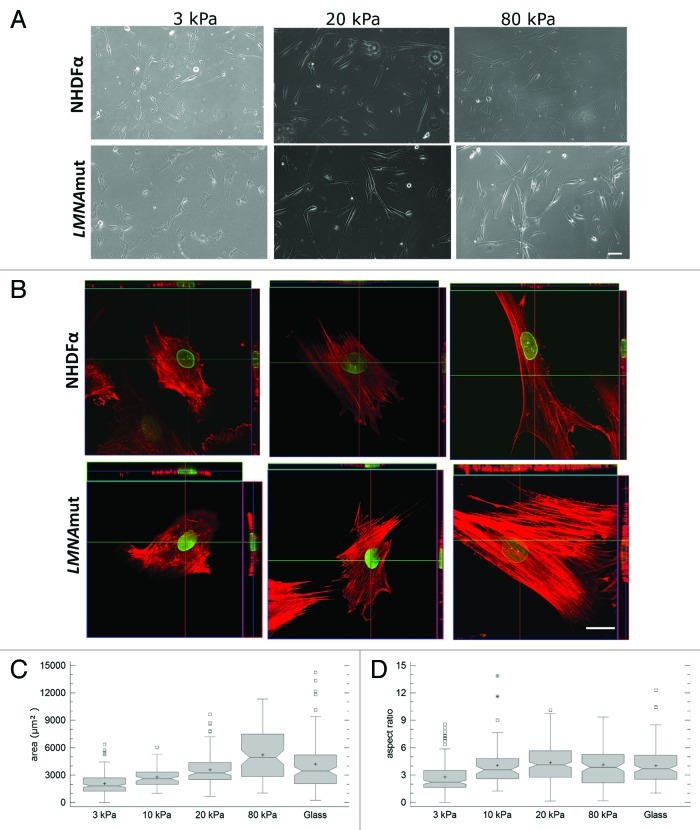
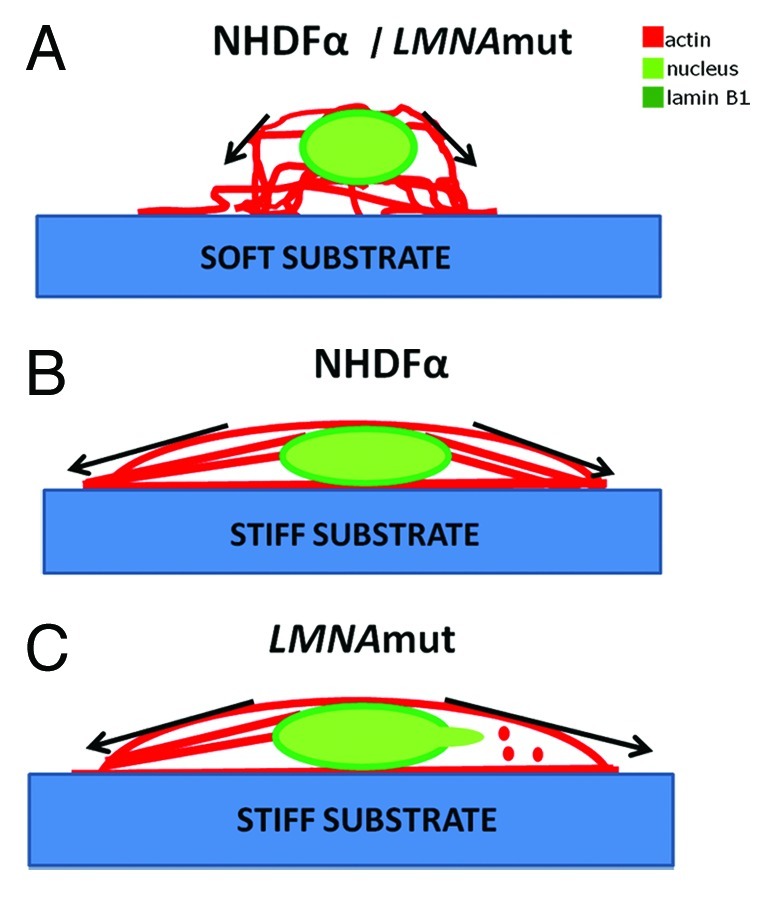
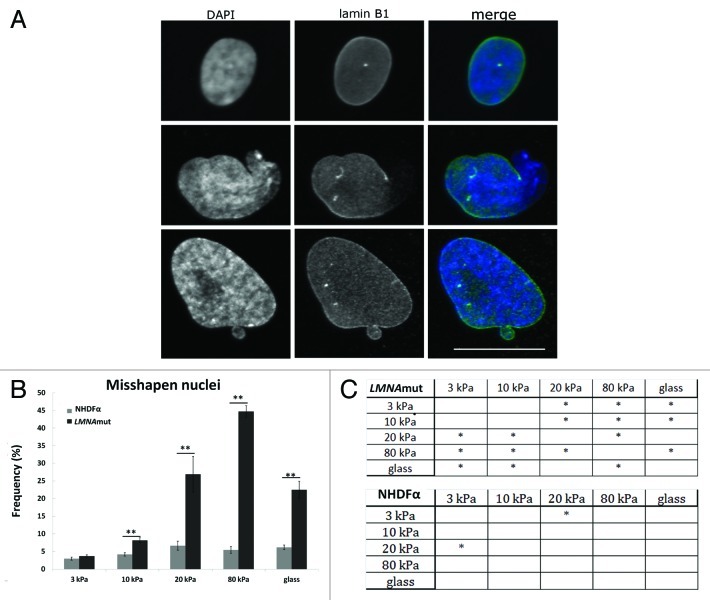
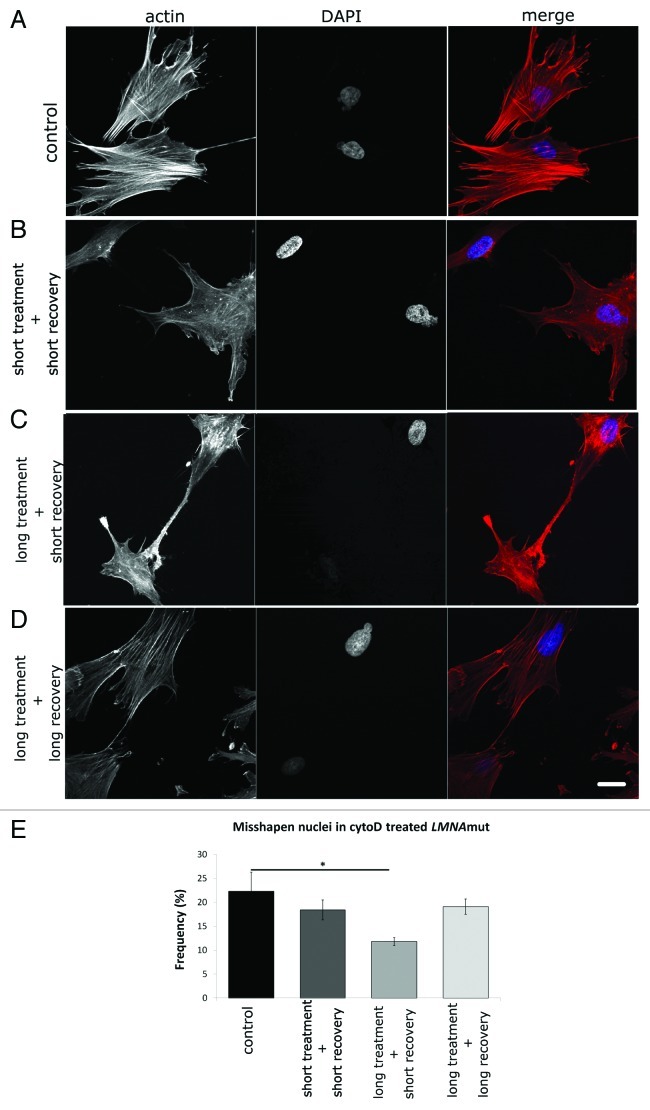
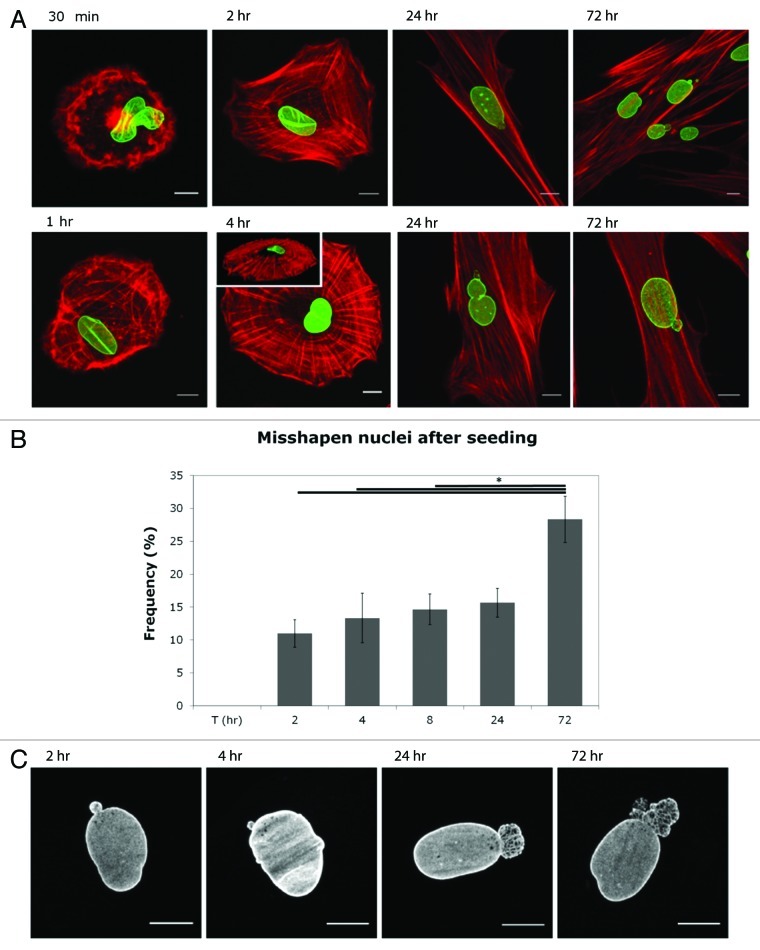
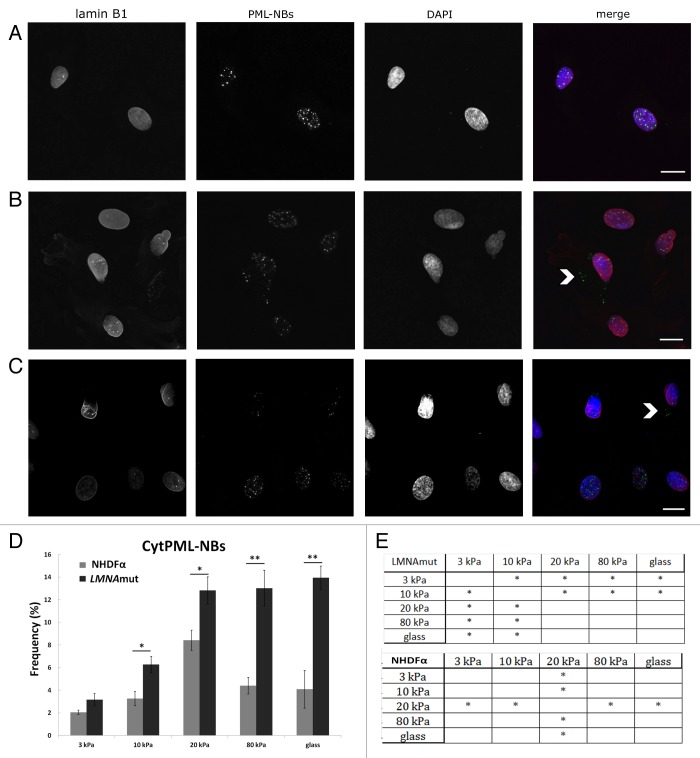
Laminopathies, mainly caused by mutations in the LMNA gene, are a group of inherited diseases with a highly variable penetrance; i.e., the disease spectrum in persons with identical LMNA mutations range from symptom-free conditions to severe cardiomyopathy and progeria, leading to early death. LMNA mutations cause nuclear abnormalities and cellular fragility in response to cellular mechanical stress, but the genotype/phenotype correlations in these diseases remain unclear. Consequently, tools such as mutation analysis are not adequate for predicting the course of the disease. Here, we employ growth substrate stiffness to probe nuclear fragility in cultured dermal fibroblasts from a laminopathy patient with compound progeroid syndrome. We show that culturing of these cells on substrates with stiffness higher than 10 kPa results in malformations and even rupture of the nuclei, while culture on a soft substrate (3 kPa) protects the nuclei from morphological alterations and ruptures. No malformations were seen in healthy control cells at any substrate stiffness. In addition, analysis of the actin cytoskeleton organization in this laminopathy cells demonstrates that the onset of nuclear abnormalities correlates to an increase in cytoskeletal tension. Together, these data indicate that culturing of these LMNA mutated cells on substrates with a range of different stiffnesses can be used to probe the degree of nuclear fragility. This assay may be useful in predicting patient-specific phenotypic development and in investigations on the underlying mechanisms of nuclear and cellular fragility in laminopathies.
核纤层病主要由 LMNA 基因突变引起,是一组具有高度变异性外显率的遗传性疾病;即,具有相同 LMNA 突变的个体的疾病谱从无症状到严重的心肌病和进行性衰老,导致早逝。LMNA 突变导致核异常和细胞脆弱性,以响应细胞机械应激,但这些疾病中的基因型/表型相关性尚不清楚。因此,突变分析等工具不足以预测疾病的进程。在这里,我们使用生长基质的刚度来探测来自具有复合进行性衰老综合征的核纤层病患者的培养皮肤成纤维细胞的核脆弱性。我们表明,将这些细胞培养在刚度高于 10 kPa 的基质上会导致核畸形甚至破裂,而在柔软的基质(3 kPa)上培养会保护核免受形态改变和破裂的影响。在任何基质刚度下,健康对照细胞均未出现畸形。此外,对这些核纤层病细胞中肌动蛋白细胞骨架组织的分析表明,核异常的发生与细胞骨架张力的增加相关。总之,这些数据表明,用不同刚度范围的基质培养这些 LMNA 突变细胞可用于探测核脆弱性的程度。该测定法可用于预测患者特定的表型发展,并可用于研究核纤层病中核和细胞脆弱性的潜在机制。