Department of Clinical Sciences, Faculty of Medicine and Health Sciences, Universiti Tunku Abdul Rahman, Sungai Long, Malaysia.
BMC Infect Dis. 2013 Jan 17;13:16. doi: 10.1186/1471-2334-13-16.
Knowledge about symptoms and transmission of tuberculosis determines health seeking behavior and helps in prevention of tuberculosis transmission in the community. Such data is useful for policy makers to formulate information, education and communication strategies for tuberculosis control.
A secondary data analysis of India demographic and health survey, 2005/6 was carried out. Questions about self-reported tuberculosis, transmission and curability of tuberculosis were analysed. Correct knowledge (without misconceptions) about tuberculosis transmission was used as a dependant variable and the explanatory variables tested were: demographic data, education, wealth quintiles, frequency of exposure to media and the curability of tuberculosis. Determinants of correct knowledge without misconceptions were tested by univariate and multivariate analyses using national weighting factor to adjust for complex sampling design.
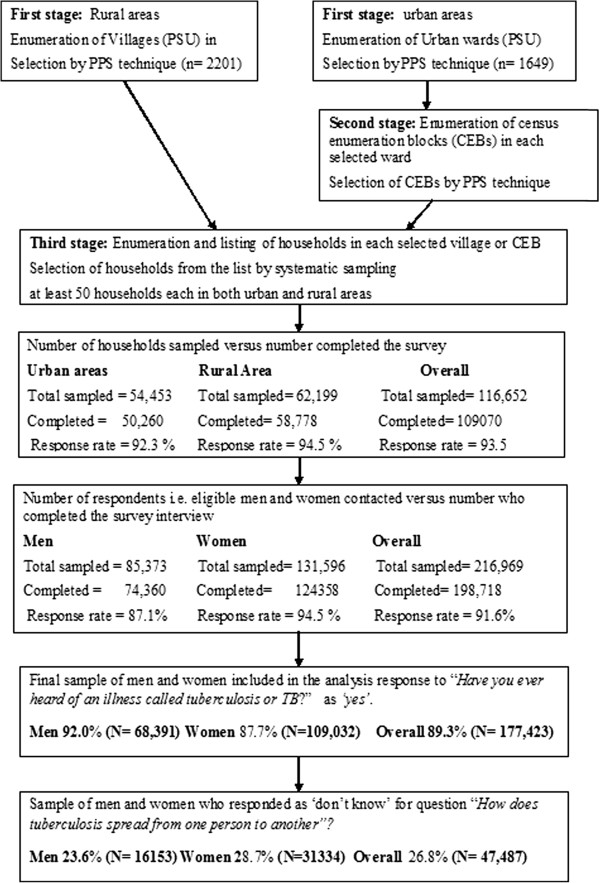
A total of 109,070 households (response rate of 93.5%) and 198,718 participants (response rate of 91.6%) completed the survey. The samples of men and women interviewed were 74,360 and 124,358 respectively. Prevalence rate of self-reported tuberculosis was 445 per 100,000 usual household residents and 4.60 per 1,000 participants. The number of respondents who had "heard of an illness called tuberculosis" was 177,423 (89.3%). Of these 47,487 (26.8%) participants did not know and 55.5% knew about the correct mode of tuberculosis transmission i.e. "Through the air when coughing or sneezing". The common misconceptions about transmission were "Through food" (32.4%), "Sharing utensils" (18.2%), and "Touching a person with tuberculosis" (12.3%). Only 52,617 (29.7%) participants had correct knowledge without misconceptions. Being male (aOR 1.17, 95% CIs 1.14, 1.21), being a Hindu (aOR 1.20, 95% CIs 1.14, 1.26) or Muslim (aOR 1.26, 95% CIs 1.18, 1.34), listening to radio (aOR 1.08, 95% CIs 1.04, 1.13) and "Tuberculosis can be cured" (aOR 1.47, 95% CIs 1.41, 1.53) were associated with correct knowledge without misconceptions.
Knowledge about tuberculosis transmission is very poor and misconceptions still exist. Among the traditional mass media, the frequency of listening to radio was associated with correct knowledge about tuberculosis transmission. Strategies to deliver information, education and communication campaigns could be improved.
对结核病症状和传播途径的了解决定了患者的求医行为,并有助于在社区中预防结核病的传播。此类数据对决策者制定结核病控制方面的信息、教育和交流策略很有用。
对印度 2005/6 年人口与健康调查的二次数据分析。分析了关于自我报告的结核病、结核病传播和可治愈性的问题。将对结核病传播没有误解的正确知识(无误解)用作因变量,测试的解释变量为:人口统计学数据、教育、财富五分位数、媒体接触频率和结核病的可治愈性。使用全国加权因子调整复杂抽样设计,通过单变量和多变量分析来测试无误解的正确知识的决定因素。
共有 109070 户家庭(回应率为 93.5%)和 198718 名参与者(回应率为 91.6%)完成了调查。接受采访的男性和女性样本分别为 74360 人和 124358 人。自我报告的结核病患病率为每 100000 名常住居民 445 例,每 1000 名参与者 4.60 例。有“听说过一种叫做结核病的疾病”的受访者人数为 177423 人(89.3%)。其中 47487 人(26.8%)不知道,55.5%知道结核病的正确传播方式,即“通过咳嗽或打喷嚏时的空气传播”。关于传播的常见误解是“通过食物”(32.4%)、“共用餐具”(18.2%)和“接触结核病患者”(12.3%)。只有 52617 人(29.7%)有正确的知识而没有误解。男性(aOR 1.17,95%CI 1.14,1.21)、印度教徒(aOR 1.20,95%CI 1.14,1.26)或穆斯林(aOR 1.26,95%CI 1.18,1.34)、听广播(aOR 1.08,95%CI 1.04,1.13)和“结核病可以治愈”(aOR 1.47,95%CI 1.41,1.53)与没有误解的正确知识有关。
对结核病传播的了解非常有限,仍然存在误解。在传统大众媒体中,收听广播的频率与结核病传播的正确知识有关。可以改进信息、教育和交流活动的提供策略。