Kenya Medical Research Institute, Nairobi, Kenya.
Sex Transm Dis. 2013 Feb;40(2):148-53. doi: 10.1097/OLQ.0b013e31827aab89.
Identifying sexually transmitted infections (STI) in HIV-infected individuals has potential to benefit individual and public health. There are few guidelines regarding routine STI screening in sub-Saharan African HIV programs. We determined sexual risk behavior and prevalence and correlates of STI in a national survey of large HIV treatment programs in Kenya.
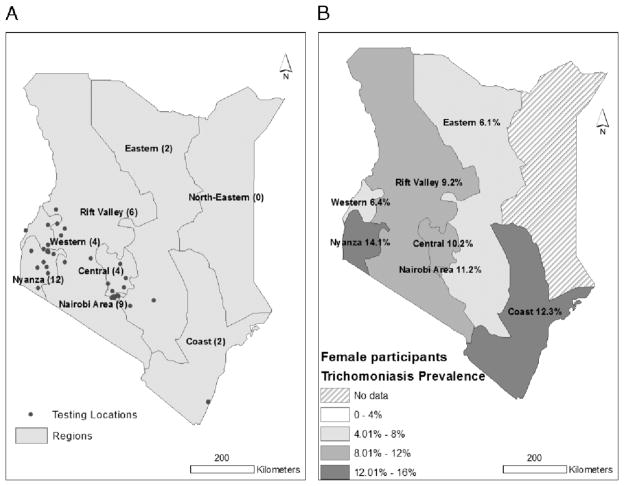
A mobile screening team visited 39 (95%) of the 42 largest HIV care programs in Kenya and enrolled participants using population-proportionate systematic sampling. Participants provided behavioral and clinical data. Genital and blood specimens were tested for trichomoniasis, gonorrhea, chlamydia, syphilis, and CD4 T-lymphocyte counts.
Among 1661 adults, 41% reported no sexual partners in the past 3 months. Among those who reported sex in the past 3 months, 63% of women reported condom use during this encounter compared with 77% of men (P < 0.001). Trichomoniasis was the most common STI in women (10.9%) and men (2.8%); prevalences of gonorrhea, chlamydia, and syphilis were low (<1%-2%). Among women, younger age (adjusted odds ratio [OR], 0.96 per year; 95% confidence interval [CI], 0.94-0.98) and primary school education or lower level (adjusted OR, 2.16; 95% CI, 1.37-3.40) were independently associated with trichomoniasis, whereas CD4 count, cotrimoxazole use, and reported condom use were not. Reported condom use at last sex was associated with reporting that the clinic provided condoms among both women (OR, 1.7; 95% CI, 1.17-2.35) and men (OR, 2.4; 95% CI, 1.18-4.82).
Women attending Kenyan HIV care programs had a 10.9% prevalence of trichomoniasis, suggesting that screening for this infection may be useful. Condom provision at clinics may enhance secondary HIV prevention efforts.
在 HIV 感染者中发现性传播感染(STI)有可能对个体和公共健康带来益处。撒哈拉以南非洲的 HIV 规划中,针对常规 STI 筛查的指南很少。我们在肯尼亚全国性的大型 HIV 治疗项目调查中,确定了性风险行为以及 STI 的流行率和相关因素。
一个移动筛查小组访问了肯尼亚 42 个最大的 HIV 护理项目中的 39 个(95%),并使用人口比例系统抽样法招募参与者。参与者提供行为和临床数据。对生殖道和血液标本进行了滴虫病、淋病、衣原体、梅毒和 CD4 淋巴细胞计数检测。
在 1661 名成年人中,41%的人报告在过去 3 个月内没有性伴侣。在过去 3 个月有过性行为的人群中,63%的女性报告在此次性行为中使用了避孕套,而男性的这一比例为 77%(P<0.001)。滴虫病是女性(10.9%)和男性(2.8%)中最常见的 STI;淋病、衣原体和梅毒的流行率较低(<1%-2%)。在女性中,年龄较小(调整后的优势比[OR],每年 0.96;95%置信区间[CI],0.94-0.98)和小学或以下教育程度(调整后的 OR,2.16;95%CI,1.37-3.40)与滴虫病独立相关,而 CD4 计数、复方磺胺甲噁唑的使用和报告的避孕套使用则没有。最后一次性行为时使用避孕套与女性(OR,1.7;95%CI,1.17-2.35)和男性(OR,2.4;95%CI,1.18-4.82)报告诊所提供避孕套有关。
在肯尼亚参加 HIV 护理项目的女性滴虫病的流行率为 10.9%,这表明筛查这种感染可能是有用的。诊所提供避孕套可能会增强二级艾滋病毒预防工作。