Biomolecular Mass Spectrometry Unit, Postbus 9600, 2300RC Leiden University Medical Center, Leiden, The Netherlands.
Mol Cell Proteomics. 2013 Apr;12(4):856-65. doi: 10.1074/mcp.R112.026005. Epub 2013 Jan 16.
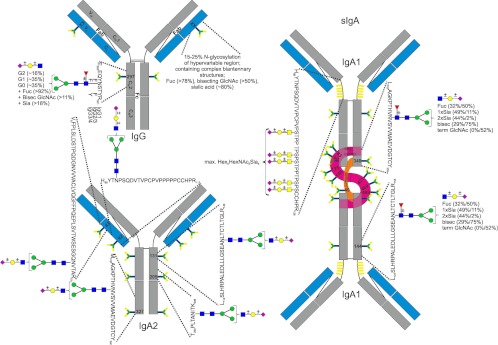
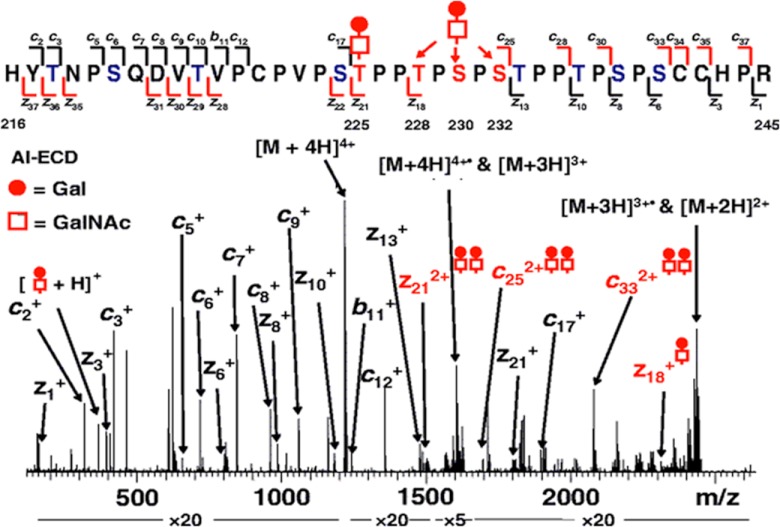
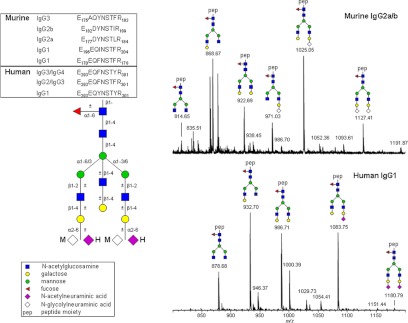
Antibody glycosylation has been shown to change with various processes. This review presents mass spectrometric approaches for antibody glycosylation analysis at the level of released glycans, glycopeptides, and intact protein. With regard to IgG fragment crystallizable glycosylation, mass spectrometry has shown its potential for subclass-specific, high-throughput analysis. In contrast, because of the vast heterogeneity of peptide moieties, fragment antigen binding glycosylation analysis of polyclonal IgG relies entirely on glycan release. Next to IgG, IgA has gained some attention, and studies of its O- and N-glycosylation have revealed disease-associated glycosylation changes. Glycoproteomic analyses of IgM and IgE are lagging behind but should complete our picture of glycosylation's influence on antibody function.
抗体糖基化已被证明会随着各种过程而改变。本综述介绍了用于分析释放聚糖、糖肽和完整蛋白质水平上抗体糖基化的质谱方法。就 IgG 片段结晶可糖化而言,质谱已显示出其用于亚类特异性、高通量分析的潜力。相比之下,由于肽部分的巨大异质性,多克隆 IgG 的片段抗原结合糖基化分析完全依赖于聚糖的释放。除了 IgG 之外,IgA 也受到了一些关注,对其 O-和 N-糖基化的研究揭示了与疾病相关的糖基化变化。IgM 和 IgE 的糖蛋白质组学分析落后,但应该完善我们对糖基化对抗体功能影响的认识。