Department of Biology, Division of Developmental Biology, University of Erlangen-Nuremberg, Erlangen, Germany.
PLoS Genet. 2013;9(1):e1003195. doi: 10.1371/journal.pgen.1003195. Epub 2013 Jan 10.
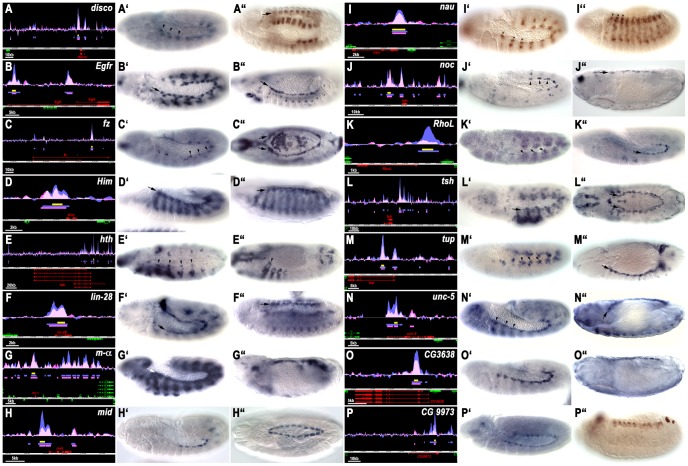
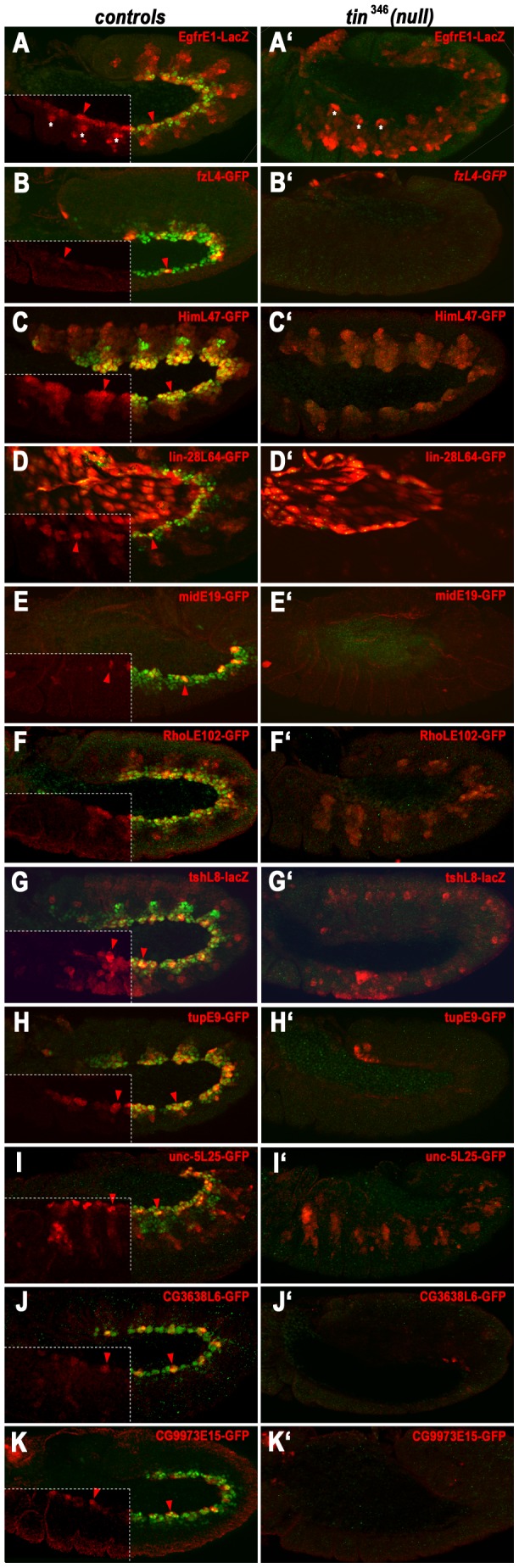
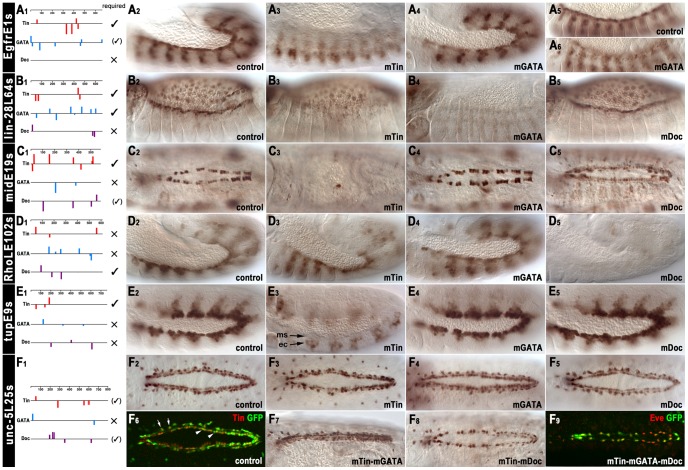
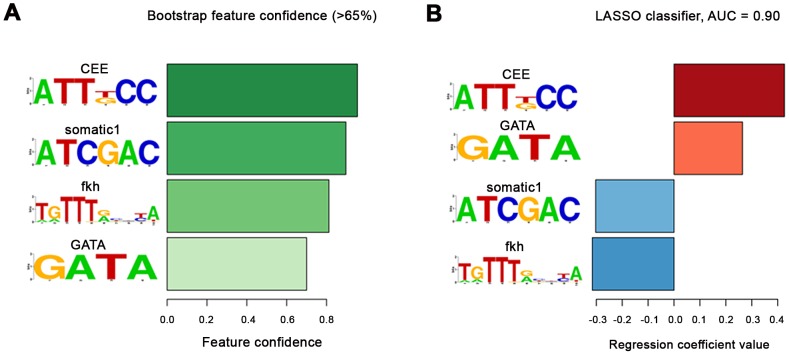
The NK homeodomain factor Tinman is a crucial regulator of early mesoderm patterning and, together with the GATA factor Pannier and the Dorsocross T-box factors, serves as one of the key cardiogenic factors during specification and differentiation of heart cells. Although the basic framework of regulatory interactions driving heart development has been worked out, only about a dozen genes involved in heart development have been designated as direct Tinman target genes to date, and detailed information about the functional architectures of their cardiac enhancers is lacking. We have used immunoprecipitation of chromatin (ChIP) from embryos at two different stages of early cardiogenesis to obtain a global overview of the sequences bound by Tinman in vivo and their linked genes. Our data from the analysis of ~50 sequences with high Tinman occupancy show that the majority of such sequences act as enhancers in various mesodermal tissues in which Tinman is active. All of the dorsal mesodermal and cardiac enhancers, but not some of the others, require tinman function. The cardiac enhancers feature diverse arrangements of binding motifs for Tinman, Pannier, and Dorsocross. By employing these cardiac and non-cardiac enhancers in machine learning approaches, we identify a novel motif, termed CEE, as a classifier for cardiac enhancers. In vivo assays for the requirement of the binding motifs of Tinman, Pannier, and Dorsocross, as well as the CEE motifs in a set of cardiac enhancers, show that the Tinman sites are essential in all but one of the tested enhancers; although on occasion they can be functionally redundant with Dorsocross sites. The enhancers differ widely with respect to their requirement for Pannier, Dorsocross, and CEE sites, which we ascribe to their different position in the regulatory circuitry, their distinct temporal and spatial activities during cardiogenesis, and functional redundancies among different factor binding sites.
NK 同源盒因子 Tinman 是早期中胚层模式形成的关键调节因子,与 GATA 因子 Pannier 和 Dorsocross T 盒因子一起,是心脏细胞特化和分化过程中关键的心脏形成因子之一。尽管调控心脏发育的基本框架已经被阐明,但迄今为止,只有大约十几个与心脏发育相关的基因被指定为直接的 Tinman 靶基因,而且它们心脏增强子的功能结构的详细信息也很缺乏。我们使用早期心脏发生的两个不同阶段的胚胎的染色质免疫沉淀(ChIP),获得了 Tinman 在体内结合的序列及其连接基因的全局概述。我们对大约 50 个具有高 Tinman 占有率的序列的分析数据表明,大多数这样的序列在 Tinman 活跃的各种中胚层组织中充当增强子。所有的背侧中胚层和心脏增强子,但不是一些其他的,都需要 tinman 功能。心脏增强子具有 Tinman、Pannier 和 Dorsocross 结合基序的不同排列。通过在机器学习方法中使用这些心脏和非心脏增强子,我们确定了一个新的基序,称为 CEE,作为心脏增强子的分类器。在体内检测 Tinman、Pannier 和 Dorsocross 的结合基序以及一组心脏增强子中 CEE 基序的要求,表明除了一个被测试的增强子之外,Tinman 位点在所有这些增强子中都是必需的;尽管它们有时可以与 Dorsocross 位点在功能上冗余。增强子在对 Pannier、Dorsocross 和 CEE 位点的要求方面差异很大,我们将其归因于它们在调控回路中的不同位置、它们在心脏发生过程中不同的时间和空间活性以及不同因子结合位点之间的功能冗余。