Department of Engineering and Public Policy, Carnegie Mellon University, Pittsburgh, Pennsylvania, USA.
PLoS One. 2013;8(1):e52971. doi: 10.1371/journal.pone.0052971. Epub 2013 Jan 9.
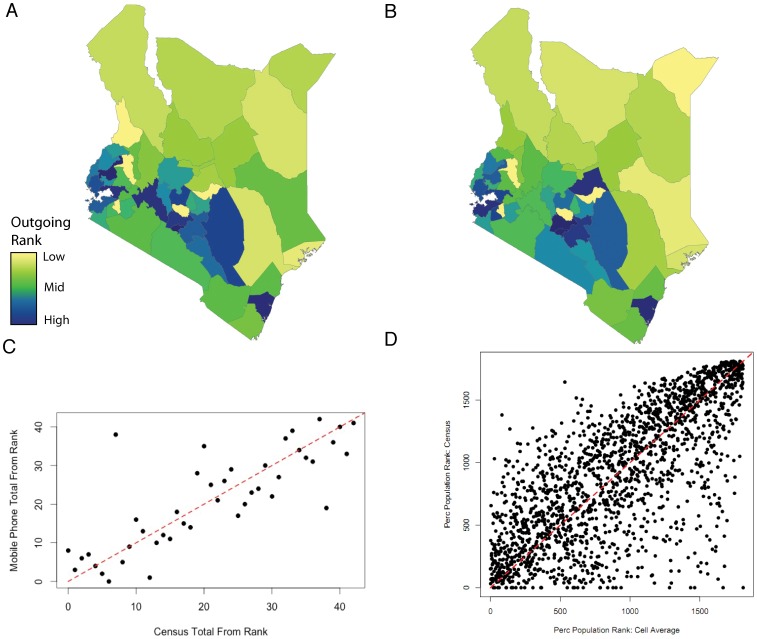
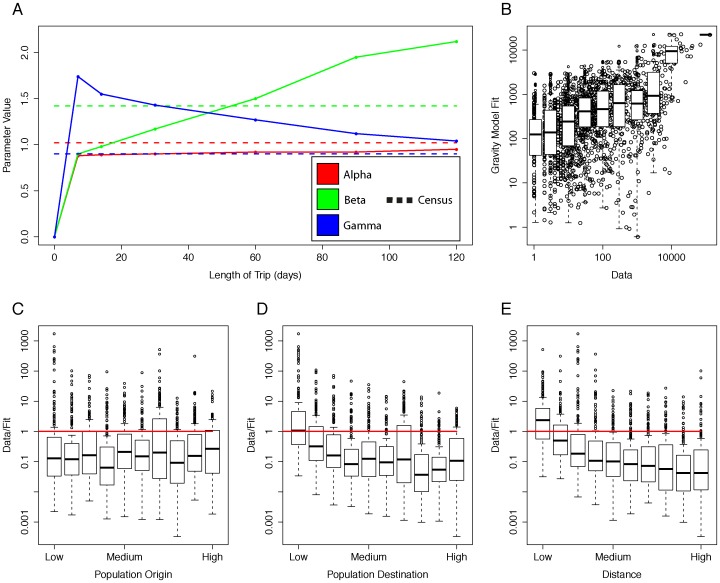
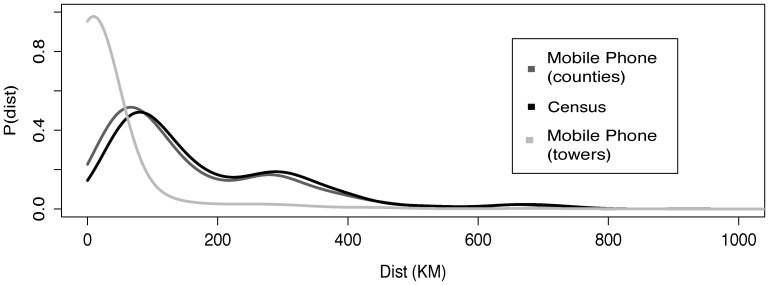
Human movement plays a key role in economies and development, the delivery of services, and the spread of infectious diseases. However, it remains poorly quantified partly because reliable data are often lacking, particularly for low-income countries. The most widely available are migration data from human population censuses, which provide valuable information on relatively long timescale relocations across countries, but do not capture the shorter-scale patterns, trips less than a year, that make up the bulk of human movement. Census-derived migration data may provide valuable proxies for shorter-term movements however, as substantial migration between regions can be indicative of well connected places exhibiting high levels of movement at finer time scales, but this has never been examined in detail. Here, an extensive mobile phone usage data set for Kenya was processed to extract movements between counties in 2009 on weekly, monthly, and annual time scales and compared to data on change in residence from the national census conducted during the same time period. We find that the relative ordering across Kenyan counties for incoming, outgoing and between-county movements shows strong correlations. Moreover, the distributions of trip durations from both sources of data are similar, and a spatial interaction model fit to the data reveals the relationships of different parameters over a range of movement time scales. Significant relationships between census migration data and fine temporal scale movement patterns exist, and results suggest that census data can be used to approximate certain features of movement patterns across multiple temporal scales, extending the utility of census-derived migration data.
人类的活动在经济和发展、服务提供以及传染病的传播中起着关键作用。然而,由于可靠的数据往往缺乏,特别是在低收入国家,其活动仍然难以被准确量化。目前最广泛使用的是人口普查中的人口迁移数据,这些数据提供了有关国家间相对长时间尺度迁移的有价值信息,但无法捕捉到构成人类活动大部分的短时间尺度、一年内的出行模式。然而,普查衍生的迁移数据可以作为短期迁移的有价值替代指标,因为区域间的大量迁移可以表明连接良好的地方在更精细的时间尺度上具有高水平的活动,但这一点从未被详细研究过。在这里,我们处理了肯尼亚广泛的移动电话使用数据集,以提取 2009 年各县之间每周、每月和每年的移动情况,并将其与同一时期进行的全国人口普查中关于居住地变化的数据进行比较。我们发现,肯尼亚各县的入境、出境和县际移动的相对顺序显示出很强的相关性。此外,来自这两个数据源的出行持续时间分布相似,并且对数据进行的空间相互作用模型拟合揭示了不同参数在一系列移动时间尺度上的关系。普查移民数据与精细时间尺度的迁移模式之间存在显著关系,结果表明普查数据可用于近似多个时间尺度上的迁移模式的某些特征,从而扩展了普查衍生的移民数据的实用性。