University of Alaska Fairbanks, Biology and Wildlife Department, Institute of Arctic Biology, Fairbanks, Alaska, United States of America.
PLoS One. 2013;8(1):e53807. doi: 10.1371/journal.pone.0053807. Epub 2013 Jan 10.
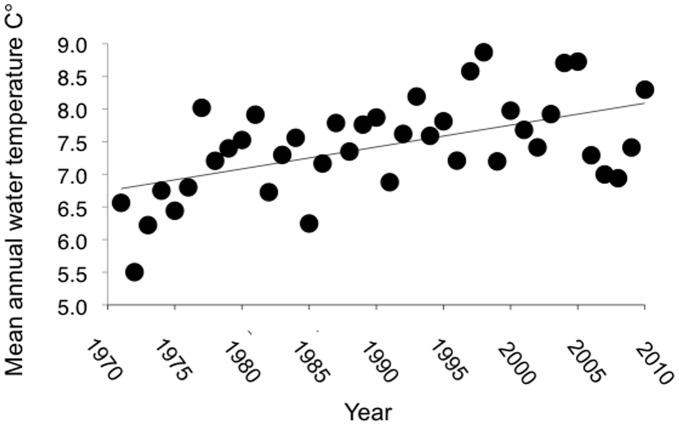
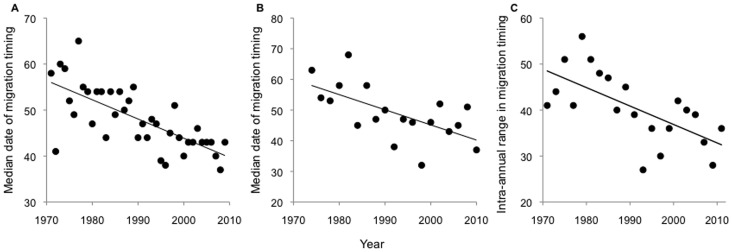
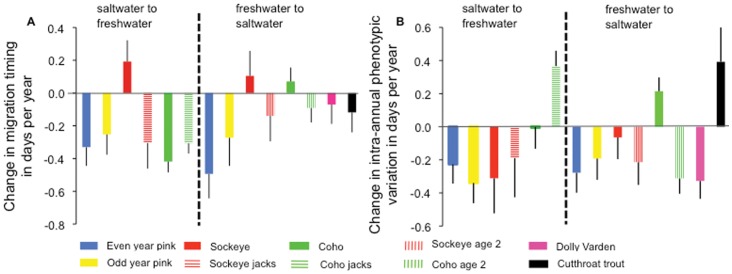
Climate-induced phenological shifts can influence population, evolutionary, and ecological dynamics, but our understanding of these phenomena is hampered by a lack of long-term demographic data. We use a multi-decade census of 5 salmonid species representing 14 life histories in a warming Alaskan stream to address the following key questions about climate change and phenology: How consistent are temporal patterns and drivers of phenology for similar species and alternative life histories? Are shifts in phenology associated with changes in phenotypic variation? How do phenological changes influence the availability of resource subsidies? For most salmonid species, life stages, and life histories, freshwater temperature influences migration timing--migration events are occurring earlier in time (mean = 1.7 days earlier per decade over the 3-5 decades), and the number of days over which migration events occur is decreasing (mean = 1.5 days per decade). Temporal trends in migration timing were not correlated with changes in intra-annual phenotypic variation, suggesting that these components of the phenotypic distribution have responded to environmental change independently. Despite commonalities across species and life histories, there was important biocomplexity in the form of disparate shifts in migration timing and variation in the environmental factors influencing migration timing for alternative life history strategies in the same population. Overall, adult populations have been stable during these phenotypic and environmental changes (λ ≈ 1.0), but the temporal availability of salmon as a resource in freshwater has decreased by nearly 30 days since 1971 due to changes in the median date of migration timing and decreases in intra-annual variation in migration timing. These novel observations advance our understanding of phenological change in response to climate warming, and indicate that climate change has influenced the ecology of salmon populations, which will have important consequences for the numerous species that depend on this resource.
气候引起的物候变化会影响种群、进化和生态动态,但由于缺乏长期的人口数据,我们对这些现象的理解受到阻碍。我们利用一项对阿拉斯加一条变暖溪流中的 5 种鲑鱼物种进行的数十年普查,这些物种代表了 14 种生活史,来回答关于气候变化和物候学的以下关键问题:相似物种和替代生活史的物候时间模式和驱动因素有多一致?物候变化是否与表型变异的变化有关?物候变化如何影响资源补贴的可获得性?对于大多数鲑鱼物种、生命阶段和生活史来说,淡水温度影响洄游时间——洄游事件发生的时间更早(在 3-5 十年期间,每十年平均提前 1.7 天),并且洄游事件发生的天数正在减少(每十年平均减少 1.5 天)。迁移时间的时间趋势与年内表型变异的变化没有相关性,这表明这些表型分布的组成部分已经独立地对环境变化做出了反应。尽管物种和生活史之间存在共性,但在同一种群中,替代生活史策略的迁移时间的不同变化以及影响迁移时间的环境因素的生物复杂性仍然很重要。总的来说,在这些表型和环境变化期间,成年种群一直保持稳定(λ≈1.0),但由于迁移时间中位数日期的变化和迁移时间年内变化的减少,鲑鱼作为资源在淡水中的时间可用性自 1971 年以来减少了近 30 天。这些新的观察结果推进了我们对气候变暖引起的物候变化的理解,并表明气候变化已经影响了鲑鱼种群的生态,这将对依赖这种资源的众多物种产生重要影响。