Department of Fish and Wildlife Sciences, College of Natural Resources, University of Idaho, Moscow, Idaho, United States of America.
PLoS One. 2018 Sep 21;13(9):e0204274. doi: 10.1371/journal.pone.0204274. eCollection 2018.
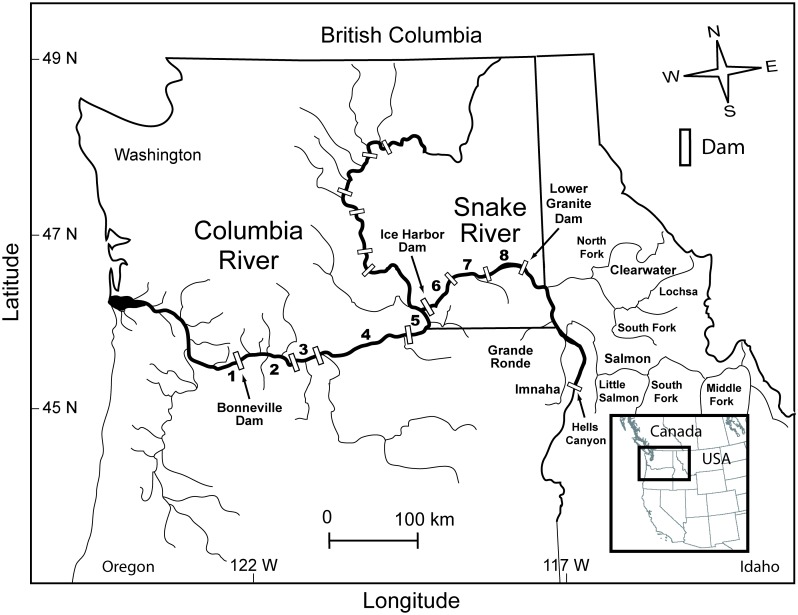
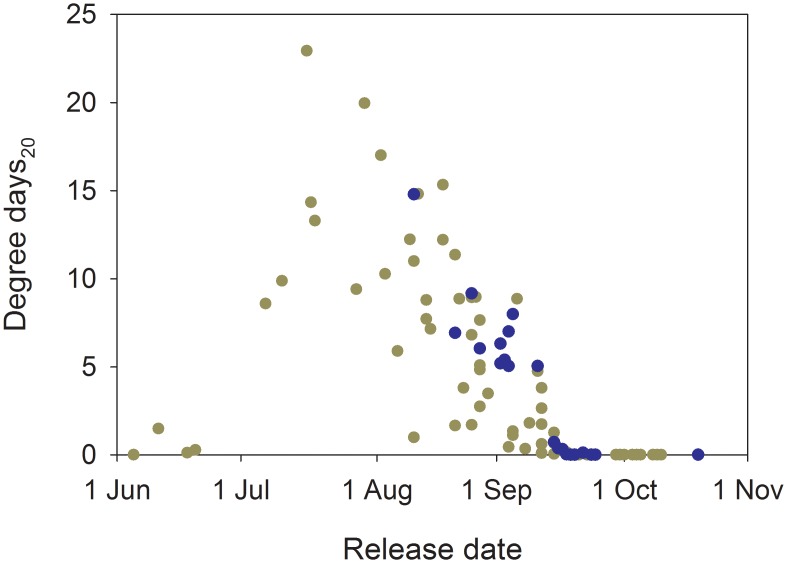
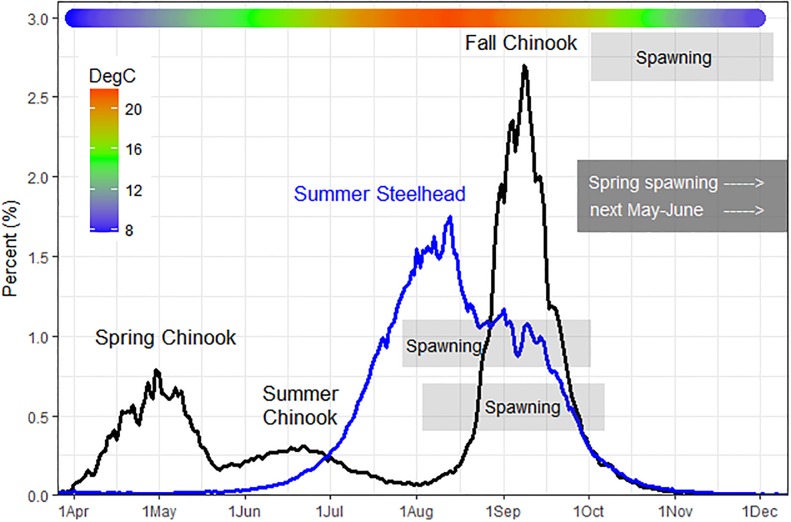
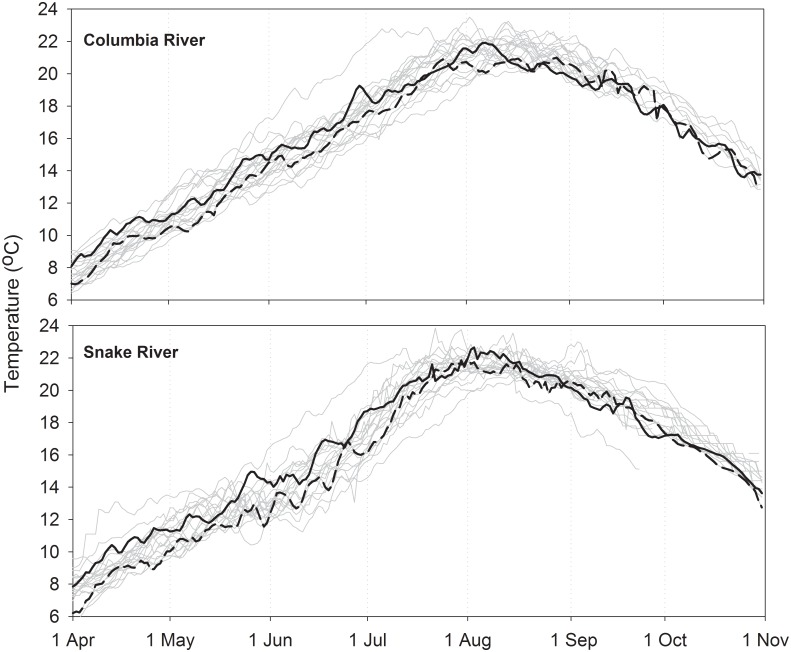
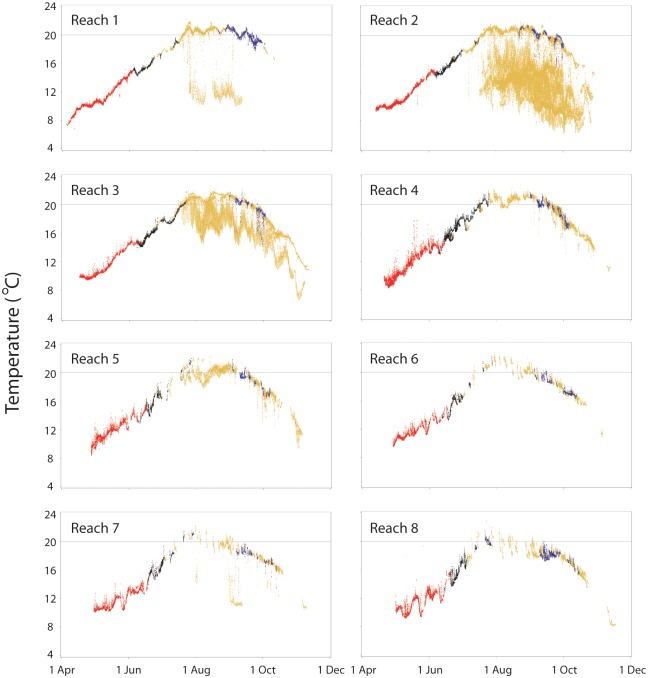
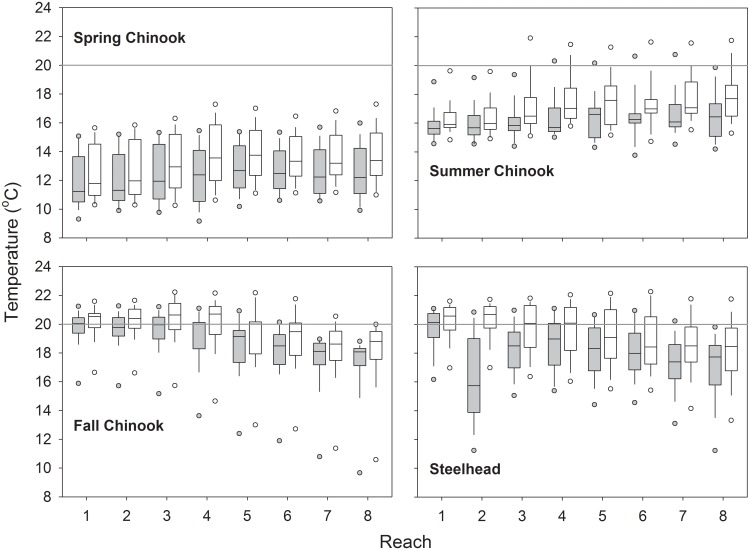
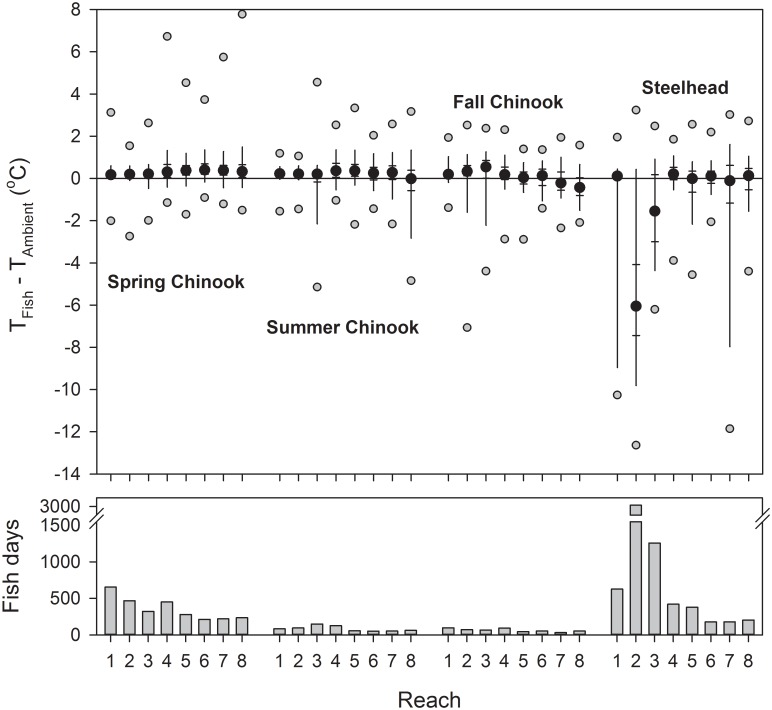
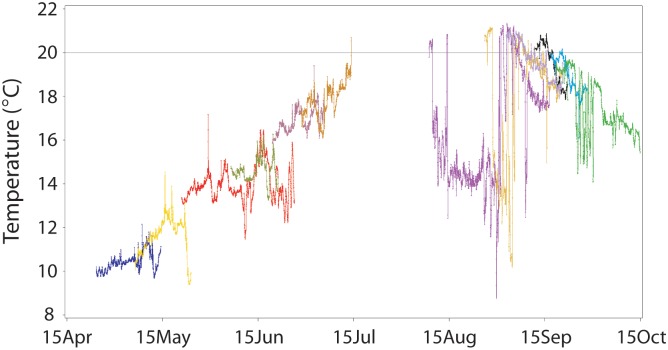
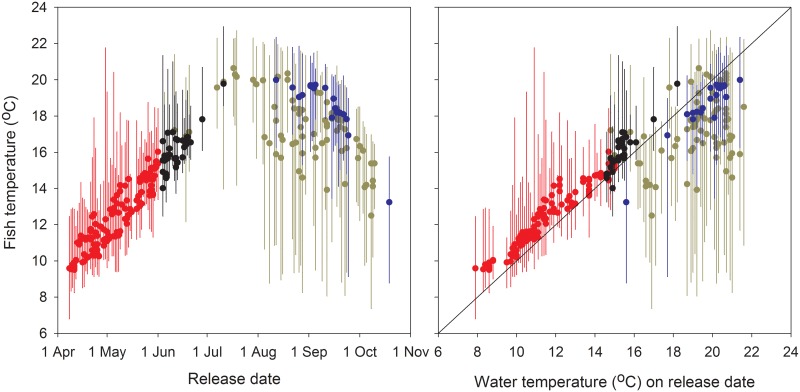
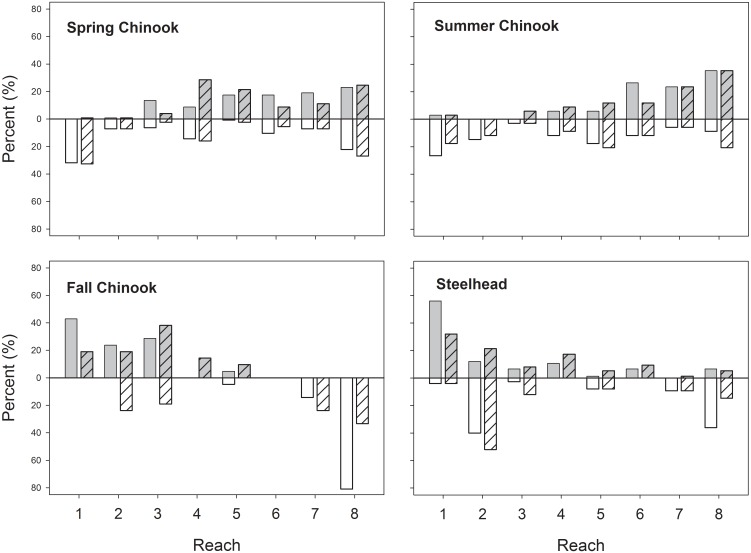
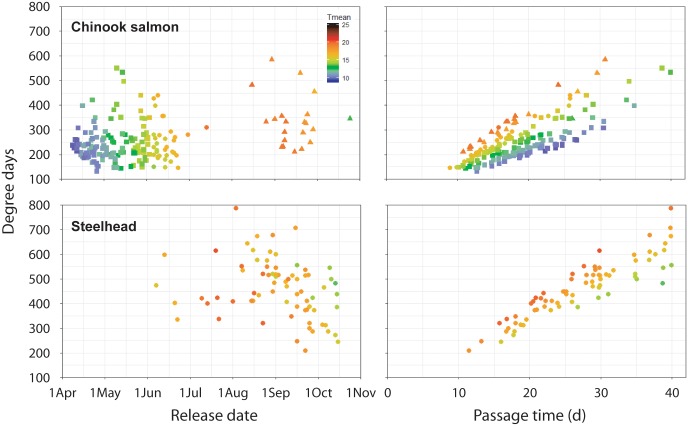
Rising river temperatures in western North America have increased the energetic costs of migration and the risk of premature mortality in many Pacific salmon (Oncorhynchus spp.) populations. Predicting and managing risks for these populations requires data on acute and cumulative thermal exposure, the spatio-temporal distribution of adverse conditions, and the potentially mitigating effects of cool-water refuges. In this study, we paired radiotelemetry with archival temperature loggers to construct continuous, spatially-explicit thermal histories for 212 adult Chinook salmon (O. tshawytscha) and 200 adult steelhead (O. mykiss). The fish amassed ~500,000 temperature records (30-min intervals) while migrating through 470 kilometers of the Columbia and Snake rivers en route to spawning sites in Idaho, Oregon, and Washington. Spring- and most summer-run Chinook salmon migrated before river temperatures reached annual highs; their body temperatures closely matched ambient temperatures and most had thermal maxima in the lower Snake River. In contrast, many individual fall-run Chinook salmon and most steelhead had maxima near thermal tolerance limits (20-22 °C) in the lower Columbia River. High temperatures elicited extensive use of thermal refuges near tributary confluences, where body temperatures were ~2-10 °C cooler than the adjacent migration corridor. Many steelhead used refuges for weeks or more whereas salmon use was typically hours to days, reflecting differences in spawn timing. Almost no refuge use was detected in a ~260-km reach where a thermal migration barrier may more frequently develop in future warmer years. Within population, cumulative thermal exposure was strongly positively correlated (0.88 ≤ r ≤ 0.98) with migration duration and inconsistently associated (-0.28 ≤ r ≤ 0.09) with migration date. All four populations have likely experienced historically high mean and maximum temperatures in recent years. Expected responses include population-specific shifts in migration phenology, increased reliance on patchily-distributed thermal refuges, and natural selection favoring temperature-tolerant phenotypes.
北美西部河流温度上升增加了许多太平洋鲑鱼(Oncorhynchus spp.)种群迁徙的能量成本和过早死亡的风险。预测和管理这些种群的风险需要有关急性和累积热暴露、不利条件的时空分布以及冷水避难所的潜在缓解作用的数据。在这项研究中,我们将无线电遥测技术与档案温度记录仪相结合,为 212 条成年奇努克鲑(Oncorhynchus tshawytscha)和 200 条成年虹鳟(Oncorhynchus mykiss)构建了连续的、空间明确的热历史。这些鱼在迁徙到爱达荷州、俄勒冈州和华盛顿州的产卵地的 470 公里哥伦比亚河和斯内克河的过程中积累了约 500,000 个温度记录(30 分钟间隔)。春季和大多数夏季洄游的奇努克鲑鱼在河流温度达到全年最高之前迁徙;它们的体温与环境温度密切匹配,大多数在下斯内克河有热最大值。相比之下,许多个体秋季洄游的奇努克鲑鱼和大多数虹鳟在哥伦比亚河下游接近热耐受极限(20-22°C)的地方有最大值。高温促使它们在支流汇合处附近广泛利用热避难所,那里的体温比相邻的迁徙通道低 2-10°C。许多虹鳟使用避难所数周或更长时间,而鲑鱼的使用时间通常为数小时到数天,这反映了产卵时间的差异。在一个约 260 公里长的河段中几乎没有发现避难所的使用,在未来更温暖的年份中,该河段可能更频繁地出现热迁移障碍。在种群内,累积热暴露与迁徙持续时间呈强烈正相关(0.88≤r≤0.98),与迁徙日期的相关性不一致(-0.28≤r≤0.09)。所有四个种群近年来可能都经历了历史上的高平均和最高温度。预期的反应包括种群特定的迁徙物候学变化、对斑块状分布的热避难所的更多依赖以及有利于耐热表型的自然选择。