International Centre of Insect Physiology and Ecology (icipe), Nairobi, Kenya.
PLoS Negl Trop Dis. 2013;7(1):e2007. doi: 10.1371/journal.pntd.0002007. Epub 2013 Jan 10.
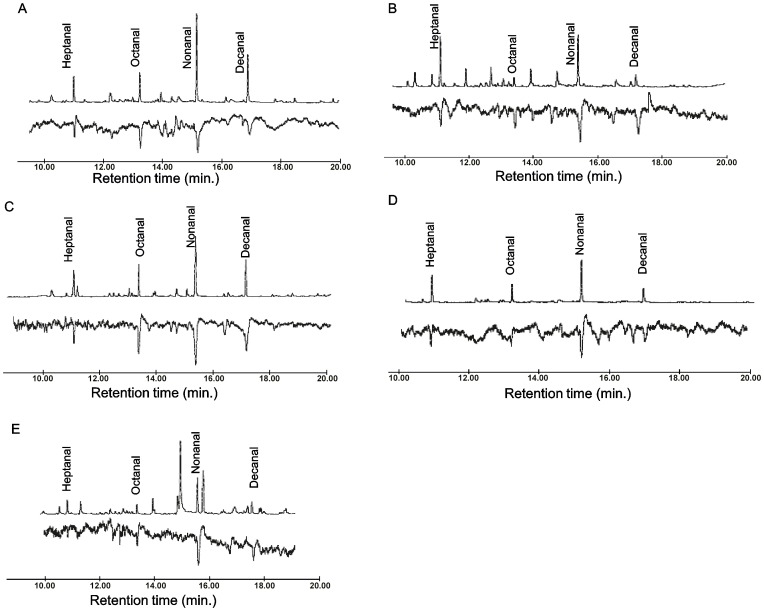
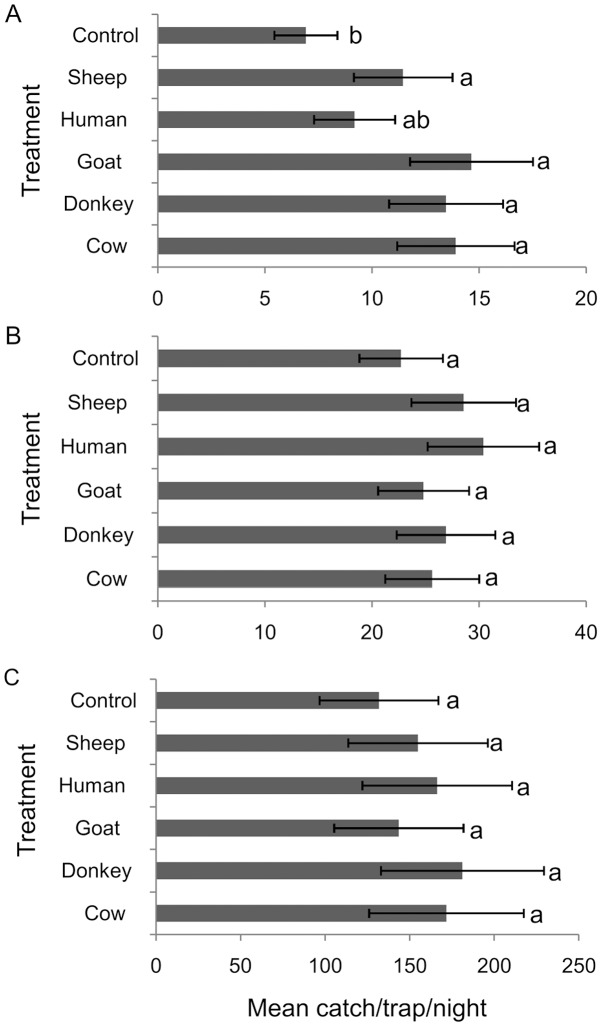
Rift Valley fever (RVF), a mosquito-borne zoonosis, is a major public health and veterinary problem in sub-Saharan Africa. Surveillance to monitor mosquito populations during the inter-epidemic period (IEP) and viral activity in these vectors is critical to informing public health decisions for early warning and control of the disease. Using a combination of field bioassays, electrophysiological and chemical analyses we demonstrated that skin-derived aldehydes (heptanal, octanal, nonanal, decanal) common to RVF virus (RVFV) hosts including sheep, cow, donkey, goat and human serve as potent attractants for RVFV mosquito vectors. Furthermore, a blend formulated from the four aldehydes and combined with CO(2)-baited CDC trap without a light bulb doubled to tripled trap captures compared to control traps baited with CO(2) alone. Our results reveal that (a) because of the commonality of the host chemical signature required for attraction, the host-vector interaction appears to favor the mosquito vector allowing it to find and opportunistically feed on a wide range of mammalian hosts of the disease, and (b) the sensitivity, specificity and superiority of this trapping system offers the potential for its wider use in surveillance programs for RVFV mosquito vectors especially during the IEP.
裂谷热(RVF)是一种由蚊子传播的人畜共患病,是撒哈拉以南非洲地区主要的公共卫生和兽医问题。在流行间歇期(IEP)监测蚊子种群和这些媒介中的病毒活动,对于为疾病的早期预警和控制提供公共卫生决策至关重要。我们通过结合现场生物测定、电生理和化学分析,证明了 RVF 病毒(RVFV)宿主包括绵羊、牛、驴、山羊和人类常见的皮肤衍生醛(庚醛、辛醛、壬醛、癸醛)是 RVFV 蚊子媒介的有效引诱剂。此外,由这四种醛组成的混合物,并与 CO(2)诱饵结合,无需灯泡,与单独用 CO(2)诱饵的对照陷阱相比,捕获量增加了一倍至三倍。我们的研究结果表明:(a)由于吸引所需的宿主化学特征的共性,宿主-媒介相互作用似乎有利于蚊子媒介,使其能够找到并机会性地吸食疾病的多种哺乳动物宿主;(b)这种诱捕系统的敏感性、特异性和优越性为其在 RVFV 蚊子媒介的监测计划中的更广泛应用提供了潜力,特别是在 IEP 期间。