Cellular, Molecular, and Developmental Biology Program, University of California, Riverside, California 92521, USA.
Nature. 2011 Jun 2;474(7349):87-91. doi: 10.1038/nature10081.
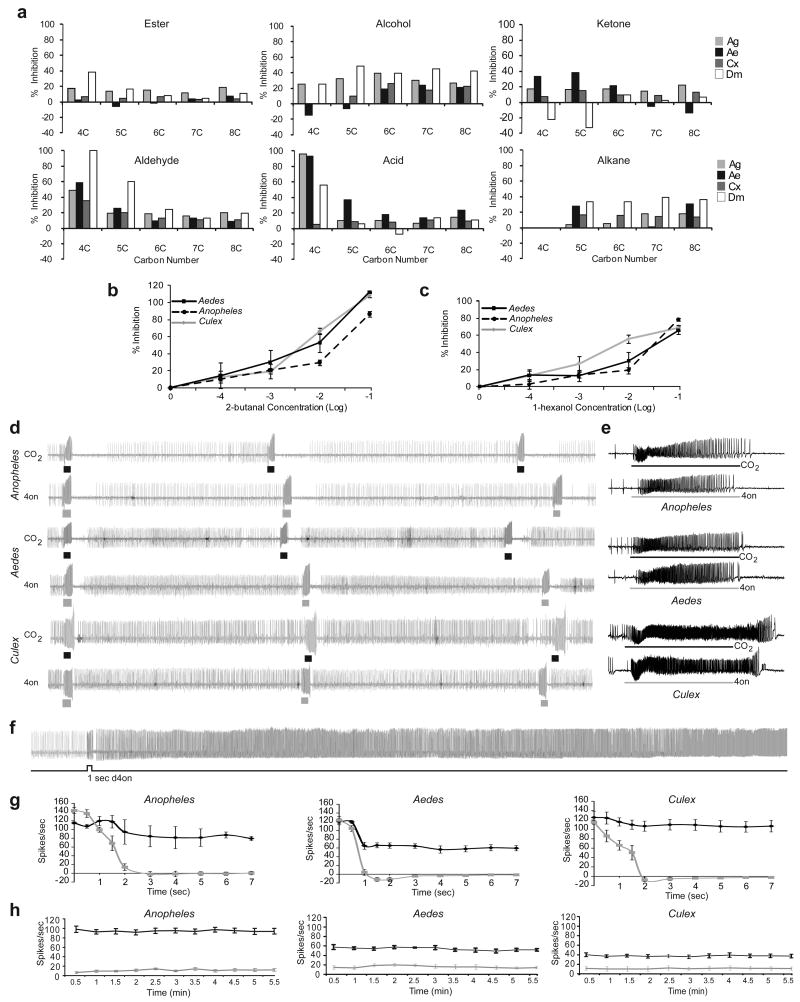
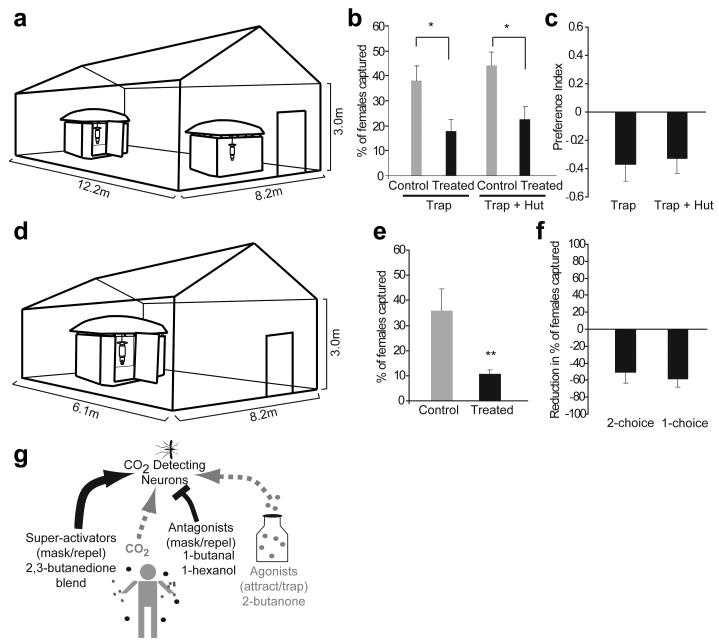
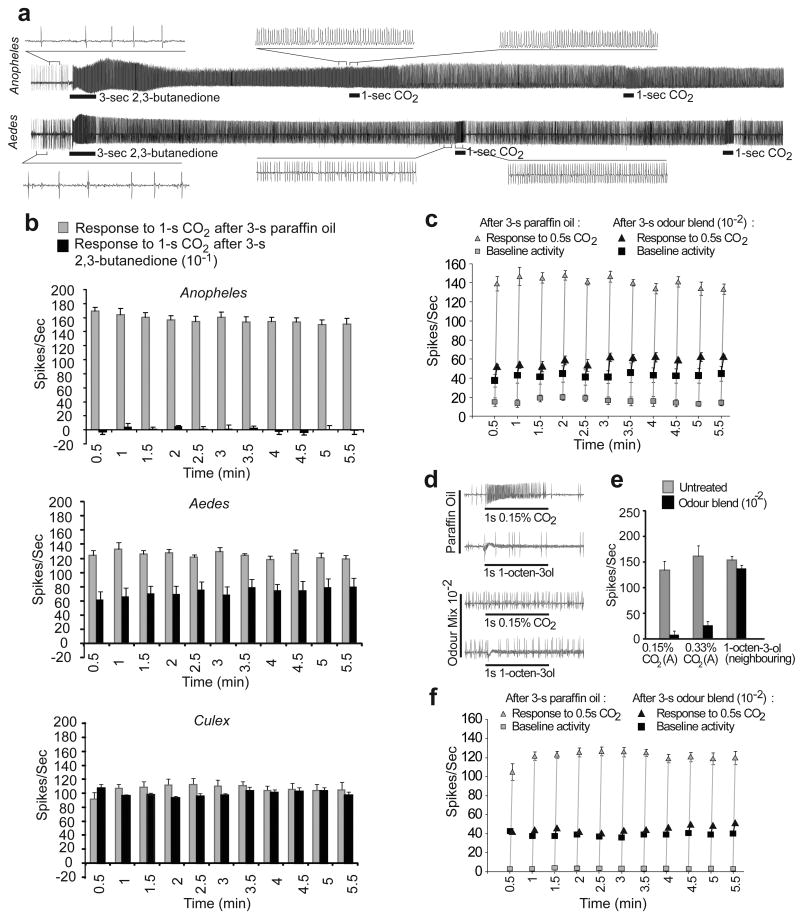
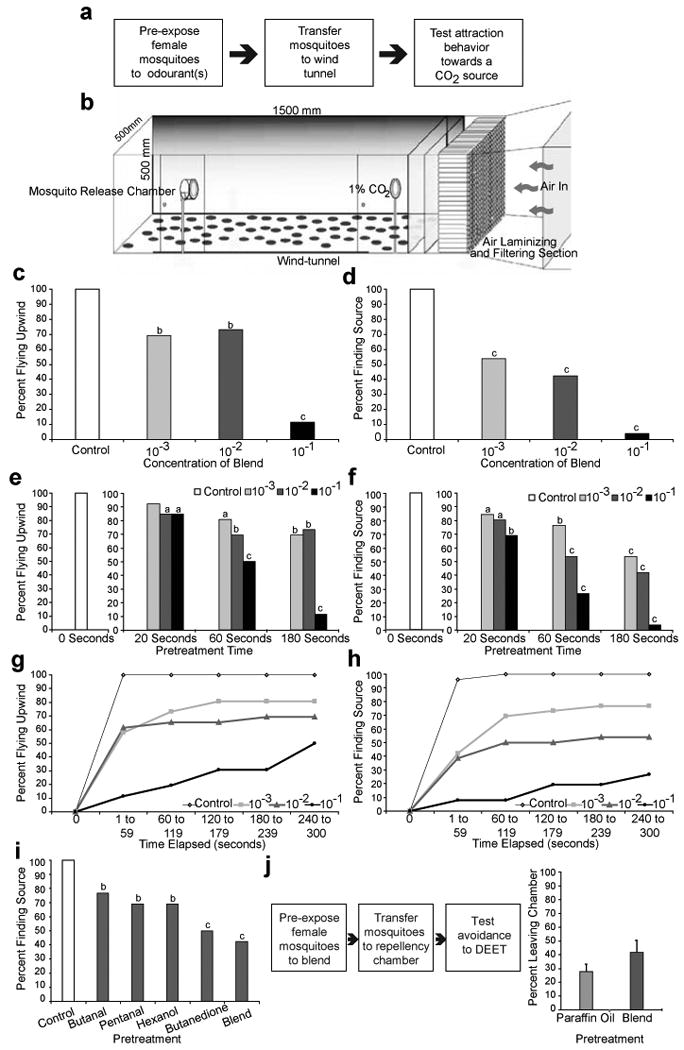
Carbon dioxide (CO(2)) present in exhaled air is the most important sensory cue for female blood-feeding mosquitoes, causing activation of long-distance host-seeking flight, navigation towards the vertebrate host and, in the case of Aedes aegypti, increased sensitivity to skin odours. The CO(2) detection machinery is therefore an ideal target to disrupt host seeking. Here we use electrophysiological assays to identify a volatile odorant that causes an unusual, ultra-prolonged activation of CO(2)-detecting neurons in three major disease-transmitting mosquitoes: Anopheles gambiae, Culex quinquefasciatus and A. aegypti. Importantly, ultra-prolonged activation of these neurons severely compromises their ability subsequently to detect CO(2) for several minutes. We also identify odours that strongly inhibit CO(2)-sensitive neurons as candidates for use in disruption of host-seeking behaviour, as well as an odour that evokes CO(2)-like activity and thus has potential use as a lure in trapping devices. Analysis of responses to panels of structurally related odours across the three mosquitoes and Drosophila, which have related CO(2)-receptor proteins, reveals a pattern of inhibition that is often conserved. We use video tracking in wind-tunnel experiments to demonstrate that the novel ultra-prolonged activators can completely disrupt CO(2)-mediated activation as well as source-finding behaviour in Aedes mosquitoes, even after the odour is no longer present. Lastly, semi-field studies demonstrate that use of ultra-prolonged activators disrupts CO(2)-mediated hut entry behaviour of Culex mosquitoes. The three classes of CO(2)-response-modifying odours offer powerful instruments for developing new generations of insect repellents and lures, which even in small quantities can interfere with the ability of mosquitoes to seek humans.
二氧化碳(CO(2))存在于呼出的空气中,是雌性吸血蚊子最重要的感觉线索,导致远距离寻找宿主的飞行、向脊椎动物宿主的导航,并且在埃及伊蚊的情况下,对皮肤气味的敏感性增加。因此,CO(2)检测机制是一个理想的干扰宿主寻找的目标。在这里,我们使用电生理测定来鉴定一种挥发性气味,它会导致三种主要传播疾病的蚊子(冈比亚按蚊、库蚊和埃及伊蚊)中 CO(2)检测神经元异常、超长激活。重要的是,这些神经元的超长激活会严重损害它们在几分钟内检测 CO(2)的能力。我们还确定了强烈抑制 CO(2)敏感神经元的气味作为干扰宿主寻找行为的候选物,以及一种引发 CO(2)样活性的气味,因此具有在诱捕装置中作为诱饵使用的潜力。对三种蚊子和具有相关 CO(2)受体蛋白的果蝇的结构相关气味进行的面板分析显示,抑制模式经常是保守的。我们在风洞实验中使用视频跟踪来证明,新型超长激活剂可以完全破坏埃及伊蚊的 CO(2)介导的激活以及源寻找行为,即使气味不再存在。最后,半野外研究表明,使用超长激活剂会破坏库蚊的 CO(2)介导的进入巢穴行为。这三类 CO(2)反应修饰气味为开发新一代昆虫驱避剂和诱饵提供了强大的工具,即使在少量的情况下,也可以干扰蚊子寻找人类的能力。