
评估强直性脊柱炎的影像学进展:我们应该使用改良斯托克强直性脊柱炎脊柱评分(mSASSS)还是强直性脊柱炎影像学脊柱评分(RASSS)?
Scoring radiographic progression in ankylosing spondylitis: should we use the modified Stoke Ankylosing Spondylitis Spine Score (mSASSS) or the Radiographic Ankylosing Spondylitis Spinal Score (RASSS)?
作者信息
Ramiro Sofia, van Tubergen Astrid, Stolwijk Carmen, Landewé Robert, van de Bosch Filip, Dougados Maxime, van der Heijde Désirée
出版信息
Arthritis Res Ther. 2013 Jan 17;15(1):R14. doi: 10.1186/ar4144.
INTRODUCTION
Radiographic damage is one of the core outcomes in axial SpA and is usually assessed with the modified Stoke Ankylosing Spondylitis (AS) Spine Score (mSASSS). Alternatively, the Radiographic AS Spinal Score (RASSS) is proposed, which includes the lower thoracic vertebrae, under the hypothesis that most progression occurs in these segments. We aimed to compare the mSASSS and RASSS with regard to performance.
METHODS
Two-yearly spinal radiographs from patients followed in the Outcome in AS International Study (OASIS) were used (scored independently by two readers). A total of 195 patients had at least one radiograph (12-year follow-up) to be included. We assessed the accessibility of vertebral corners (VCs) for scoring, as well as status and 2-year progression scores of both scoring methods. To assess the potential additional value of including the thoracic segment in the score, the relative contribution (in %) to the 2-year total RASSS progression of each spinal segment (cervical, thoracic and lumbar) was determined, and compared to the expected contribution, under the assumption that a balanced segmental progression would occur, proportional to the number of sites per segment.
RESULTS
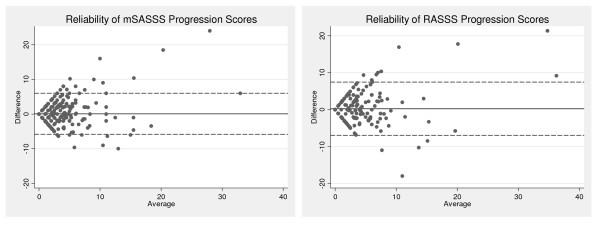
The mSASSS could be scored in a total of 809 radiographs and the RASSS in 78% of these. In 58% of the latter, the score was based on one to two available thoracic VCs scores, and the remaining two to three were imputed because they were missing. There were 520 two-year mSASSS intervals available, and in 63% of them RASSS progression could be assessed. The mean (SD) 2-year interval progression score (330 intervals) was 2.0 (3.6) for the mSASSS and 2.4 (4.4) for the RASSS, yielding a similar effect size (mSASSS 0.57 and RASSS 0.55). Exclusive progression of the thoracic segment occurred in only 5% of the cases. There was no significant difference between the observed (14%) and expected (16%) contribution to progression of the thoracic segment (P=0.70).
CONCLUSIONS
The determination of RASSS for radiographic damage of the spine is frequently impossible or strongly influenced by non-contributory imputation. In comparison to the mSASSS, the contribution of thoracic VCs in the RASSS method is negligible, and does not justify the additional scoring efforts.
引言
影像学损伤是轴性脊柱关节炎的核心结局之一,通常采用改良斯托克强直性脊柱炎(AS)脊柱评分(mSASSS)进行评估。另外,有人提出了影像学AS脊柱评分(RASSS),该评分纳入了下胸椎,其假设是大部分进展发生在这些节段。我们旨在比较mSASSS和RASSS的性能。
方法
使用强直性脊柱炎国际研究(OASIS)中患者每两年的脊柱X光片(由两位阅片者独立评分)。共有195例患者至少有一张X光片(随访12年)纳入研究。我们评估了用于评分的椎体角(VC)的可及性,以及两种评分方法的状态和两年进展评分。为了评估在评分中纳入胸段的潜在附加价值,确定了每个脊柱节段(颈椎、胸椎和腰椎)对两年总RASSS进展的相对贡献(以%表示),并与预期贡献进行比较,假设各节段进展均衡,与每个节段的部位数量成比例。
结果
总共809张X光片可进行mSASSS评分,其中78%可进行RASSS评分。在后者中,58%的评分基于一到两个可用的胸椎VC评分,其余两到三个是推算的,因为它们缺失。有520个两年的mSASSS间隔期可用,其中63%可评估RASSS进展。mSASSS的平均(标准差)两年间隔期进展评分(330个间隔期)为2.0(3.6),RASSS为2.4(4.4),效应量相似(mSASSS为0.57,RASSS为0.55)。仅5%的病例出现胸段单独进展。胸段进展的观察贡献(14%)与预期贡献(16%)之间无显著差异(P = 0.70)。
结论
确定RASSS用于脊柱影像学损伤评估通常是不可能的,或者受到无贡献推算的强烈影响。与mSASSS相比,RASSS方法中胸椎VC的贡献可忽略不计,且不值得额外的评分努力。
 Zotero 插件