Chen Yen-Ju, Chen Der-Yuan, Lan Haw-Chang, Huang An-Chih, Chen Yi-Hsing, Huang Wen-Nan, Chen Hsin-Hua
Division of Allergy, Immunology and Rheumatology, Department of Internal Medicine, Taichung Veterans General Hospital, Taichung, Taiwan.
Institute of Clinical Medicine, National Yang Ming University, Taipei, Taiwan.
Ther Adv Musculoskelet Dis. 2024 Oct 7;16:1759720X241285973. doi: 10.1177/1759720X241285973. eCollection 2024.
Detecting vertebral structural damage in patients with ankylosing spondylitis (AS) is crucial for understanding disease progression and in research settings.
This study aimed to use deep learning to score the modified Stoke Ankylosing Spondylitis Spinal Score (mSASSS) using lateral X-ray images of the cervical and lumbar spine in patients with AS in Asian populations.
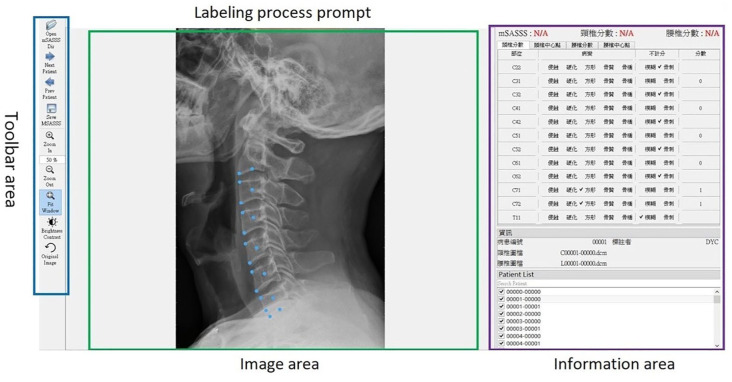
A deep learning model was developed to automate the scoring of mSASSS based on X-ray images.
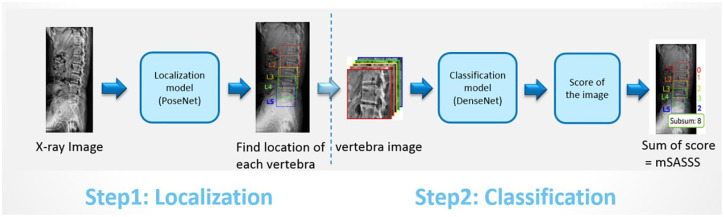
We enrolled patients with AS at a tertiary medical center in Taiwan from August 1, 2001 to December 30, 2020. A localization module was used to locate the vertebral bodies in the images of the cervical and lumbar spine. Images were then extracted from these localized points and fed into a classification module to determine whether common lesions of AS were present. The scores of each localized point were calculated based on the presence of these lesions and summed to obtain the total mSASSS score. The performance of the model was evaluated on both validation set and testing set.
This study reviewed X-ray image data from 554 patients diagnosed with AS, which were then annotated by 3 medical experts for structural changes. The accuracy for judging various structural changes in the validation set ranged from 0.886 to 0.985, whereas the accuracy for scoring the single vertebral corner in the test set was 0.865.
This study demonstrated a well-trained deep learning model of mSASSS scoring for detecting the vertebral structural damage in patients with AS at an accuracy rate of 86.5%. This artificial intelligence model would provide real-time mSASSS assessment for physicians to help better assist in radiographic status evaluation with minimal human errors. Furthermore, it can assist in a research setting by offering a consistent and objective method of scoring, which could enhance the reproducibility and reliability of clinical studies.
检测强直性脊柱炎(AS)患者的椎体结构损伤对于了解疾病进展以及在研究环境中至关重要。
本研究旨在利用深度学习,通过亚洲人群AS患者颈椎和腰椎的侧位X线图像对改良斯托克强直性脊柱炎脊柱评分(mSASSS)进行评分。
开发了一种深度学习模型,用于基于X线图像自动对mSASSS进行评分。
我们纳入了2001年8月1日至2020年12月30日在台湾一家三级医疗中心的AS患者。使用定位模块在颈椎和腰椎图像中定位椎体。然后从这些定位点提取图像并输入分类模块,以确定是否存在AS的常见病变。根据这些病变的存在情况计算每个定位点的分数,并将其相加得到mSASSS总分。在验证集和测试集上评估模型的性能。
本研究回顾了554例诊断为AS的患者的X线图像数据,然后由3名医学专家对结构变化进行注释。验证集中判断各种结构变化的准确率在0.886至0.985之间,而测试集中单个椎体角评分的准确率为0.865。
本研究展示了一个训练有素的mSASSS评分深度学习模型,用于检测AS患者的椎体结构损伤,准确率为86.5%。这种人工智能模型将为医生提供实时mSASSS评估,以帮助更好地辅助进行放射学状态评估,减少人为误差。此外,它可以通过提供一种一致且客观的评分方法来辅助研究,这可以提高临床研究的可重复性和可靠性。