Department of Medicine; Ottawa Hospital Research Institute; University of Ottawa; Ottawa, ON Canada; ICES@Uottawa; Ottawa Hospital Research Institute; University of Ottawa; Ottawa, ON Canada.
Hum Vaccin Immunother. 2013 May;9(5):1153-7. doi: 10.4161/hv.23533. Epub 2013 Jan 17.
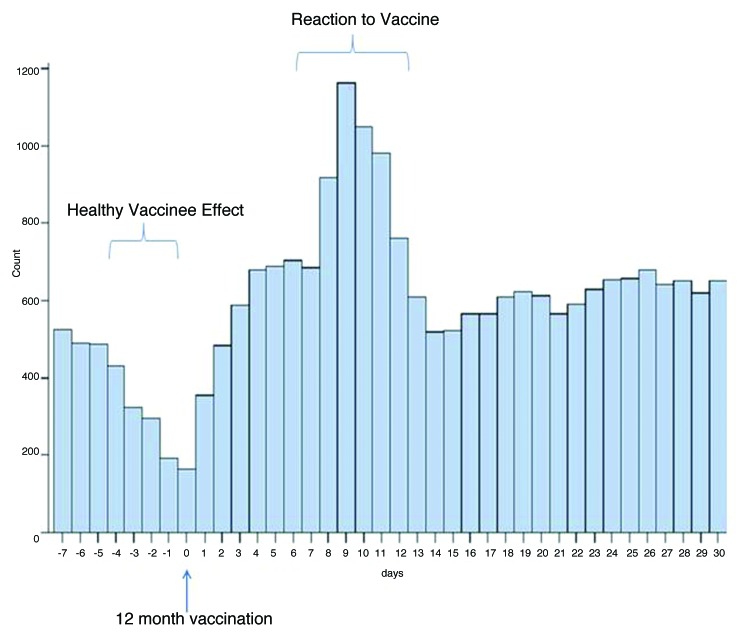
Using a population-based self-controlled case series design, we examined data on children born between the years 2002 and 2009 in the province of Ontario, Canada. We specifically examined how socioeconomic status (SES) influences rates of adverse events following immunization (AEFI), defined as emergency room visits and / or hospital admissions. For vaccination at 2, 4 and 6 mo combined, the relative incidence of AEFI (95% CI) in the first 72 h after vaccination was 0.69 (0.67 to 0.71). For all three vaccinations combined, we observed no relationship between the relative incidence of an event and quintile of socioeconomic status (p = 0.1433). For the 12-mo vaccination alone, the relative incidence of events (95% CI) on days 4 to 12 following immunization was 1.35 (1.31 to 1.38). We observed a significant relationship between socioeconomic status and vaccination at 12 mo, with lower SES being associated with a higher relative incidence of events (p = 0.0075). When the lowest 2 quintiles of income combined were compared with the highest 3 quintiles, the relative incidence ratio (95% CI) was 0.94 (0.89 to 0.99, p = 0.02). These results translate to 150 additional adverse events in the lower SES quintiles as compared with the higher SES quintiles for every 100,000 children vaccinated, or 1 additional event for every 666 individuals vaccinated. Future studies should explore potential explanations for this observation.
采用基于人群的自身对照病例系列设计,我们研究了加拿大安大略省 2002 年至 2009 年间出生的儿童数据。我们特别研究了社会经济地位(SES)如何影响接种后不良事件(AEFI)的发生率,AEFI 定义为急诊就诊和/或住院。对于 2、4 和 6 个月的联合疫苗接种,接种后 72 小时内 AEFI 的相对发病率(95%CI)为 0.69(0.67 至 0.71)。对于所有三种疫苗联合接种,我们没有观察到事件的相对发病率与 SES 五分位数之间存在关系(p = 0.1433)。对于单独的 12 个月疫苗接种,接种后第 4 天至第 12 天的事件相对发病率(95%CI)为 1.35(1.31 至 1.38)。我们观察到 SES 与 12 个月疫苗接种之间存在显著关系,SES 较低与事件的相对发病率较高相关(p = 0.0075)。当将最低的两个收入五分位数与最高的三个五分位数进行比较时,相对发病率比(95%CI)为 0.94(0.89 至 0.99,p = 0.02)。与 SES 较高的五分位数相比,SES 较低的五分位数每 10 万名接种儿童会增加 150 例额外的不良事件,或每接种 666 人就会增加 1 例额外的事件。未来的研究应该探索这种观察结果的潜在解释。