Division of Gastroenterology and Hepatology, Shanghai Jiao-Tong University School of Medicine Renji Hospital, Shanghai Institute of Digestive Disease; Key Laboratory of Gastroenterology & Hepatology, Ministry of Health (Shanghai Jiao-Tong University). 145 Middle Shandong Rd, Shanghai 200001, China.
Int J Med Sci. 2013;10(2):156-63. doi: 10.7150/ijms.5457. Epub 2013 Jan 3.
TRAF3 and TRAF5 share a common ancestral gene, and interact as essential components of signaling pathways in immunity. TRAF3 and TRAF5 are overexpressed in the colon of rat/mouse models with colitis. However, the expressions of TRAF3 and TRAF5 in patients with inflammatory bowel disease have not been elucidated. The aim of the present study is to explore the potential roles of TRAF3 and TRAF5 in patients with inflammatory bowel disease.
Plasma levels of TRAF3 and TRAF5 proteins were detected by Enzyme-linked Immunosorbent Assay (ELISA). Colonic expression of TRAF3 and TRAF5 proteins was detected by western blot analysis. Quantitative Real-time PCR (qRT-PCR) was applied for gene expression. Inflamed intestinal mucosa and non-inflamed intestinal mucosa in patients with inflammatory bowel disease and normal mucosa was analyzed from healthy controls.
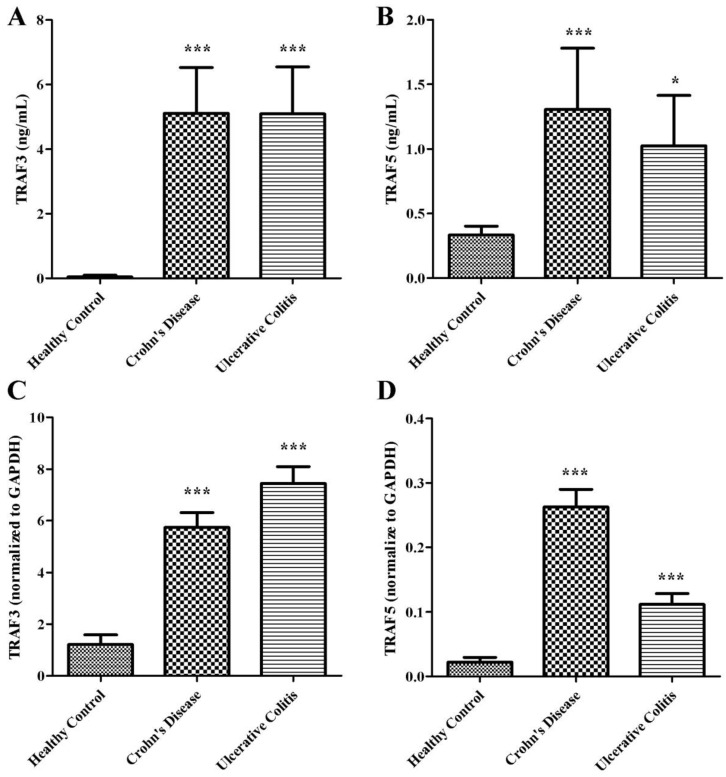
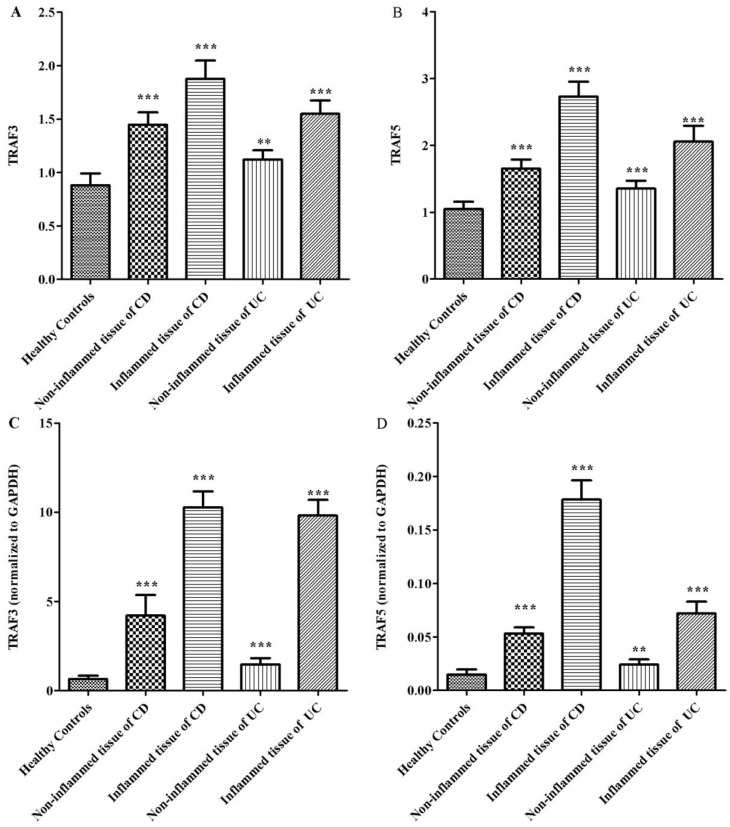
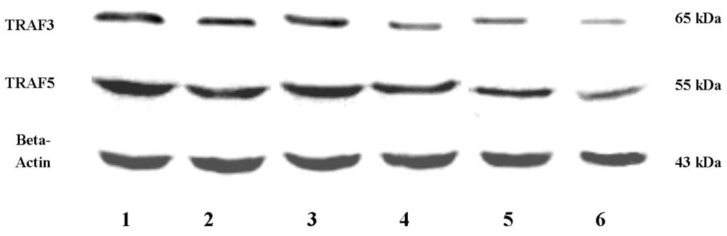
The plasma levels of TRAF3 and TRAF5 were significantly higher both in patients with Crohn's disease and ulcerative colitis than in healthy controls. Only soluble TRAF5 showed a weak correlation with endoscopic disease activity index (Baron score) in patients with ulcerative colitis (spearman's r=0.358, P=0.022). Gene expressions of TRAF3 and TRAF5 in peripheral blood mononuclear cells were significantly higher both in patients with Crohn's disease and ulcerative colitis than in healthy controls (all P<0.0001). Gene and protein expressions of TRAF3 and TRAF5 were significantly higher in inflamed colonic mucosa of patients with Crohn's disease and ulcerative colitis than in non-inflamed colonic mucosa and normal mucosa of healthy controls (all P<0.0001). Furthermore, gene and protein expressions of TRAF3 and TRAF5 were also significantly higher in non-inflamed colonic mucosa of patients with Crohn's disease and ulcerative colitis than in normal mucosa of healthy controls.
TRAF3 and TRAF5 are overexpressed in inflammatory bowel disease. Although the endoscopic appearance can be normal, TRAF3 and TRAF5 pre-activation can be detected in non-inflamed colonic segments.
TRAF3 和 TRAF5 拥有共同的祖先基因,并作为免疫信号通路的必需组成部分相互作用。TRAF3 和 TRAF5 在结肠炎大鼠/小鼠模型的结肠中过度表达。然而,TRAF3 和 TRAF5 在炎症性肠病患者中的表达尚未阐明。本研究旨在探讨 TRAF3 和 TRAF5 在炎症性肠病患者中的潜在作用。
通过酶联免疫吸附测定(ELISA)检测 TRAF3 和 TRAF5 蛋白的血浆水平。通过 Western blot 分析检测 TRAF3 和 TRAF5 蛋白的结肠表达。应用定量实时 PCR(qRT-PCR)进行基因表达分析。从健康对照者中分析炎症性肠病患者的炎症性和非炎症性肠黏膜与正常黏膜。
克罗恩病和溃疡性结肠炎患者的 TRAF3 和 TRAF5 血浆水平均明显高于健康对照组。仅可溶性 TRAF5 与溃疡性结肠炎患者的内镜疾病活动指数(Baron 评分)呈弱相关(spearman's r=0.358,P=0.022)。克罗恩病和溃疡性结肠炎患者外周血单个核细胞中 TRAF3 和 TRAF5 的基因表达均明显高于健康对照组(均 P<0.0001)。克罗恩病和溃疡性结肠炎患者的炎症性结肠黏膜中 TRAF3 和 TRAF5 的基因和蛋白表达均明显高于非炎症性结肠黏膜和健康对照组的正常黏膜(均 P<0.0001)。此外,克罗恩病和溃疡性结肠炎患者的非炎症性结肠黏膜中 TRAF3 和 TRAF5 的基因和蛋白表达也明显高于健康对照组的正常黏膜。
TRAF3 和 TRAF5 在炎症性肠病中过度表达。尽管内镜表现可能正常,但在非炎症性结肠节段也可检测到 TRAF3 和 TRAF5 的预激活。