Department of Human Oncology, University of Wisconsin-Madison, WI 53705, USA.
FEBS J. 2013 May;280(10):2194-206. doi: 10.1111/febs.12134. Epub 2013 Feb 11.
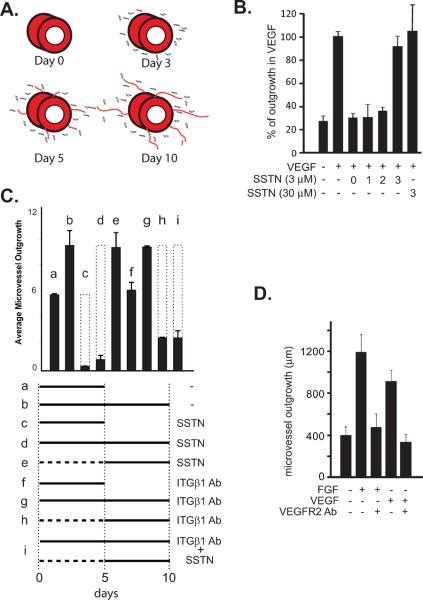
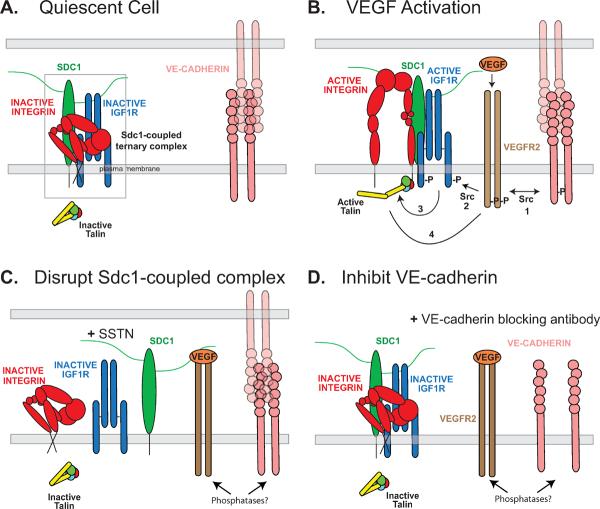
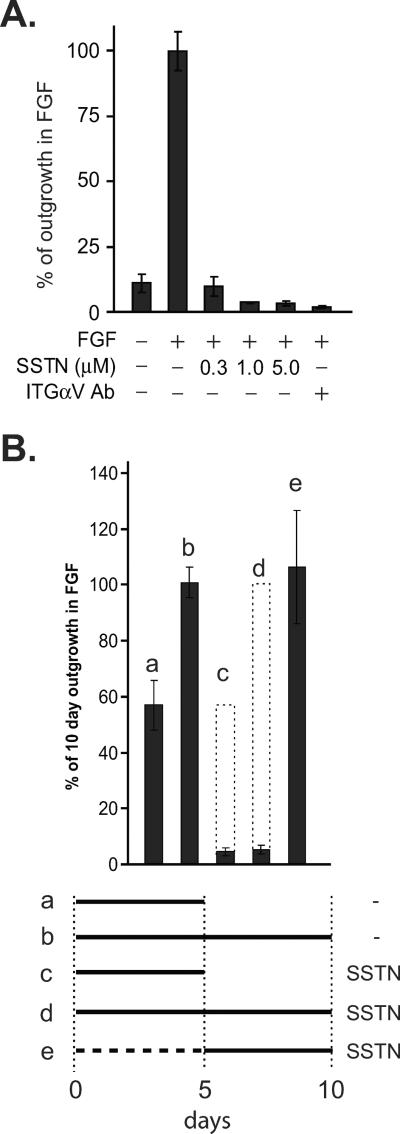
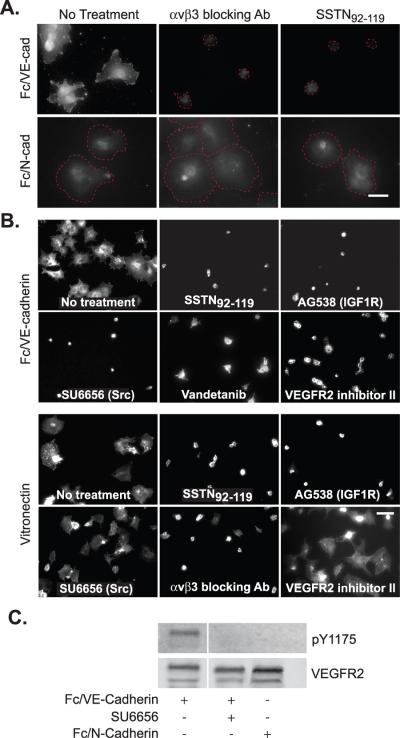
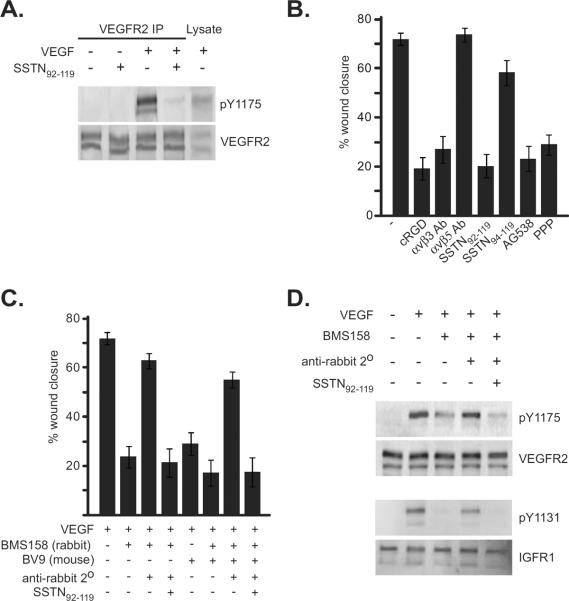
Vascular endothelial growth factor (VEGF)-stimulated angiogenesis depends on a cross-talk mechanism involving VEGF receptor 2 (VEGFR2), vascular endothelial (VE)-cadherin and the αVβ3 integrin. Because we have shown that αVβ3 integrin activation is dependent on its incorporation, along with the insulin-like growth factor-1 receptor (IGF1R) kinase, into a ternary receptor complex organized by the matrix receptor syndecan-1 (Sdc1), we questioned the role of this core complex in VEGF-stimulated angiogenesis. We find that the Sdc1-coupled ternary receptor complex is required for VEGF signalling and for stimulation of vascular endothelial cell migration by vascular endothelial cadherin (VE-cadherin) engagement. VE-cadherin binding to Fc/VE-cadherin extracellular domain chimera activates Sdc1-coupled IGF1R and αvβ3 integrin; this depends on VEGFR2 and c-Src activated by the cadherin. Blocking homotypic VE-cadherin engagement disrupts VEGF-stimulated cell migration, which is restored by clustering the cadherin in the absence of cell-cell adhesion. This cadherin-dependent stimulation requires VEGFR2 and IGF1R and is blocked by synstatin (SSTN)(92-119), a peptide that competitively disrupts the Sdc1-coupled ternary complex and prevents the αVβ3 integrin activation required for VEGFR2 activation. VEGFR2-stimulated angiogenesis in the mouse aortic ring explant assay is disrupted by SSTN, although only early in the process, suggesting that IGF1R coupling to Sdc1 and αVβ3 integrin comprises a core activation mechanism activated by VE-cadherin that is necessary for VEGFR2 and integrin activation in the initial stages of endothelial cell dissemination during angiogenesis.
血管内皮生长因子(VEGF)刺激的血管生成依赖于一种涉及 VEGF 受体 2(VEGFR2)、血管内皮(VE)-钙粘蛋白和 αVβ3 整合素的交叉对话机制。因为我们已经表明,αVβ3 整合素的激活依赖于其与胰岛素样生长因子-1 受体(IGF1R)激酶一起整合到由基质受体 syndecan-1(Sdc1)组织的三元受体复合物中,所以我们质疑这个核心复合物在 VEGF 刺激的血管生成中的作用。我们发现,Sdc1 偶联的三元受体复合物是 VEGF 信号转导和血管内皮细胞迁移所必需的,而血管内皮钙粘蛋白(VE-cadherin)的结合可刺激血管内皮细胞迁移。VE-cadherin 与 Fc/VE-cadherin 外显子嵌合体的结合激活 Sdc1 偶联的 IGF1R 和 αvβ3 整合素;这依赖于由钙粘蛋白激活的 VEGFR2 和 c-Src。阻断同质 VE-cadherin 的结合会破坏 VEGF 刺激的细胞迁移,而在没有细胞-细胞粘附的情况下,钙粘蛋白的聚集会恢复细胞迁移。这种钙粘蛋白依赖性刺激需要 VEGFR2 和 IGF1R,并且可以被 synstatin(SSTN)(92-119)阻断,SSTN 是一种竞争性破坏 Sdc1 偶联三元复合物并阻止 VEGFR2 激活所需的 αVβ3 整合素激活的肽。SSTN 破坏了在小鼠主动脉环外植体实验中 VEGFR2 刺激的血管生成,尽管只是在早期过程中,这表明 IGF1R 与 Sdc1 和 αVβ3 整合素的偶联构成了一种核心激活机制,该机制被 VE-cadherin 激活,对于 VEGFR2 和整合素在血管生成过程中内皮细胞扩散的初始阶段的激活是必需的。