
误入歧途:道德心理学中的过程与内容
On the Wrong Track: Process and Content in Moral Psychology.
作者信息
Kahane Guy
机构信息
Faculty of Philosophy, Oxford University.
出版信息
Mind Lang. 2012 Nov;27(5):519-545. doi: 10.1111/mila.12001. Epub 2012 Oct 29.
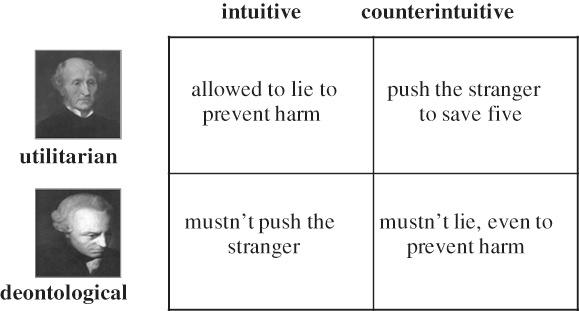
According to Joshua Greene's influential dual process model of moral judgment, different modes of processing are associated with distinct moral outputs: automatic processing with deontological judgment, and controlled processing with utilitarian judgment. This article aims to clarify and assess Greene's model. I argue that the proposed tie between process and content is based on a misinterpretation of the evidence, and that the supposed evidence for controlled processing in utilitarian judgment is actually likely to reflect, not 'utilitarian reasoning', but a form of moral deliberation which, ironically, is actually in serious tension with a utilitarian outlook. This alternative account is further supported by the results of a neuroimaging study showing that intuitive and counterintuitive judgments have similar neural correlates whether or not their content is utilitarian or deontological.
根据约书亚·格林颇具影响力的道德判断双加工模型,不同的加工模式与不同的道德输出相关联:自动加工与道义论判断相关,而控制性加工与功利主义判断相关。本文旨在阐明并评估格林的模型。我认为,该模型所提出的加工过程与内容之间的联系是基于对证据的错误解读,而且,功利主义判断中所谓的控制性加工证据实际上可能反映的并非“功利主义推理”,而是一种道德审议形式,具有讽刺意味的是,这种道德审议形式实际上与功利主义观点存在严重冲突。一项神经影像学研究结果进一步支持了这一替代性解释,该研究表明,无论其内容是功利主义的还是道义论的,直觉性判断和反直觉性判断都具有相似的神经关联。

 Zotero 插件