Cognitive Psychology, Vrije Universiteit Brussel Brussels, Belgium ; Neurological Rehabilitation, Vrije Universiteit Brussel Brussels, Belgium ; Center for Neurosciences, Vrije Universiteit Brussel Brussels, Belgium.
Front Hum Neurosci. 2013 Jan 10;6:356. doi: 10.3389/fnhum.2012.00356. eCollection 2012.
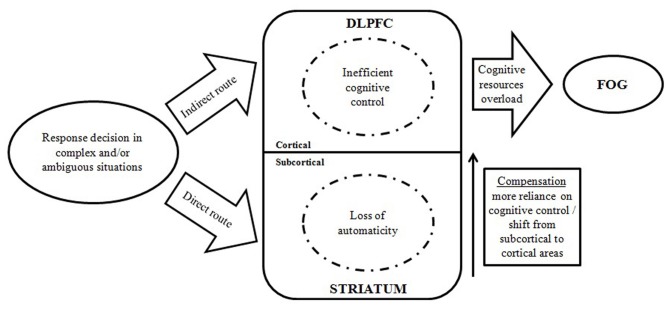
Recent studies emphasize a key role of controlled operations, such as set-shifting and inhibition, in the occurrence of freezing of gait (FOG) in Parkinson's disease (PD). However, FOG can also be characterized as a de-automatization disorder, showing impairments in both the execution and acquisition of automaticity. The observed deficits in automaticity and executive functioning indicate that both processes are malfunctioning in freezers. Therefore, to explain FOG from a cognitive-based perspective, we present a model describing the pathways involved in automatic and controlled processes prior to a FOG episode. Crucially, we focus on disturbances in automaticity and control, regulated by the frontostriatal circuitry. In complex situations, non-freezing PD patients may compensate for deficits in automaticity by switching to increased cognitive control. However, as both automatic and controlled processes are more severely impaired in freezers, this hampers cognitive compensation in FOG, resulting in a potential breakdown. Future directions for cognitive rehabilitation are proposed, based on the cognitive model we put forward.
最近的研究强调了受控操作(如转换和抑制)在帕金森病(PD)患者冻结步态(FOG)中的关键作用。然而,FOG 也可以被描述为一种去自动化障碍,在执行和获得自动性方面都存在障碍。观察到的自动性和执行功能的缺陷表明,在冻结者中这两个过程都出现了故障。因此,为了从基于认知的角度解释 FOG,我们提出了一个模型,描述了在 FOG 发作之前涉及自动和受控过程的途径。至关重要的是,我们专注于由额纹状体回路调节的自动性和控制的干扰。在复杂的情况下,非冻结 PD 患者可以通过增加认知控制来补偿自动性的缺陷。然而,由于自动和受控过程在冻结者中受到更严重的损害,这阻碍了 FOG 中的认知补偿,导致潜在的崩溃。根据我们提出的认知模型,提出了认知康复的未来方向。